Elena Caragiani Stoenescu, the first woman aviator in Romania, has a street bearing her name in Bucharest
- Articles
- 30 MAR 26
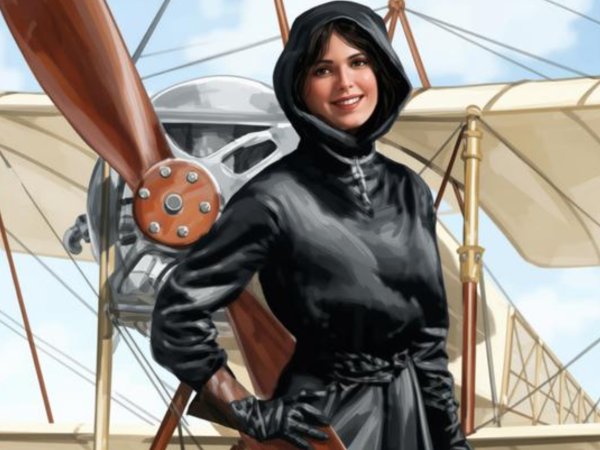
Romania can take pride in numerous personalities who have had a significant impact not only nationally, but also internationally. Among them is Elena Caragiani-Stoenescu, a remarkable figure of early aviation, who managed to overcome the limits imposed by the society of her time and carve out her own path in a field considered exclusively masculine.
A pioneer of aviation in a male-dominated world
Born on May 13, 1887, in Tecuci, into a cultivated family, Elena Caragiani was the daughter of physician Alexandru Caragiani and Zenia Radovici. Intelligence and ambition defined her from a young age, and her path would become an example of courage and determination. At just 27 years old, she managed to obtain the international pilot license, thus becoming the first woman aviator in Romania and the eleventh in the world.
At a time when the role of women was limited to the domestic sphere, Elena Caragiani chose the sky. This choice was not only a personal achievement, but also an act of defiance against social norms. She demonstrated that talent, discipline and passion are not determined by gender, and her example paved the way for other women in aviation. The idea that “a woman who can find fulfillment in the skies will never again need to live her life in the spare moments of a man” perfectly reflects the spirit of this pioneer.
The road to the sky and the struggle with prejudice
Her first contact with aviation took place in 1912, when Elena Caragiani flew as a passenger, with Mircea Zorileanu at the controls, one of Romania’s first aviators. The experience was decisive: she realized that she wanted to pilot an aircraft herself. In 1913, after graduating from the Faculty of Law—thus becoming one of the first women in Romania with legal studies—she enrolled in the flight school of George Valentin Bibescu.
Within this school, Elena was the only female student, a fact that caused astonishment and even skepticism among her male colleagues. She was trained by experienced aviators such as Constantin Fotescu and Nicu Capșa, flying fragile aircraft specific to the early days of aviation—machines built from lightweight materials such as bamboo, wire and fabric.
However, her path was not without obstacles. During the Balkan War, she asked to be accepted into the corps of aviators, even as an observer or courier, but was refused. Later, after completing her training, the Romanian authorities rejected her request to obtain a civil pilot license. It was a clear sign of the gender prejudices that dominated that era.
Determined not to give up, Elena went to France, where she enrolled in the aviation school of Roger Sommer. There, in 1914, she obtained the international pilot license issued by the International Aeronautical Federation, officially becoming an aviator. Nevertheless, even after this achievement, she was not allowed to fly in Romania.
A life between aviation, journalism and war
Repeatedly rejected by the Romanian authorities, Elena Caragiani was forced to seek other ways to assert herself. She became a journalist and began traveling the world, writing reports from regions such as the Caribbean and South America. She also worked as a war correspondent for a Mexican press trust, once again proving her courage and adventurous spirit.
During the World War I, she wished to actively contribute to Romania’s war effort as a pilot, transporting wounded soldiers or medical supplies. Once again, her request was denied. Eventually, she joined the Red Cross, working as a nurse in field hospitals in Bucharest and Iași.
After the retreat of Romanian authorities to Moldavia, she organized, together with her sister, a medical point in her childhood home in Tecuci. For her dedication, she was decorated, but official recognition as a pilot in Romania remained an unfulfilled dream.
After the war, she continued her journalistic career internationally, writing about aviation and global events. Settled for a time in Paris, she married Virgil Stoenescu, a Romanian lawyer. Unfortunately, her life was cut short prematurely: she fell ill with tuberculosis and returned to Romania, where she died on March 29, 1929, at only 41 years old.
A legacy rediscovered late
Although during her lifetime she did not receive the recognition she deserved, the memory of Elena Caragiani-Stoenescu was recovered over time. She remains a symbol of courage and perseverance, a woman who refused to accept the limits imposed by society.
In 2012, the National Bank of Romania issued a commemorative silver coin marking 125 years since her birth. Also, a high school in Tecuci bears her name, and her grave is located in Bellu Cemetery, a resting place for numerous Romanian personalities.
Elena Caragiani is part of an impressive gallery of pioneering women in aviation, alongside figures such as Amelia Earhart and Raymonde de Laroche. These women demonstrated that the sky is not a limit, but an opportunity.
Where Elena Caragiani Street is located in Bucharest
In recognition of her contribution, the name Elena Caragiani-Stoenescu was given to a street in Bucharest. Elena Caragiani Street is located in Sector 1, in Aviației neighborhood, a quiet area situated in the northern part of the city. It lies near important arteries such as Aerogării Boulevard and Bucharest-Ploiești Road, and is also relatively close to Henri Coandă International Airport.
The area where the street is located symbolically reflects the connection to aviation—the field in which Elena Caragiani excelled. Thus, even if during her lifetime she was not fully recognized in her own country, today Bucharest preserves her name on its map, as a gesture of recovering an essential memory for the history of Romanian aviation.
We also recommend: Who was Smaranda Brăescu and why a street in Bucharest bears her name. The tragic story of Romania’s first female parachutist