Discovered by Lucia Sturdza, protected by Maria Filotti. The great actor Mihai Popescu died on stage, playing in Othello
- Articles
- 09 JAN 26
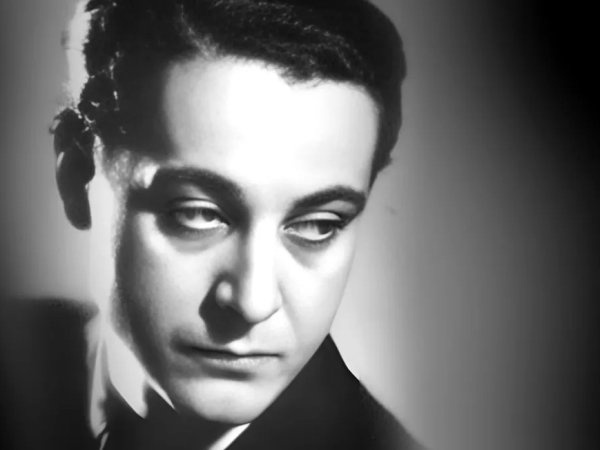
The history of Romanian theatre is filled with exceptional destinies, but few are as dramatic and symbolic as that of the actor Mihai Popescu. A talent out of the ordinary, shaped under the guidance of great figures of the stage and affirmed both in Romania and on European stages, Mihai Popescu lived theatre with rare intensity. For him, the stage was not merely a workplace, but a vital space in which he breathed, loved, and fulfilled himself. His death, which occurred during a performance of Othello by William Shakespeare, turned his life and career into a symbol of total sacrifice for art.
Solid roots and the early calling of the stage
Mihai Popescu was born on July 22, 1909, in Târgoviște, into a respected family, being the son of the priest and academician Nae Popescu. His upbringing in an intellectual and spiritual environment decisively contributed to the formation of a complex, sensitive, and profound personality.
From a young age, his inclination toward dramatic arts was evident, and theatre quickly became the center of his aspirations. His native talent, doubled by rare scenic intelligence, was noticed very early on.
From his very first year of study at the Conservatory of Dramatic Art in Bucharest, Mihai Popescu attracted the attention of Lucia Sturdza Bulandra, one of the most important figures of Romanian theatre.
The recognition coming from such a personality was essential for his later path, confirming that he stood before an actor with exceptional potential.
Professional debut and rapid affirmation
The year 1931 marked a decisive moment in his artistic life. Mihai Popescu graduated from the Conservatory with the play The Comedy of the Dawn by Mircea Ștefănescu, in which he performed the role of Vlad. His performance was received with enthusiasm by both the public and critics, who recognized in the young actor a name destined for a brilliant career. It was clear that Romanian theatre had gained a new, powerful, and distinct voice.
Shortly after graduation, in 1932, Mihai Popescu was hired by Maria Ventura in her theatre company. This collaboration offered him the opportunity to broaden his artistic horizons and to evolve in a professional environment of high caliber. His desire for perfection soon took him to France and Germany, where he studied and observed major European theatre schools, accumulating experience and scenic refinement.
The Viennese experience and international consecration
The most important step of his international career was his enrollment at Max Reinhardt’s Dramatic Seminar in Vienna, between 1933 and 1935. There, Mihai Popescu entered an elite artistic environment, where rigor, discipline, and the pursuit of perfection were fundamental norms. Reinhardt’s influence on his formation was decisive, contributing to the consolidation of a modern, profound, and expressive style.
In a short time, the Romanian actor came to perform on prestigious stages in Salzburg and Vienna, including the renowned Volkstheater. His interpretations in roles such as Laertes in Hamlet, Orlando in As You Like It, and Mortimer in Mary Stuart by Schiller brought him recognition and acclaim. He was only the second Romanian actor to conquer the Viennese stage, after the legendary Agatha Bârsescu, a fact that underlined the magnitude of his achievement.
The critics of the time described him as “young, handsome, elegant, and witty,” with a well-timbred voice, vibrant in pathetic moments, a charming, intelligent, and cultured actor. His intelligence, culture, and sensitivity made Mihai Popescu a complete actor, capable of transmitting emotion and depth in any role.
Return to Romania and the protection of Maria Filotti
In 1939, Mihai Popescu returned to Romania, and the news of his return was received with enthusiasm in the theatrical world. It is said that Maria Filotti personally waited for him at the North Railway Station and immediately offered him a contract, without unnecessary formalities. This artistic protection was essential for his reintegration into Romanian theatre at a historically tense moment.
In the 1939–1940 season, he performed in the Maria Filotti Company, and later continued his career at the Comedia Theatre and the National Theatre in Bucharest. He approached both “leading young man” roles and character roles, demonstrating remarkable versatility. The public admired him for his charm, while critics appreciated the rigor and depth of his interpretations.
War, suffering, and return to the stage
The Second World War brutally interrupted his artistic ascent. Although he had been invited to perform the role of Hamlet in several European theatres, these projects did not materialize. Instead, Mihai Popescu went through the traumatic experience of a concentration camp, an event that profoundly marked his existence and health.
Returning to Romania in November 1945, he was once again warmly received by Maria Filotti, who offered him the role of Armand Duval in The Lady of the Camellias, alongside Elvira Godeanu. This return to the stage was not only an artistic act, but also a form of healing, theatre once again becoming the space in which he regained his balance.
The peak of his career and landmark roles
In the years that followed, Mihai Popescu continued to impress in highly successful productions. His interpretation in Romeo and Juliet, alongside Maria Botta, remained memorable, being considered one of the most sensitive and intense versions of the play. In 1949, the leading role in the drama Bălcescu by Camil Petrescu, directed by Sică Alexandrescu, highlighted his impeccable diction and incontestable dramatic talent.
In the 1950s, Mihai Popescu had become one of the central figures of the National Theatre of Bucharest. He performed in important productions such as Dangerous Turning by J. B. Priestley and Othello by Shakespeare. In this latter production, he shared the role of Iago with Fory Etterle, in an exceptional staging directed by Nicolae Massim.
Death on stage and artistic legacy
The tragedy occurred during a performance of Othello, a production that had been running for several seasons, having premiered on December 18, 1948. An undiagnosed brain tumor caused a fatal stroke. Before a horrified audience, Mihai Popescu collapsed on stage, the place he called “home.” On February 24, 1953, the great actor passed away at only 43 years of age.
Although his life was cut tragically and prematurely short, his artistic legacy remains impressive. In the Golden Archive of Romanian Radio, two of his recordings are preserved: Intrigue and Love by Schiller and Egmont by Goethe, both considered masterpieces of radio theatre.
The destiny of Mihai Popescu remains emblematic of the artist who lived and died for theatre, leaving behind not only memorable roles, but also an example of absolute dedication.
We also recommend: A Lovestory Like in the Movies: Tony Bulandra and Lucia Sturdza, “Fatal Love”, the First Romanian Film in History