Casa Poporului, Beyond the Numbers. Workers Buried Alive in Concrete on the Site, and Other Stories — Confirmed or Not
- Articles
- 16 JUN 26
If you stop in Constitution Square and try to fit the Palace of Parliament into a single photograph, you quickly run into a problem: the building doesn't fit. It's too wide, too tall, too deep for any ordinary lens. Tour guides leading visitors through the interior usually recite an impressive set of numbers — the second-largest administrative building in the world, thousands of rooms, tons of marble. Few visitors notice, though, that these same numbers shift from one guide to the next, from one tourism website to the next, from one press article to the next. Beyond the legend, Casa Poporului has a real problem with its own statistics.
A competition won by a young architect
The official story begins with a national design competition, held in the early 1980s, after Nicolae Ceaușescu decided to redevelop the center of the capital. The winner was Anca Petrescu, a young architect — sources disagree on whether she was 28 or 31 at the time of selection — who went on to lead a team of roughly 700 architects.
Here comes the first important caveat. Over the years, Petrescu has been credited in the press as the project's "sole author." However, the Chamber of Deputies, the institution that administers the building today, responded to an official public-information request by stating that it does not hold the architectural documentation needed to confirm or deny the exact authorship of the project with certainty. The most accurate way to put it is that Anca Petrescu was the chief architect and the public face of the project, working within a large team whose individual contributions remain, in part, unclear.
A seismically safe hill, an entire neighborhood razed
The choice of location was not accidental. The earthquake of March 4, 1977 badly damaged Bucharest, and Ceaușescu used the reconstruction as a pretext for a new civic center. Arsenal Hill — the old Spirii Hill — was also preferred because it had the lowest seismic risk in the city. That hill, however, was home to the Uranus neighborhood, one of Bucharest's old districts, with sloping streets, boyar villas, and modest houses.
Demolitions began in the early 1980s and continued, in successive waves, until close to the end of the decade. How many houses were demolished and how many people were displaced remain, to this day, disputed figures: Romanian press reports cite anywhere between 40,000 and 57,000 people or families, while the number of demolished buildings ranges from 9,000 to 40,000, depending on the source. Researchers involved in oral-history projects about the neighborhood (such as Uranus Acum) partly explain why: the demolitions did not follow a single plan set from the start, but expanded gradually as the Casa Poporului project itself kept changing — which makes a centralized, exact record unlikely to have ever existed.
The cases of the churches are better documented. Three places of worship in the Uranus area — Alba-Postăvari, Spirea Veche, and Izvorul Tămăduirii — were demolished. Two others, Schitul Maicilor and Mihai Vodă, were physically relocated and hidden behind the new apartment blocks to keep them as inconspicuous as possible. The figure of "over 30 churches and synagogues," often cited in international press, likely refers to the entire systematization project of Bucharest's Civic Center, not strictly to the Uranus neighborhood, and shouldn't be confused with it.
The record that isn't quite from Guinness
Almost every article about Casa Poporului mentions a spot in the "Book of Records." The detail that tends to get lost: the records are certified by the World Records Academy, a private organization specializing in this kind of ranking, not by Guinness World Records, the organization it's constantly confused with. According to that source, the building is the second-largest administrative structure for civilian use in the world, after the Pentagon — though the Pentagon is a military building, not a civilian administrative one, which makes the comparison questionable from the start. What's more, according to Wikipedia, the Thai parliament building in Bangkok overtook it in floor area in 2021, so the title of "second-largest" is, strictly speaking, no longer accurate.
The building's floor area also varies, cited as anywhere between 330,000 and 360,000 square meters depending on the source, with the discrepancy never explained. The same goes for the number of rooms: some sources cite 1,100 rooms (of which only around 400 were reportedly finished), others cite 3,100, and one account from the officer who oversaw the underground works puts the figure at nearly 5,000. There is no single official public document that settles this number definitively.
What it actually cost
Here too, the numbers contradict each other. A 1989 estimate put the cost at $1.75 billion. Later estimates, from 2006, reached €3 billion in one source and $4 billion in another — without it being clear whether the discrepancy comes from different calculation methods or simply from one figure being uncritically copied from another, a frequent pattern in Romanian coverage of this subject.
What's better documented are the materials used: roughly 700,000 tons of steel and bronze, one million cubic meters of marble, 3,500 tons of crystal glass, and 900,000 cubic meters of wood, almost entirely sourced from Romania — the one known exception being the mahogany in the Union Hall, a diplomatic gift from Zairean president Mobutu Sese Seko.
How many people worked there, and how many died
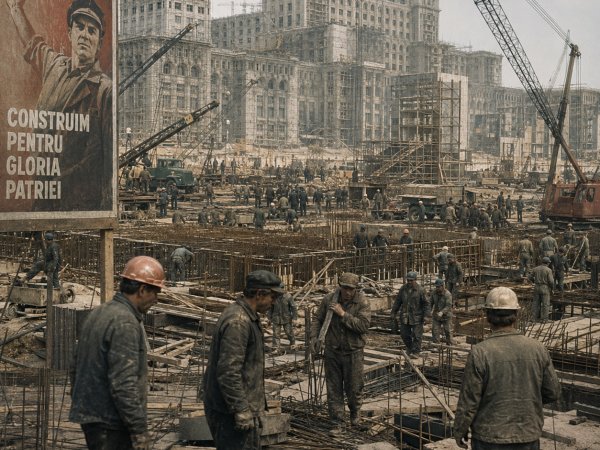
At any given time, around 20,000 workers were on site — a figure confirmed by Anca Petrescu herself in an interview. Alongside them, thousands of soldiers were used for the underground works, with figures ranging between 5,000 and 12,000 depending on the source. Over the nearly seven years of construction, through rotation, press estimates suggest that more than 100,000 people passed through the project at one point or another — a cumulative figure, not a simultaneous headcount.
The number of casualties is far less clear. There is no official public tally of fatal accidents on site — a subject treated, at the time, as taboo. Press reports occasionally cite a figure of 27 deaths in workplace accidents, without a clearly identifiable primary source. Anca Petrescu herself, in an interview, spoke of "10 to 15 fatal accidents," noting that each death was followed by a military investigation. At the same time, rumors circulated about workers buried in concrete or sealed inside the walls — claims the architect herself publicly called "absurd." These are stories worth mentioning as urban legend surrounding the site, not as confirmed fact.
What's actually inside today
Beyond the disputed numbers, what can be verified with more confidence is the building's current use. The Chamber of Deputies has been housed here since 1994, the Senate joined in 2004, and since that same year one wing of the building (E4) has hosted the National Museum of Contemporary Art. An International Conference Center has also operated there since 1994, hosting, among other events, the 2008 NATO summit.
As for the percentage of unused space, estimates converge loosely around 60-70%, though without an official document confirming the exact figure — which, by this point in the article, should come as no surprise. Casa Poporului remains, perhaps, the perfect monument to an era that produced numbers with the same ease it produced concrete: in impressive quantities, but without much concern for how well they'd hold up under scrutiny.
Also recommended The Palace of Parliament, between history and myth: What are the most credible stories about the People’s House?