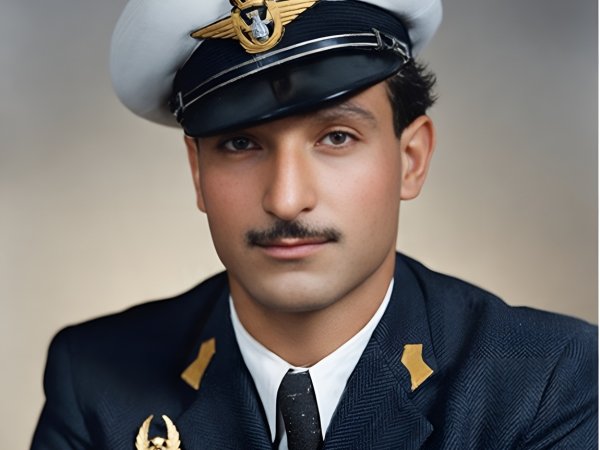
Captain Alexandru Șerbănescu, the hero pilot with 55 aerial victories, has a street named after him in Bucharest
- Articles
- 06 JUL 26
The history of Romanian military aviation includes many names that have remained in the memory of generations through their courage and sacrifice. Among them, Alexandru Șerbănescu occupies a special place. Considered one of Romania's greatest fighter pilots during the Second World War, he entered history thanks to his 55 confirmed aerial victories, an achievement that places him among the most successful Romanian flying aces. His life, however, was a short one. He died at just 32 years old while carrying out a combat mission, after choosing to confront an overwhelmingly superior air force, convinced that defending Romanian airspace was a duty he could not avoid. Today, his memory is preserved through monuments, commemorative ceremonies, and a street in Bucharest that bears his name. Recently, 105 years have passed since the birth of the man who would become one of the legendary figures of Romanian aviation.
From the child of Colonești to one of Romania's greatest fighter pilots
Alexandru Șerbănescu was born on May 17, 1912, in the commune of Colonești, Olt County. From an early age, he chose a military career, and his passion for flying led him to aviation, a branch of the armed forces that was becoming increasingly important in modern warfare.
His qualities as a pilot were quickly recognized. He was appreciated for his exemplary discipline, his calmness during missions, and his ability to make rapid decisions in extremely difficult situations. At the same time, his fellow pilots described him as a commander who remained close to his men, constantly concerned about their safety and training.
The experience he gained on the Eastern Front transformed him into a formidable fighter pilot. His aerial victories accumulated one after another, and his name became increasingly respected both within the Romanian Air Force and among its German allies.
An important moment in his career came on February 13, 1944, when he was officially appointed commander of the 9th Fighter Group. It was one of the elite units of the Romanian Air Force, but the situation on the front was becoming increasingly difficult. The pilots had fewer and fewer modern aircraft available, while casualties continued to rise month after month.
The commander who fought alongside his men
Alexandru Șerbănescu's appointment as commander of the 9th Fighter Group came at a critical moment in the war. In February 1944, despite unfavorable weather conditions, Romanian pilots continued to carry out escort, patrol, reconnaissance, and bomber protection missions almost every day.
Within only a few weeks, the group participated in 12 aerial engagements and achieved 11 confirmed victories. These successes, however, were overshadowed by the loss of experienced pilots, making every mission increasingly dangerous.
During this period, Alexandru Șerbănescu achieved his 36th aerial victory on the Eastern Front, once again confirming his reputation as an exceptional pilot.
Unlike many commanders who directed operations from the ground, Șerbănescu preferred to fly on the front line alongside his subordinates. He accepted the same risks as they did and personally took part in combat, earning the respect of the entire group.
The day he lost one of his closest comrades
One of the most tragic moments of Alexandru Șerbănescu's life occurred on March 13, 1944. During a reconnaissance mission, he was flying together with Adjutant Tiberiu Vinca, one of the group's most experienced pilots and one of his closest comrades.
At one point, the two pilots encountered a formation of German Heinkel He 111 bombers and approached them for identification. Because of a tragic misunderstanding, one of the German bombers opened fire on the Romanian aircraft.
Tiberiu Vinca's airplane was hit and crashed in flames. His death shocked the entire 9th Fighter Group. Vinca had already achieved 13 confirmed aerial victories and had completed no fewer than 248 combat missions.
His fellow pilots later recalled that it was the first time they had ever seen Alexandru Șerbănescu cry. The commander, known for his self-control, could not hide the grief caused by the loss of the comrade with whom he had flown many dangerous missions.
The retreat to Romania and the defense of Moldavia
At the end of March 1944, the military situation on the Eastern Front had deteriorated significantly. Soviet troops had already entered Bessarabia, and Romanian units received orders to withdraw.
The 9th Fighter Group was initially relocated toward Odessa before being transferred to the airfield at Tecuci. Personnel and equipment were transported aboard Junkers Ju-52 aircraft under difficult conditions.
Beginning on April 4, 1944, Tecuci Airfield became one of the most important operational bases of the Romanian Air Force in Moldavia. From there operated the 9th Fighter Group, the 8th Assault Group, and heavy bomber units equipped with Ju-88 aircraft.
As the Soviet offensive advanced from the northeast, a second threat emerged from the south. American bombers began attacking Romanian territory, forcing Romanian fighter pilots to fight simultaneously against both Soviet and American aviation.
Under these circumstances, the 9th Fighter Group carried out numerous escort and interception missions every day, operating not only from Tecuci but also from the airfields at Bacău, Galați, Focșani, and Buzău.
The battles became increasingly intense while available resources steadily declined. Despite these difficulties, Alexandru Șerbănescu remained on the front line, convinced that his experience could make the difference in the aerial battles that lay ahead.
The decisive battles and the victories that turned him into a legend
The first days at Tecuci were marked by an exhausting operational tempo. On April 5, 1944, Bucharest was subjected to a massive American bombing raid, and the 9th Fighter Group was scrambled to help defend Romanian airspace. The following day, the unit carried out no fewer than four combat missions: protecting Tecuci Airfield, escorting assault and bomber aircraft, and intervening wherever the situation required.
In the Galați area, Romanian pilots fought against American P-38 Lightning and P-51 Mustang fighters, while near Iași they engaged Soviet Airacobra aircraft. It was a period in which the Romanian Air Force had to respond to attacks coming from two different directions while its available resources continued to shrink.
During a free-hunting mission over the Hârlău–Târgu Frumos area, Alexandru Șerbănescu was forced to abandon combat for a completely unexpected reason. A stork struck the elevator of his Messerschmitt Bf 109, damaging it badly enough that the aircraft could no longer be safely controlled. The commander had to return to Tecuci Airfield while his fellow pilots continued the mission and achieved two aerial victories.
As the front approached Romania's borders, pressure on the 9th Fighter Group intensified. At the end of April, Soviet troops launched a major offensive north of Iași, forcing Romanian pilots to fly as many as five or six missions per day. At that point, the group had only ten operational aircraft left.
Under these circumstances, the German command promised to deliver six new Messerschmitt Bf 109 fighters. The promise was fulfilled at the end of May, precisely when Alexandru Șerbănescu was being celebrated for achieving his remarkable 40th aerial victory.
The recognition received from the German allies
The 40th aerial victory represented one of the greatest moments of Alexandru Șerbănescu's career. His achievement was remarkable even when compared to experienced Luftwaffe pilots, and the German military leadership officially congratulated him.
On that occasion, the 9th Fighter Group received the six Bf 109 aircraft promised by Generaloberst Otto Deßloch. As a sign of appreciation for the cooperation between the Romanian and German air forces, the unit was given the honorary designation "Deßloch–Șerbănescu."
Pilot Mălăcescu designed the group's emblem, which was subsequently painted on all of the unit's aircraft. Around the same time, Alexandru Șerbănescu also received a congratulatory letter from the commander of Army Group South Ukraine, praising him for becoming the leading ace of the victorious Romanian Air Force.
Despite this recognition, his attitude remained unchanged. His comrades remembered him as the same modest commander, more concerned with the well-being of his men than with his own achievements.
Confronting the American bombers
During the summer of 1944, the air war over Romania reached an unprecedented intensity. American bombers focused primarily on the oil refineries around Ploiești, considered essential for supplying Germany's war machine.
On June 11, 1944, Alexandru Șerbănescu achieved his first victory against the United States Army Air Forces by shooting down a B-17 Flying Fortress. It was his 45th confirmed aerial victory.
The bombing raids grew larger and larger. The number of bombers and escort fighters increased continuously, forcing Romanian and German fighter groups to cooperate in increasingly large formations.
On July 31, 1944, a single American formation consisted of more than 360 bombers. Despite being heavily outnumbered, Alexandru Șerbănescu managed to shoot down one Mustang, followed by another confirmed victory over the same type of aircraft on August 4. That would become his final officially confirmed victory, bringing his total to 55.
Meanwhile, the 9th Fighter Group continued losing experienced pilots. Almost every mission ended with destroyed aircraft or pilots who never returned to base.
The final mission and the ultimate sacrifice
By early August 1944, the situation had become almost hopeless. On August 8, American bombing raids struck the Buzău area, leaving several members of the 9th Fighter Group wounded. Two days later, more than 450 bombers, escorted by numerous fighters, attacked Romania once again. Șerbănescu's group attempted to oppose them with only 14 aircraft, losing Adjutant Ioan Panaite, another experienced pilot.
After these losses, the unit had only 13 combat-ready pilots remaining. On August 17, 1944, the commanders of the Romanian fighter groups were summoned to Bucharest. During the meeting, the military leadership criticized them for their alleged ineffectiveness against the American bombing campaign, despite the overwhelming numerical superiority of the enemy.
These accusations deeply affected Alexandru Șerbănescu. The commanders were even advised to avoid direct combat whenever possible because the odds of success were minimal. For Șerbănescu, such a recommendation was impossible to accept.
"I cannot understand how an enemy, no matter how large and powerful, can enter my country as if it were an unguarded village and devastate it. It shall never be said that no Romanian stood up to face the Americans, even if we lose the battle," declared the commander of the 9th Fighter Group.
The following day, on August 18, 1944, hundreds of American bombers, protected by numerous escort fighters, headed toward the oil refineries at Ploiești and Câmpina. Nearly 900 aircraft entered Romanian airspace in seven massive formations.
Facing this enormous force, Alexandru Șerbănescu took off together with the only 12 pilots he still had available. The battle was almost impossible to win.
During the engagement near Rușavăț, Buzău County, the commander's aircraft was shot down. Alexandru Șerbănescu was killed in action, remaining faithful to his military oath until his final moment.
The legacy of a hero of Romanian aviation
The death of Alexandru Șerbănescu deeply affected his fellow pilots. Four days later, on August 22, 1944, he was buried with full military honors. Representatives of both the Romanian and German air forces attended the funeral, demonstrating the respect he had earned from everyone who knew him.
With 55 confirmed aerial victories, Alexandru Șerbănescu remains one of the greatest Romanian fighter aces of all time. His achievements were accomplished during a period when the enemy enjoyed overwhelming numerical and technological superiority, making every combat mission extraordinarily dangerous.
Today, his name continues to be honored throughout Romania. A street in Bucharest bears his name, while commemorative ceremonies dedicated to the history of Romanian aviation continue to pay tribute each year to the pilot who chose to fight until the very end in defense of his country's skies.
Alexandru Șerbănescu's story is not only that of an exceptional pilot but also of an officer who led his men from the front, shared every danger of war with them, and remained faithful to his convictions even when he knew that his chances of survival were extremely small. It is precisely this combination of professionalism, courage, and devotion that continues to make him one of the most respected figures in the history of Romanian military aviation.
We also recommend: Elena Caragiani Stoenescu, the first woman aviator in Romania, has a street bearing her name in Bucharest