Bucharest and its first paved street: the story of Calea Victoriei, beyond the legend
- Articles
- 22 JUN 26
For nearly three centuries, Calea Victoriei has carried the kind of reputation every other Bucharest street secretly envies: the address where the city came to be seen, where governments were quietly assembled over coffee, and where, depending on who you ask, modern Bucharest itself first took shape underfoot. Today, it's also the street nearly everyone points to when asked which was the first in Bucharest to be paved, and later asphalted — a claim repeated so often, in such identical wording, that it has long since stopped sounding like a fact and started sounding like folklore. Pull on that thread, though, and the story turns out to be far less settled than the internet would have you believe.
From oak beams to cobblestone
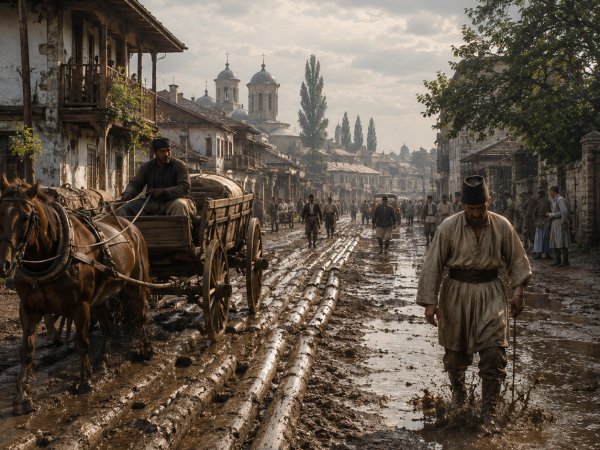
The road started out, like so many others in old Bucharest, with nothing solid underfoot. In 1692, Constantin Brâncoveanu cut a new route to connect his estate on the bank of the Dâmbovița river with his property at Mogoșoaia, paying no mind to the noble families whose land he crossed. He had the new road covered with thick oak beams — hence the name Podul Mogoșoaiei, "the Mogoșoaia bridge-road," a name several Bucharest streets carried back then, since the system was used widely across the city, not just here.
The beams didn't solve much, though. Mud would gather underneath them, and passers-by would frequently sink up to the waist, as the writer Nicolae Filimon noted at the time. The system was gradually phased out: river stone paving began in 1824, and only in 1864, under mayor Barbu Vlădoianu, did the systematic paving of Podul Mogoșoaiei with cobblestone begin — work that was finished in 1872, alongside the laying of sidewalks. Historian Gheorghe Parusi, author of the monumental Chronology of Bucharest, describes this moment as the city's first systematic cobblestone paving project.
This is where the first piece of confusion around Calea Victoriei creeps in. Many texts state, plainly, that it "was the first paved street in Romania," as though the claim were universally settled. In reality, at least one source points to a different street altogether — the former "Pensionatului" street in the Old Town, also paved with cobblestone, but in 1870, using granite brought from Belgium rather than Scotland, as the more widely repeated version about Calea Victoriei claims. Neither version is backed by an explicitly cited archival document, which means the "first in the country" label remains, for now, a nice turn of phrase more than a verified fact.
Asphalt: a story that doesn't hold up nearly as well
If the cobblestone paving has at least a reasonably solid source behind it, the asphalt part fares much worse. The version that circulates most often claims that asphalt was first laid on Calea Victoriei "around the time of the First World War" — sometime between 1910 and 1916, roughly. It sounds plausible, but none of the articles repeating this claim cite any document, monograph, or specialist study. The most likely source for many of the details circulating about the street is Gheorghe Crutzescu's book, Podul Mogoșoaiei: The Story of a Street, published in 1943 — yet none of those repeating the asphalt story seem to have quoted an actual passage from it.
What's more, there's a detail that complicates things further: according to a piece on the local history of Timișoara, the first asphalted street on what is now Romanian territory may have appeared there instead, as early as 1895, on a stretch near the port district, followed shortly after by a section of Ștefan cel Mare street. If that's accurate — and it, too, comes from a journalistic rather than an academic source, so it deserves the same caution — then the idea that Bucharest had the country's first asphalted street, more than fifteen years after Timișoara, simply doesn't hold up.
What does seem far better documented is something else entirely: the large-scale introduction of asphalt in Bucharest's historic center happened only after 1950. Materials from a Bucharest City Museum exhibition dedicated to the City Hall's Technical Department make clear that the 20th century, and especially the postwar period, brought widespread asphalting to the streets of the old quarter — and in places like Covaci, Zarafi, or Pasajul Francez, the old cobblestone paving survived underneath, with asphalt simply poured directly over it. If the major asphalting wave really came after the mid-20th century, it becomes hard to believe that a fully asphalted street already existed, decades earlier, right in the city center.
What actually remains of the story
Calea Victoriei remains, without question, one of Bucharest's oldest and most important streets — the place where, over more than three centuries, the city's political and cultural elite crossed paths, where Bucharest's first public lighting was installed, and where landmark buildings such as the CEC Palace or the former Post Office Palace went up. Everything related to its urban evolution, from wooden beams to cobblestone, rests on credible sources.
But labels like "first paved street in Romania" or "first asphalted street in Bucharest" appear to have started, at some point, in one article or another, and have simply been repeated ever since, without anyone going back to check. It's the kind of story that sounds so good nobody feels the need to verify it — which is precisely why it deserves a little caution before we pass it along any further.