Bolta Rece, the summer garden, the centuries-old trees and the capital’s elite. The history of Bucharest’s legendary restaurant
- Articles
- 04 SEP 26
In old Bucharest, restaurants and summer gardens were more than places where people went to eat. They were meeting places, social spaces and important landmarks of urban life. Among the establishments that became well known over the decades was Bolta Rece, the restaurant on Popa Savu Street that was associated with outdoor dining, mititei, grilled dishes, chilled wine and long evenings spent in its garden. According to historical and commercial accounts about the establishment, Bolta Rece was founded in 1889, at 53-55 Popa Savu Street, in an area that is today part of Aviatorilor, close to Kiseleff Road and Charles de Gaulle Square. Its history followed the major transformations of Bucharest during the 20th century, from the development of the northern districts and the interwar period to nationalization, communism, privatization and the modernization of the restaurant industry after 1989. Over more than a century, Bolta Rece changed its appearance and function several times. It began as a summer garden, became one of the better-known taverns in northern Bucharest during the communist period, continued operating after the 1989 Revolution and was completely rebuilt in 2008. In its later years, the venue was used largely for private events before eventually closing.
The history of Bolta Rece restaurant in Bucharest
The year 1889 is generally given as the founding date of Bolta Rece. At the end of the 19th century, Bucharest was expanding rapidly, and the northern part of the city was gradually acquiring an increasingly important residential and social role. The proximity of Kiseleff Road, one of the capital’s major promenades, contributed to the development of restaurants, cafés, gardens and other leisure establishments in the area.
The original Bolta Rece was conceived as a traditional Bucharest summer garden. One of the elements associated with the restaurant from its earliest period was the presence of two large, old trees, which provided shade during the hot months. The garden was an important part of the establishment’s identity, allowing customers to dine outdoors in a relatively secluded setting.
The restaurant became associated with Romanian food, particularly mititei and grilled meat, as well as wine served chilled. The name Bolta Rece itself reinforced the connection with a cool summer setting and with the custom of drinking chilled wine during the warm season.
Unlike the large restaurants located on the capital’s principal boulevards, Bolta Rece had a more discreet location. Its position on Popa Savu Street allowed it to develop a character based on the garden, the food and the atmosphere rather than on a monumental architectural setting.
From a summer garden to a well-known Bucharest tavern
As Bucharest entered the 20th century, restaurants and summer gardens became increasingly important parts of urban entertainment. Establishments of this kind attracted a varied clientele, and Bolta Rece gradually established itself as one of the better-known addresses in the northern part of the capital.
Its reputation was built largely around traditional Romanian food and the outdoor garden. Mititei, grilled dishes and wine were among the products most closely associated with the establishment. The garden also allowed the restaurant to accommodate larger groups, particularly during the summer months.
The restaurant’s location near the Kiseleff area was another advantage. The northern part of Bucharest was developing into one of the capital’s more desirable residential areas, while Kiseleff Road and the surrounding parks attracted residents and visitors looking for leisure activities away from the increasingly crowded central areas.
Over time, Bolta Rece became part of the network of restaurants that defined Bucharest’s social and culinary landscape. Its significance was not based on an exceptional architectural monument, but on the continuity of the establishment and its ability to adapt to successive changes in the city.
Bolta Rece during the communist period
The history of the restaurant changed fundamentally after the establishment of the communist regime and the nationalization of private businesses. Like many other restaurants and taverns, Bolta Rece entered the state-controlled public food-service system.
Despite the new economic and political framework, the establishment continued to operate and maintained its reputation as a popular restaurant in northern Bucharest. Its clientele was diverse, and the restaurant became known for its lively atmosphere and long gatherings.
An article published by Adevărul about the legendary taverns of Bucharest describes Bolta Rece as famous for its long parties, diverse clientele, mititei and wine. The same source is critical of the later condition of the restaurant, arguing that renovations had weakened its historical character.
The garden remained an important component of the restaurant. Outdoor dining, music and traditional food helped preserve the establishment’s popularity even as Bucharest’s social life changed dramatically under communism.
The restaurant therefore occupied a particular position in the city’s network of popular establishments. It was neither a formal luxury restaurant nor simply a neighborhood eatery. Its clientele could include artists, intellectuals, residents of the surrounding area and people from very different social backgrounds.
The restaurant after 1989
The fall of communism brought major changes to the Romanian restaurant industry. Private businesses began to develop rapidly, competition increased and traditional restaurants had to adapt to new expectations.
Bolta Rece entered this period with an important advantage: an established name. Its reputation from the previous decades gave it recognition among customers who were already familiar with the restaurant.
Its position in the Bucharest restaurant scene shortly after the Revolution is documented by a 1991 ranking reproduced by Restocracy from a classification originally published in Libertatea. Bolta Rece was included among the restaurants awarded three stars, alongside several other established names in the capital. The ranking is significant because it shows that the restaurant remained an active and recognized establishment during the early transition period.
During the 1990s and early 2000s, the restaurant continued to combine its traditional identity with the changing demands of the market. Its offer expanded beyond the strictly Romanian menu, while the premises could also be used for celebrations and private gatherings.
This was a period in which many historic restaurants in Bucharest faced the same challenge: how to preserve a recognizable name while adapting their spaces and services to a new commercial environment.
The 2008 reconstruction
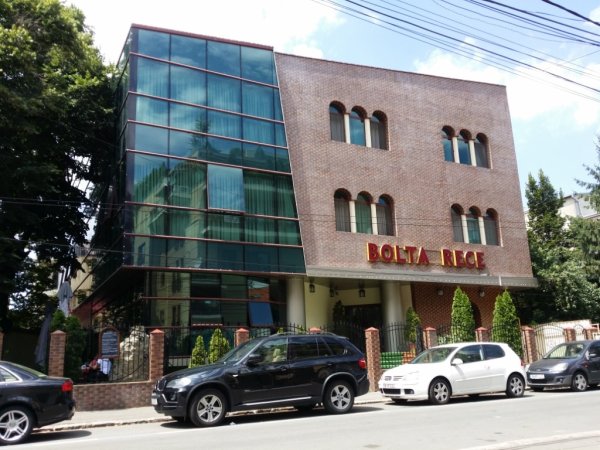
The most significant physical transformation of Bolta Rece took place in 2008, when the old building was demolished and replaced with a completely rebuilt structure. The new venue was substantially different from the traditional summer-garden restaurant that had existed in previous decades.
The reconstruction introduced a modern interior and several halls designed for different types of events. The establishment increasingly functioned as an event venue, hosting weddings, christenings, corporate gatherings and private parties, while continuing to offer restaurant services.
Commercial descriptions of the renovated establishment presented it as a multifunctional venue with several halls and a garden. The new configuration reflected the evolution of the Romanian hospitality industry, in which restaurants increasingly relied not only on regular dining but also on private events as an important part of their business.
The garden remained an important feature of the property, while the two old trees associated with the location were preserved. Their presence provided a direct physical connection with the earlier configuration of the restaurant, even though the building itself had been completely changed.
The renovation also attracted criticism. In its retrospective assessment of old Bucharest taverns, Adevărul described the new Bolta Rece as an example of a renovation that failed to preserve the atmosphere and architectural character associated with the old establishment.
The final years and the closure of Bolta Rece
In its final period of operation, Bolta Rece had become primarily a restaurant and event venue rather than the classic summer garden of earlier decades. Its facilities were suited to private celebrations and organized events, while the traditional Romanian culinary profile remained part of its identity.
The transformation was representative of a broader change in Bucharest. Many historic restaurants that had survived the communist period were faced with increasingly modern competition, changing consumer preferences and rising operating costs. Some adapted by becoming event venues, while others disappeared altogether.
Bolta Rece ultimately followed this path. The historic address on Popa Savu Street remained associated with the restaurant’s name, but the establishment ceased its regular activity. Current restaurant listings indicate that the location is permanently closed, while Restocracy records its closure in 2025.
The closure marked the end of a restaurant whose history stretched back to the late 19th century. Founded in 1889, Bolta Rece had operated through several radically different periods of Bucharest’s history and had repeatedly changed its format in response to the city around it.
Its story illustrates how a restaurant can become part of the urban history of a capital without necessarily being a monument or an officially protected historic building. Its importance came from its continuity, its location, its garden, its food and the generations of customers who passed through its doors.
From the summer garden built around two old trees to the modern event venue created after the 2008 reconstruction, Bolta Rece reflected the changing habits and social life of Bucharest. Its closure leaves behind the record of one of the capital’s long-running restaurants and another chapter in the history of the city’s traditional dining establishments.
We also recommend: „The Red Snake”, between Glory and Ruin: How the Favorite Tavern of 20th-Century Bucharest’s Great Artists Met Its End