Bălăneanu Parish Church, 150 Years of History: Iancului Barrier, the 218 Parishioners, the Holy Place in the East of the Capital
- Articles
- 07 MAY 26
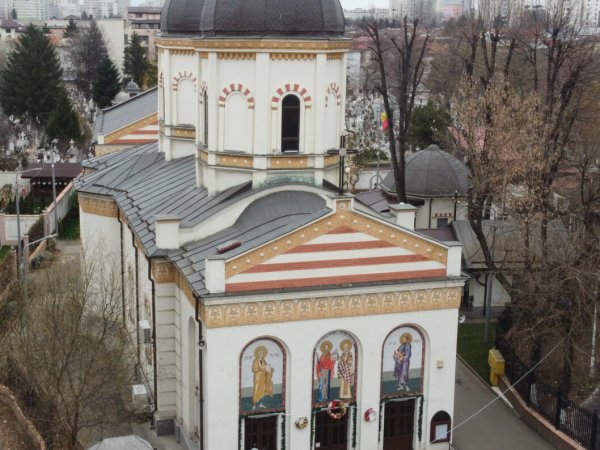
In the eastern part of Bucharest, near the intersection of Mihai Bravu Road, Iancului Road and Vatra Luminoasă Street, stands one of the places of worship that keeps alive the memory of a community developed together with the expansion of the Capital. Bălăneanu Parish Church represents not only a spiritual landmark for the faithful in the area, but also a monument that speaks about the urban, social and cultural evolution of Bucharest during the last almost two centuries. The story of the church begins in the times when Bucharest was delimited by entry and exit barriers, meant to control the development of the city and the circulation of the inhabitants. Beyond the walls and borders of the old city, communities began to grow, and people felt the need for a place of prayer close to their homes. Thus was born the idea of building a new church for the inhabitants living “outside the Iancului Barrier”.
From the Iancului Barrier to the formation of a strong community
At the beginning of the 19th century, Bucharest was organized around barriers that had an administrative and fiscal role. In 1807, among the 13 access barriers to the Capital was also the Iancului Barrier. These checkpoints aimed to prevent the uncontrolled expansion of the city and to supervise the circulation of people and goods.
As Bucharest developed, the area beyond the barrier began to transform into a distinct neighborhood. The Iancului suburb quickly became one of the most populated in this part of the city. The censuses of the time show that there were 125 families and 112 houses here, and by 1838 the population had reached approximately 550 inhabitants.
With the administrative reorganization of the Capital, at the beginning of the 20th century, the Iancului suburb was integrated into Sector II Black. Later, the interwar period brought an accelerated development of Bucharest, through the appearance of new neighborhoods such as Mihai Bravu, Iancului and Vatra Luminoasă. Vatra Luminoasă especially stood out through the model houses built by the Social Insurance institution, part of them entering the parish area.
The population growth inevitably also led to the need to build a new place of worship. Thus, 218 parishioners of the Old Iancului Church, who lived beyond the barrier, officially requested permission for the raising of a new church, intended for the religious needs of the community. The future place of worship was to bear the name Iancu Nou Church.
How the church was built in only a few months
The steps for building the church were supported by the local community and by several owners of the suburb. On February 19, 1872, protoiereus Alecu Hartofilax presented to Metropolitan Nifon the report regarding the necessity of raising the new church and mentioned the financial contribution of 24 parishioners and owners who each donated 5,000 lei for this project.
Among the most important founders was the merchant Stanciu Ioan Bălăneanu, the one who offered the land on which the church was to be built. His gesture remained forever linked to the history of the parish, and the name Bălăneanu became synonymous with this holy place.
In May 1873 the beginning of the works was approved, and Metropolitan Nifon blessed the reading of the prayer for the beginning of the church building. Construction began on June 14, 1873 and was carried out at an impressive pace for that period. On December 2, 1873, the church was already completed and consecrated.
The place of worship received as protectors Saint Hierarch Nicholas, celebrated on December 6, Saint Hieromartyr Haralambie, celebrated on February 10, as well as Saints Emperors Constantine and Helen, honored on May 21.
The architecture of a representative monument for old Bucharest
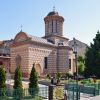
The church impresses through its architectural balance and through the decorative elements specific to the era. Built in triconch plan, the edifice has dimensions of 32 meters length, 13 meters width and 16 meters height. The two octagonal towers, of equal dimensions, offer the monument a harmonious and elegant appearance.
The construction is made of handmade Oltenian brick bound with hydraulic lime mortar. The exterior is decorated with a frieze rich in geometric and floral motifs, which is also found on the façades, at the base of the towers and on the porch pediment.
The windows are framed by pilasters with Corinthian capitals, and the semicircular frames made of exposed brick alternate with plastered surfaces, offering the building a special expressiveness. The porch is marked by three tall blind arches, decorated with painting and provided in the lower part with access doors.
Inside, the church impresses through the compartmentalization of the nave, supported by two rows of columns with Corinthian capitals and massive cubic pedestals. These support the arches and vaults that sustain the towers and the central dome.
The altar apse is semicircular and covered with a quarter-sphere vault, while the lateral apses have slightly curved vaults. The entire ensemble preserves the specificity of Romanian church architecture from the second half of the 19th century.
Restorations and transformations throughout time
In its more than 150 years of existence, the church went through numerous restoration and consolidation works. The first important interventions took place in 1907-1908, and in 1928 the bell tower was built.
The 1940 earthquake affected the tower of the narthex, which was later rebuilt. At that time an alveolus was also added in the southern part of the altar. Other important works were carried out in 1957, when the porch and the alveolus in the northern part of the altar were built.
After the 1977 earthquake, new consolidations were made, including the mounting of a support beam under the cornice. The most extensive works, however, took place between 2009 and 2014, when the entire parish ensemble was modernized and restored.
During this period the parish settlement was built, together with a service residence, the church was consolidated, the liturgical furniture was restored and the entire enclosure was arranged. At the same time, the new mortuary chapel and the new bell tower, 17 meters high, provided with an oak wood pavilion and three automated bells, were raised.
Also, a holy water pavilion, a candle stand and a new enclosing fence were built, and the courtyard was rearranged through asphalting, paving and restoration of the green spaces.
The artistic value of the painting and liturgical furniture
Bălăneanu Church owns an important artistic heritage, resulting from the contribution of valuable painters and sculptors. The carved wooden iconostasis, the side paneling and the episcopal throne are the work of sculptor Grigore Dumitrescu.
The windows preserve stained glass windows made in the first half of the 20th century, and the interior painting went through several stages of restoration and renewal. Between 1912 and 1913, the church was painted in oil. Later, between 1957 and 1959, painter Gheorghe Vânătoru created a new painting in fresco technique, in neo-Byzantine style.
The painting was restored in 1984 by Virginia Videa, and during 1995-1996 by Marian Rondelli. Between 2014 and 2017 an extensive conservation and restoration of the painting took place, coordinated by the restorer Magda-Augustina Cârciumaru.
The iconostasis also benefited from important artistic interventions. The initial painting was made by Petre Achițenie, and between 2016 and 2018 painter Oprea Pioară created a new iconographic painting.
In the church courtyard there are several symbolic troițe: the Heroes’ Troița, the troița dedicated to donors and benefactors, raised in 2014, as well as the wooden troița inaugurated in 2018 under the message “God is with us!”.
The reconsecration in 2019 and the spiritual role of the parish
A special moment in the recent history of the church took place on June 30, 2019, 146 years after the laying of the foundation stone. With the blessing of Patriarch Daniel, the consecration service was officiated by His Grace Father Varlaam Ploieșteanul, Patriarchal Assistant Bishop, on the Sunday of the Romanian Saints.
The church was consecrated through sprinkling with holy water and anointing with the Holy and Great Myrrh. The faithful present had the possibility to venerate the relics of Saint Venerable Martyr Ephraim the New, brought from the historic chapel “Saint Great Martyr George” of the Patriarchal Residence.
After the service, all participants received the blessing to enter the Holy Altar in order to kiss the Holy Gospel, the Holy Cross and the Holy Table, a moment of profound spiritual significance for the community.
The cultural and social activity of the parish
Throughout time, the parish was not only a religious center, but also a cultural and social one. During the interwar period, cultural gatherings and activities dedicated to children and families were organized here, with the participation of the pupils of Ferdinand School, the choir of Nifon Seminary and the choir of the Blind Asylum from Vatra Luminoasă.
Between 1949 and 1975, a parish choir made up of professionals functioned here, and between 1940 and 1949 the parish supported a canteen for the blind people in the area.
The parish library developed through donations from priests and faithful and preserves valuable collections of old books registered in the official inventory of the parish.
At present, the pastoral activity includes weekly liturgical and catechetical programs, visiting the faithful at home, organizing pilgrimages and activities for young people. In collaboration with Secondary School no. 85, educational programs for pupils are carried out, and the parish workshop “Light and Color” supports the development of children’s artistic abilities.
The parish offers support to needy families, sick people and those with many children and provides religious assistance for Luminița Kindergarten nearby.
Today, Bălăneanu Parish Church remains one of the most important spiritual hearths in the eastern part of the Capital. Beyond the architectural beauty and the artistic heritage, the place of worship keeps alive the memory of a community that grew together with Bucharest and which, for more than 150 years, has found here its peace, faith and continuity.
We also recommend: Symbols of Bucharest: Bucur the Shepherd Church, the city's first place of worship and the story behind the Capital's name