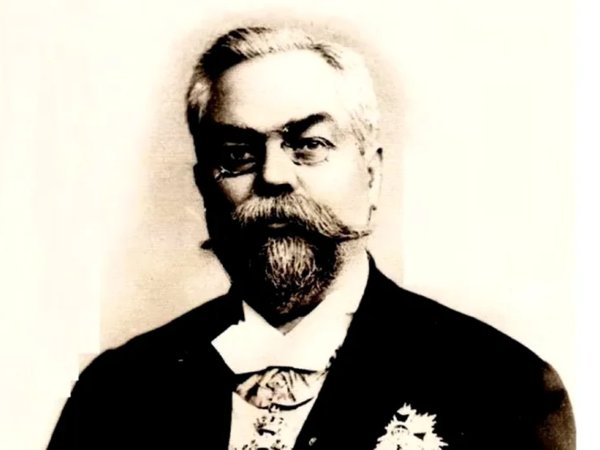
Anghel Saligny, the greatest Romanian engineer, the “father” of the Cernavodă Bridge, has a street bearing his name in the center of Bucharest
- Articles
- 13 FEB 26
Few personalities in Romania’s history have managed to leave behind a body of work as imposing and enduring as that of Anghel Saligny. His name is forever linked to the Cernavodă Bridge, the monumental construction that united Dobrogea with the rest of the country and that represented, at the end of the 19th century, a true demonstration of technical strength and engineering vision. Considered by many to be the greatest Romanian engineer, Anghel Saligny was not only a brilliant specialist, but also a visionary spirit, capable of designing the infrastructure of a country in full transformation. Today, his memory is preserved not only through his engineering works, but also through the fact that a street in the center of the Capital bears his name, reminding Bucharest residents of the man who changed forever the face of Romanian infrastructure.
The child passionate about tools who dreamed of becoming an engineer
Anghel Saligny was born on April 19, 1854, in the locality of Șerbănești, Galați County. From childhood, he showed a special attraction to everything that meant technique, mechanisms, tools, and instruments. In an era when Romania was timidly beginning to outline its modernization, little Anghel was already looking toward the future.
His school years confirmed his vocation. He was drawn to mathematics, physics, and mechanics, disciplines that stimulated his logical thinking and his desire to build. The dream of becoming an engineer was not a passing one, but a firm decision, supported by work and perseverance.
To complete his training, he left for Germany, where he attended the courses of the University of Berlin and the Higher Technical School of Charlottenburg. His studies provided him with a solid foundation and familiarized him with the most modern technical solutions of the time. There the foundations were laid for a career that would decisively shape Romania’s infrastructure.
The return to the country and the beginning of major projects
After completing his studies, Anghel Saligny devoted himself almost exclusively to the design and construction of railways and bridges. In 1876, he returned to Romania, where he was appointed engineer within the Bridges and Roads Service. The country urgently needed modern infrastructure, and the young engineer was ready to meet this challenge.
The first major project in which he became involved was the construction of the Ploiești–Predeal railway, an essential work for the development of transport and for the connection with Transylvania. The project involved considerable technical difficulties, yet Saligny quickly demonstrated that he possessed not only theoretical knowledge, but also the ability to find efficient practical solutions.
Only five years after returning to the country, due to his professionalism, he was appointed deputy director of the Bridges and Roads Service. He contributed to the construction of the Adjud–Târgu Ocna and Bârlad–Vaslui railway lines, works of strategic importance, meant to facilitate the transport of people and goods and to strengthen economic links between regions.
In 1883, he was transferred to a new service specially created for the construction of bridges and railways. There he continued his activity with the same passion and rigor, building numerous metal bridges that became essential elements of Romanian infrastructure.
The Cosmești Bridge – the prelude to a masterpiece
One of the important projects of this period was the bridge over the Siret River at Cosmești, inaugurated in 1888. The construction once again demonstrated Anghel Saligny’s ability to combine technical innovation with structural safety.
The Cosmești Bridge was a decisive step toward the great challenge of his career: creating a stable link across the Danube, a river that represented a major natural barrier between Dobrogea and Muntenia.
The great challenge: the Cernavodă Bridge
The most ambitious project of his life was, without doubt, the Cernavodă Bridge, initially known as King Carol I Bridge. The construction was to cross the Danube and connect Cernavodă, in Constanța County, with Fetești, in Ialomița County.
Built between 1890 and 1895 under the direct coordination of Anghel Saligny, the bridge had an impressive length of 4,408 meters. At the time of its inauguration, it was the longest bridge in Europe and the third in the world. The deck, with a width of 12 meters, allowed the circulation of two railway lines.
Its metal structure, designed with extraordinary rigor, offered remarkable stability. The bridge was conceived to withstand not only the force of the waters and the whims of nature, but also the intense traffic of trains.
At the inauguration, King Carol I cut the official ribbon, uttering words full of admiration for the Romanian engineers who had successfully completed this monumental work. The event was a moment of national pride, proof that Romania could accomplish projects of European scale.
The supreme test: the wager with his own life
To demonstrate the solidity of the construction, specialists decided to subject the bridge to an extreme test: a convoy made up of 15 heavy locomotives was to cross the structure simultaneously.
Confident in his calculations and technical solutions, Anghel Saligny made a gesture that would enter legend. He boarded, together with several workers, a boat anchored directly beneath the bridge, thus assuming the ultimate risk. If the structure had failed, he would have lost his life.
When all 15 locomotives passed without problems, the engineer exclaimed, relieved and triumphant: “I knew it would hold!” It was the moment that definitively consecrated his reputation.
The regret of a perfectionist
After the inauguration, Anghel Saligny spent entire weeks analyzing his own work. He would look at the bridge for hours on end, not to boast, but to discover its possible imperfections.
In a discussion with engineer Nicolae Ionescu Johnson, he confessed that he regretted not having provided also an access way for pedestrians and carts. He would have wished the connection between Dobrogea and Muntenia to be complete, not only railway-based. This confession says much about his character: a demanding professional, always in search of perfection.
From King Carol I Bridge to Anghel Saligny Bridge
During the communist period, the bridge was renamed Anghel Saligny Bridge, in honor of its creator. The construction remained functional until 1987, when a new bridge was built, and the old one was decommissioned. In parallel, a road bridge for the A2 Motorway was also constructed.
Even today, the statues of the dorobanți soldiers can be admired, seemingly symbolically guarding the entrance to the bridge, recalling the era in which Romania was affirming its identity and strength.
The modernization of the Port of Constanța and technical innovations
Anghel Saligny’s activity was not limited to bridges and railways. As director of the works of the Port of Constanța, he introduced for the first time in Romania modern construction techniques, including the use of piles and reinforced concrete rafts.
He developed innovative solutions for the foundation of quays and port basins, contributing decisively to the transformation of Constanța into a modern port capable of supporting the country’s economic development.
Engineer Anghel Saligny Street in the center of Bucharest
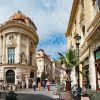
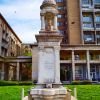
In recognition of his exceptional contribution, a street in the center of the Capital bears his name: Engineer Anghel Saligny Street. It is located in a historic area of Bucharest, near Calea Victoriei and Doamnei Street, in a perimeter filled with buildings of architectural and symbolic value. Its placement in the heart of the city represents a discreet but significant tribute paid to the one who united, through bridges, entire regions of the country.
A legacy that crossed time
Anghel Saligny’s legacy goes beyond the limits of an era. The Cernavodă Bridge, the railway works, and the port modernization are proofs of an exceptional engineering mindset. He demonstrated that through rigor, courage, and vision, Romania could accomplish constructions comparable to the greatest European projects.
Considered the favorite of King Carol I, Anghel Saligny was more than an engineer. He was an architect of Romania’s modernization, a pioneer of technology, and a symbol of determination in the face of natural and technological challenges.
His name remains linked to an era in which infrastructure became the foundation of national development. And the fact that a street in the center of Bucharest bears his name is proof that his memory continues to be honored, as it should be, by the generations who today benefit from the legacy left by this genius of Romanian engineering.
We also recommend: Famous Boulevard Names: Theodor Pallady Abandoned Engineering to Become One of Romania’s Greatest Painters