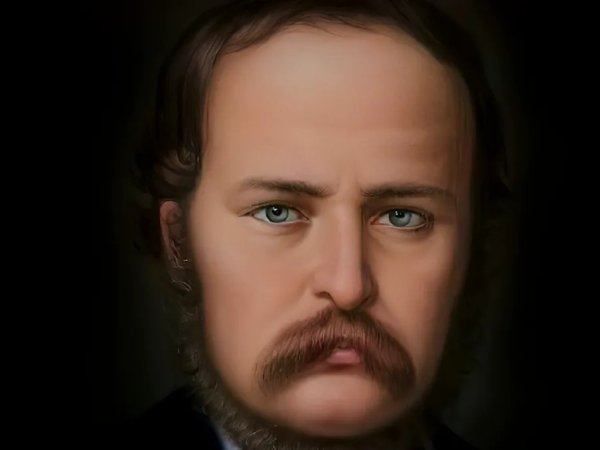
Andrei Mureșanu, the celebrated poet who wrote the national anthem “Awaken thee, Romanian!” has a street bearing his name in Bucharest
- Articles
- 13 JAN 26
Few names in Romanian culture are as closely linked to national identity as that of Andrei Mureșanu. Poet, publicist, and participant in the 1848 revolutionary movement, he has remained in the collective consciousness especially through the poem “Un răsunet” (“A resounding call”), which later became the national anthem of Romania. His verses, written in a tense historical context, went beyond the boundaries of literature and turned into a symbol of the awakening of national consciousness. Today, the memory of Andrei Mureșanu is honored not only through textbooks and official ceremonies, but also through a street in Bucharest that bears his name, a sign of lasting recognition of his contribution to Romanian history and culture.
The origins and childhood of the poet
Andrei Mureșanu was born in Bistrița, into a modest family of peasants. His father, Teodor Mureșanu, leased a bark-tanning mill, an activity through which he managed to provide for his family, made up of three children. Although the material conditions were far from favorable, the family environment encouraged education and hard work, elements that were to play an essential role in shaping the future poet.
He attended his first years of schooling in his native town. In 1825, Andrei Mureșanu was admitted as a pupil to the Saxon Normal School in Bistrița, where he quickly distinguished himself through intelligence and discipline. Later, he continued his studies at the Piarist high school in the same town, being regarded as one of the best students. These academic results paved the way for a solid intellectual formation, at a time when access to education was limited for many young Romanians in Transylvania.
The student years in Blaj and the meeting with George Barițiu
In 1832, Andrei Mureșanu arrived in Blaj, an important cultural and spiritual center of the Transylvanian Romanians. Here, with the support of Professor Nicolae Marin, he studied philosophy for two years, after which he pursued theology. The intellectual atmosphere in Blaj, dominated by national and Enlightenment ideas, had a major impact on his formation as a poet and publicist.
Also in Blaj he met George Barițiu, a fellow student a few years older, who was to become one of his most important friends and collaborators. Barițiu coordinated a Romanian-language theater troupe, and this cultural initiative brought Mureșanu closer to the world of art and the written word. The friendship between the two grew stronger over time and continued in Brașov, decisively influencing the poet’s professional path.
Settlement in Brașov and teaching activity
In 1837, George Barițiu left Blaj and took over the leadership of the Romanian school in Brașov. Wishing to have him close, he thought of bringing Andrei Mureșanu there as well. Although Mureșanu was still a student in his final year, Barițiu managed to obtain a dispensation that allowed him to enter the educational system without having completed his studies.
Thus, in 1838, Andrei Mureșanu settled in Brașov, where he became an instructor at the Romanian school led by Barițiu. Two years later, in 1840, he was appointed professor at the Romanian gymnasium, a position he held until 1849. At the same time, he began to collaborate intensively with the publications coordinated by his friend, publishing poems and articles. His poetic debut took place in the magazine “Foaia pentru minte, inimă și literatură” (“The paper for mind, heart, and literature”), one of the most important cultural journals of the period.
The birth of the anthem “Awaken thee, Romanian!”
The most important moment in Andrei Mureșanu’s creation is linked to the poem “Un răsunet.” Written in Brașov, to the anonymous melody of an old religious hymn known as “Din sânul maicii mele” (“From my mother’s womb”), the text quickly gained exceptional mobilizing power. Nicolae Bălcescu would call it “the Marseillaise of the Romanians,” emphasizing its revolutionary character.
The poem reflects the social and political turmoil of the time, calling for unity, dignity, and action. In 1848, Andrei Mureșanu was among the leaders of the Revolution, and “Un răsunet” became the march of the Romanian revolutionaries in Transylvania. In 1990, this poem was officially adopted as the national anthem of Romania, under the title “Deșteaptă-te, române!” (“Awaken thee, Romanian!”), definitively consecrating the poet’s place in national history.
After the revolution: captivity and civil service
The defeat of the 1848 Revolution brought difficult years for Andrei Mureșanu. In 1849, together with George Barițiu, he crossed into Wallachia, where he was taken prisoner by the Tsarist army and carried as far as northern Moldavia. This traumatic experience deeply marked his life.
After his release, he settled in Sibiu, where he was employed as a civil servant, as a “government clerk,” and as a translator of Romanian for the Official Bulletin of the government. He also collaborated with the local newspaper “Telegraful român” (“The Romanian Telegraph”), where he published poems and articles with an educational role, aimed at initiating the reading public into various branches of art. However, office work weighed heavily on his spirit, and his poetic activity remained relatively limited, although it retained all the traits of the 1848 generation’s lyricism, with patriotic and social accents.
The final years, poverty, and late recognition
Andrei Mureșanu retired in 1861, but his pension was insufficient to support his family. In 1862, he published his poems in a volume, hoping that its sale would bring him both moral comfort and some financial relief. Unfortunately, the books sold poorly, and the poet fell into deep poverty.
Iacob Mureșanu launched public appeals in “Gazeta Transilvaniei” to help the sick and destitute poet, urging the Romanian public to buy his volume. The “Astra” Society awarded Mureșanu a prize of 50 gold coins, a gesture of recognition, but insufficient to change his dramatic situation.
The death and memory of Andrei Mureșanu
Andrei Mureșanu died on the night of October 11 to 12, 1863, in Brașov, in poverty, “as a result of a prolonged nervous illness,” as recorded by “Gazeta Transilvaniei.” He left behind a grieving family: his wife Suzana, his son Gheorghe, a seventh-grade student, and a daughter of only 11 months, Eleonora.
His funeral took place with great pomp, attended by a large public, teachers, and students, who accompanied the coffin with torches and decorations. George Barițiu describes in his monumental work dedicated to the history of Transylvania the circumstances of his friend’s death, speaking about the profound melancholy that overwhelmed him and turned into a fatal mental suffering.
Today, Andrei Mureșanu remains one of the fundamental figures of Romanian culture. The street in Bucharest that bears his name is not only an urban landmark, but also a symbol of gratitude toward the poet who gave Romanians their anthem and transformed poetry into a cry for national awakening.
We also recommend: The story of Romania’s first national anthem. It was chosen through a competition that offered a prize of 100 guilders