8 People who shaped Bucharest – between construction and destruction
- Articles
- 19 FEB 26
Bucharest was not built in a single era, nor shaped by a single vision. It is the result of political, urban, and cultural decisions that overlapped, contradicted one another, and at times destroyed each other. Some gave the city coherence and direction. Others started over from scratch, without asking what would be left behind.
The result is a city that is difficult to read at a glance — layered, contradictory, fascinating precisely because it does not resemble anything carefully planned. Every street, every building preserved or demolished, says something about who held the power to decide and what they chose to do with it.
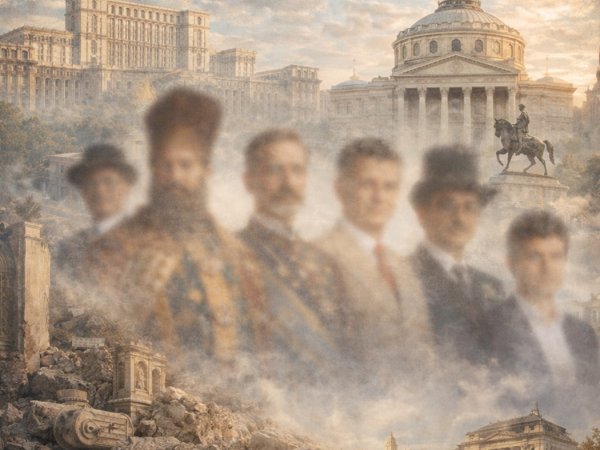
Here are eight figures who changed what Bucharest is today.
1. Constantin Brâncoveanu (r. 1688–1714)
Political consolidation and cultural affirmation
During the reign of Constantin Brâncoveanu, Bucharest strengthened its role as the capital of Wallachia. The Princely Court was expanded, and the Brâncovenesc style — a synthesis of Byzantine, Ottoman, and Renaissance influences — began shaping the architectural language of the period.
Although many original structures no longer survive in their initial form, Brâncoveanu’s era contributed significantly to the cultural and aesthetic identity of the city.
Impact: Political consolidation and early cultural definition of the capital.
2. Barbu Dimitrie Știrbei (r. 1849–1856)
Early administrative modernization
In the mid-19th century, Bucharest began transitioning from a loosely organized urban settlement into a more structured European city. Under Știrbei’s rule, early modernization efforts included improvements in public lighting, infrastructure, and administrative organization.
These reforms laid groundwork for systematic urban development.
Impact: Initiation of Bucharest’s modernization process.
3. Carol I (r. 1866–1914)
Westernization and the “Little Paris” era
Under King Carol I, Bucharest underwent one of its most significant transformation periods. Major public buildings and institutions were constructed or completed during this era, including:
– The Romanian Athenaeum
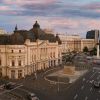
– The CEC Palace
– The Royal Palace
– Expansion and modernization of major boulevards
Infrastructure improvements and architectural investments gave Bucharest a distinctly Western European character, contributing to its nickname, “Little Paris.”
Impact: Structural modernization and consolidation of Bucharest as a European capital.
4. Ion Mincu (1852–1912)
Defining a national architectural identity
Architect and theorist Ion Mincu is considered the founder of the Romanian Revival (Neo-Romanian) style. At a time when Bucharest heavily adopted Western architectural models, Mincu proposed a design language inspired by traditional Romanian architecture.
Buildings such as the Central Girls’ School and the Lahovari House helped shape a distinct national aesthetic within the urban landscape.
Impact: Establishment of a Romanian architectural identity within a rapidly Westernizing city.
5. Duiliu Marcu (1885–1966)
Institutional modernism and state architecture
An influential architect during the interwar period and beyond, Duiliu Marcu shaped many institutional buildings in Bucharest. His style evolved from modernism to a more monumental and austere architectural expression aligned with state representation.
His work contributed to defining the official architectural image of the Romanian state within the capital.
Impact: Formalization of institutional and governmental architecture.
6. Aristide Blank (1883–1960)
Economic expansion during the interwar period
As a prominent banker and investor, Aristide Blank played a significant role in the economic growth of interwar Bucharest. The interwar years represented one of the city’s most dynamic development periods, marked by private investments, financial growth, and architectural expansion.
This era reinforced Bucharest’s cosmopolitan identity before World War II.
Impact: Economic acceleration and urban expansion during the interwar boom.
7. Nicolae Ceaușescu (1965–1989)
Radical demolition and urban restructuring
Any serious analysis of Bucharest must address the impact of Nicolae Ceaușescu’s regime. In the 1980s, extensive areas of historic neighborhoods were demolished to construct the Civic Center and the House of the People (now the Palace of Parliament). Entire districts, churches, and heritage buildings were destroyed. The city’s central urban structure was permanently altered.
Impact: Massive destruction of historical fabric and ideological reshaping of the city’s core.
8. Nicușor Dan (urban activism post-2006; Mayor since 2020)
Urban regulation and heritage protection
In the post-communist era, Bucharest faced rapid and often chaotic real estate development. Urban activism beginning in the 2000s — followed by Nicușor Dan’s mayoral mandate — emphasized legal protection of heritage buildings and stricter regulation of construction permits. Regardless of political interpretation, his impact on urban legal frameworks and heritage debates has been significant.
Impact: Attempted stabilization and protection of Bucharest’s architectural heritage amid development pressures.
Conclusion
Today’s Bucharest is what remains after eight different visions imposed on the same city. Some layers are still visible — in the façades downtown, in the wide boulevards, in the buildings that survived multiple regimes. Others have disappeared, yet their absence is just as present — in the empty spaces between apartment blocks, in churches moved a few meters to escape the bulldozer, in neighborhoods that now exist only in photographs.
What makes Bucharest difficult to grasp is precisely this: it never had the time to become just one thing. It was always in the middle of something — a modernization, a demolition, a reconstruction. And every person who held the power to reshape it left behind both what they built and what they destroyed.
Also recommended Bucharest’s Mayors: From Communism to the Present Day