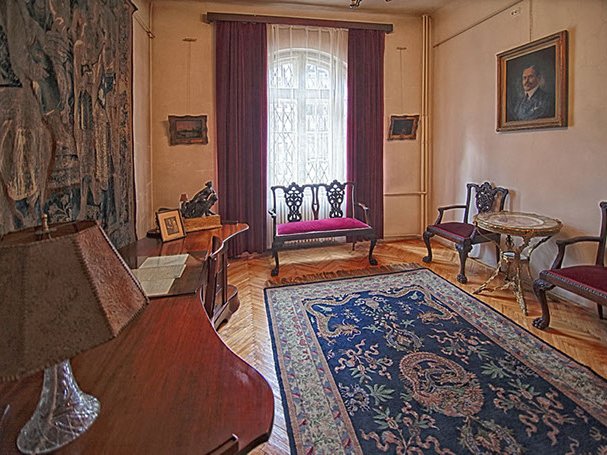
Victor Babeș died in 1926, yet the Institute of Bacteriology he founded in Bucharest still bears his name today, as does the genus of parasites he discovered — Babesia — present in every microbiology textbook in the world. The world's first bacteriology treatise, written by him in 1885 alongside the French scientist Victor André Cornil, is on display in an interwar villa in the Dorobanți neighbourhood, at Strada Andrei Mureșanu nr. 14A — not in a museum built in his memory after the fact, but in his son's home, donated to the state precisely so that the scientist's belongings could remain together and accessible to the public.
A scientist with a European biography
Born in 1854, Victor Babeș built his scientific formation by moving through some of the most important medical centres in nineteenth-century Europe. He studied medicine in Budapest and Vienna, where he completed his doctorate, pursued further specialisation in Berlin and Munich, then worked in Paris alongside Louis Pasteur — the founder of modern microbiology. This trajectory placed him from the outset at the heart of the most dynamic medical discipline of the era.
Returning to Romania, he founded the Institute of Bacteriology in Bucharest and taught for four decades, training generations of doctors and researchers. His scientific work encompasses the discovery of over 50 pathogenic microbes, viruses and parasites, fundamental contributions to the development of modern serotherapy and, above all, the world's first bacteriology treatise — published with Victor André Cornil and considered the founding document of bacteriology as an autonomous scientific discipline. In 1893 he was elected full member of the Romanian Academy, and France awarded him the rank of Officer of the Legion of Honour.
A house donated twice
The villa on Strada Andrei Mureșanu was built between 1928 and 1929 by Mircea Babeș, the scientist's son and a Romanian diplomat posted in Warsaw, Ottawa and Moscow. Mircea gathered his father's belongings from the Institute of Bacteriology apartment where Victor Babeș had lived from 1887 until his death, and brought them to his own home, where he kept them carefully for nearly three decades.
In 1956, at the suggestion of C.I. Parhon — himself a former student of Victor Babeș and one of the founders of Romanian endocrinology — Mircea donated the ground floor of the house to the Romanian state for the creation of a memorial museum, which he personally directed until his death in 1968. Eighteen years later, in July 1986, his wife Sofia left the first floor of the house to the Bucharest City Hall in her will, completing the donation and integrating the entire building into the museum circuit. The building, constructed in the eclectic style characteristic of the 1920s, was reopened to the public in November 2018, following a complete reorganisation of the permanent exhibition.
What you find inside
The exhibition carries the title "Victor Babeș (1854–1926). Principles, Values, Legacies" and traces the scientist's life and work chronologically, from his childhood in Lugoj to his major discoveries. The three ground-floor rooms and two rooms on the upper floor hold scientific manuscripts, original correspondence, photographs, diplomas, titles and medals, Babeș' personal microscope, his death mask, his personal library, family furniture and a collection of seventeenth-century Italian school paintings.
The 1885 bacteriology treatise — the first medical book of its kind in the world — is displayed alongside the scientist's other publications, providing the context needed to understand the true scale of his contribution. On the upper floor, visitors have access to a documentary film about Victor Babeș' life and an interactive game. A guided tour remains the recommended option for anyone who wants to understand more than a label can convey.
Practical information
Opening hours: Wednesday – Sunday, 10:00 – 18:00 (last entry 17:30)
Admission:
- 20 lei — adults
- 10 lei — students, retirees, military personnel, organised groups
- Free — children under 7
- 20 lei per person — guided tour
Free admission: on the first Saturday of every month
Bus lines: 131, 182, 282, 301, 330, 331, 335