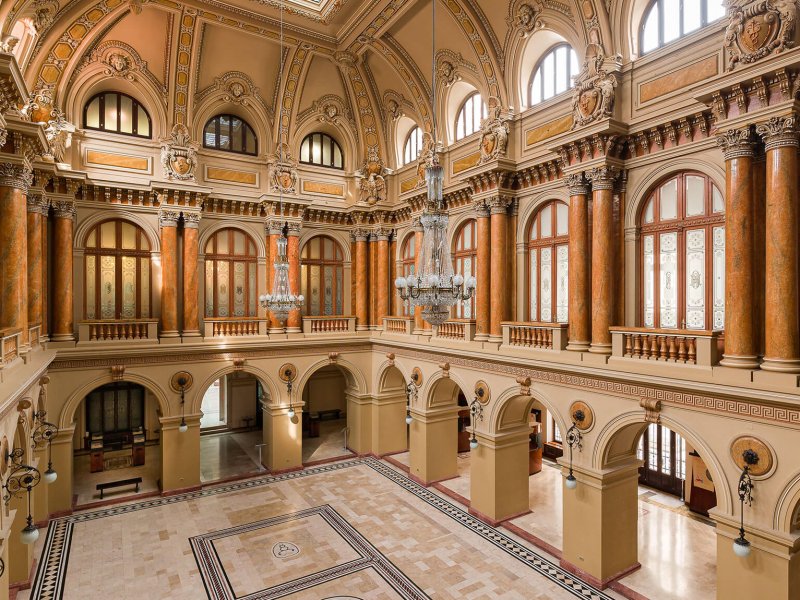
The National Bank of Romania Museum operates inside the Old Palace of the NBR, at Strada Lipscani 25, in Sector 3. The building went up between 1884 and 1890, designed by French architects Cassien Bernard and Albert Galeron, with construction overseen by Romanians Grigore Cerchez and E. Băicoianu. Many consider it the most beautiful building in Bucharest's old center, built during the era when the city was known as "Little Paris."
The idea of a museum dates back to 1914, but organizing it properly only started in 1933, with the first exhibition opening to the public in July 1943. The collection moved several times over the decades — at one point it sat with the Romanian Academy, after the space was taken over by the Ministry of Finance — and only returned to the palace for good in 1997, when the museum officially reopened on May 3. The building's last major restoration took place between 1992 and 1994.
The collection includes coin series issued by the NBR over the years, jubilee and commemorative coins, banking documents, official seals, and a portrait gallery of all the bank's governors. Visits are guided only, run about an hour, and cover both the building's history and the evolution of Romania's banking system.
Entry is free, but booking ahead is mandatory — ideally at least two days in advance, by emailing muzeul@bnro.ro with your name, ID number, and preferred time slot. Since it's the headquarters of a central bank, the building operates under strategic-site security: visitors go through a security check at the entrance and need to bring ID. Photography is allowed throughout the tour at no extra cost.
Beyond the Lipscani headquarters, the NBR also runs a treasury museum at Tismana Monastery, along with traveling exhibitions organized periodically through its regional branches across the country.