Who sculpted the Broken Violin Fountain. The history of one of Bucharest’s most spectacular monuments
By Bucharest Team
- Articles
Bucharest is a city of contrasts, where history, modernity, and contemporary art meet at every step. Among the old buildings, crowded boulevards, and urban spaces in constant transformation, there are monuments that manage to offer moments of calm and reflection. One of these is the Broken Violin Fountain, an artistic work that over time has become a cultural and visual landmark of the capital.
An urban artwork with its own identity
This fountain impresses not only through its size or location but especially through the artistic message it conveys. It is a work that combines the symbolism of music with the expressive power of sculpture and the continuous movement of water, creating a unique experience for anyone who stops in front of it.
The Broken Violin Fountain cannot be seen as a simple decorative element placed in a public space. It belongs to the category of contemporary urban art, intended to interact directly with passersby and provoke emotions. Through its unusual form and the message it conveys, the monument immediately stands out from the classic patterns of ornamental fountains.
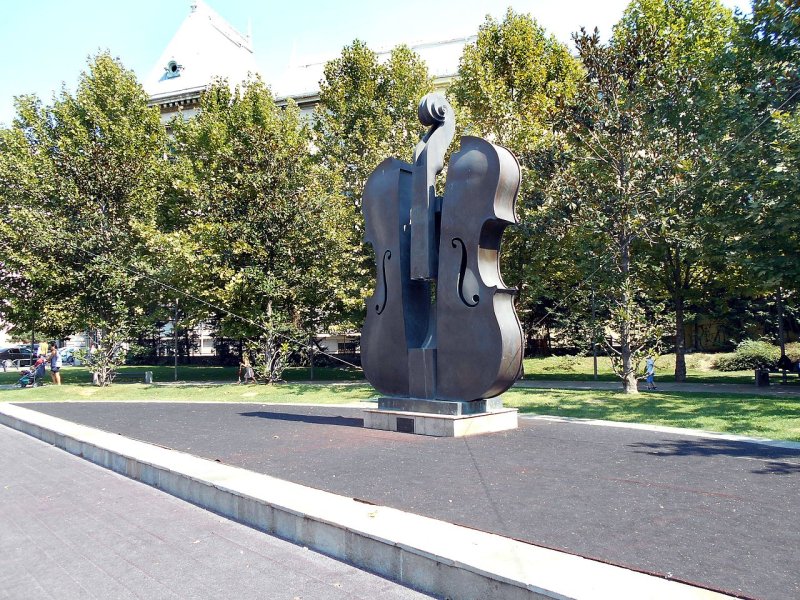
The work is designed to attract the attention even of those who are not particularly passionate about art. The form of a large violin, seemingly damaged, sparks curiosity and invites interpretation. Every detail seems intended to suggest both fragility and the continuity of artistic creation.
Sculptor Ioan Bolborea and his artistic vision
The author of the Broken Violin Fountain is the Romanian sculptor Ioan Bolborea, one of Romania’s most appreciated contemporary artists. Known for his monumental works placed in public spaces, Bolborea has constantly sought to create works that communicate with the general public, not only with art specialists.
In his creations, the artist often combines traditional elements with modern forms of expression. The Broken Violin Fountain fits perfectly into this artistic direction, being a work that speaks about emotion, fragility, and the power of the creative spirit. For Ioan Bolborea, sculpture is not just form but also story, and this fountain tells a deeply human one.
The symbol of the broken violin and its emotional message
At first glance, the idea of a broken violin may seem paradoxical, especially in a monument dedicated to art and beauty. Yet precisely this contradiction gives the work its symbolic strength. The violin, an instrument associated with harmony and sensitivity, appears here fragmented but continues to “play” through water.
The metaphor is a powerful one: music, like art, cannot truly be destroyed. Even when the instrument is damaged, the emotion remains alive. The water flowing from the body of the violin suggests tears, intense feelings, and the deep connection between the artist and the audience.
This interpretation makes the fountain appreciated not only by tourists but also by musicians and art lovers, who find in it a reflection of their own experiences.
Sculptural composition and the play of water
Visually, the fountain consists of an oversized violin, placed on a solid stone base. Beside it is the bow, captured in a dynamic position, as if in mid-motion. This illusion of a suspended gesture gives the monument a sense of life.
Water plays an essential role in the ensemble. It jets from multiple points of the violin, flows, collects, and spills, emphasizing the idea of a melody that never stops. The constant movement transforms the sculpture into a living spectacle, different depending on the time of day.
By integrating the aquatic element, the artist succeeded in adding depth and dynamism to a work that would otherwise be static.
A place of relaxation in the heart of the city
The placement of the Broken Violin Fountain was carefully chosen in a central area of Bucharest, easily accessible to pedestrians. Around it are cafes, restaurants, and green spaces, which make the area ideal for short breaks or moments of relaxation.
During the day, sunlight reflects on the water’s surface and the sculpture’s material, creating subtle plays of light and shadow. The atmosphere is calm, and the sound of water softens the city’s noise. Many Bucharest residents choose to stop here for a few moments of respite.
At night, architectural lighting completely changes the perception of the monument. The details of the violin are highlighted, and the entire ensemble gains an almost theatrical aura.
The fountain as a tourist attraction
In recent years, the Broken Violin Fountain has become one of the most photographed urban landmarks in Bucharest. Tourists often discover it by chance and are impressed by its originality. Selfies and photos taken here constantly circulate on social networks, contributing to the monument’s popularity.
For visitors, the fountain represents a welcome stop on a busy urban route. It offers a visual experience different from classic historical monuments and demonstrates that Bucharest can also impress through high-quality contemporary art.
At the same time, the site has become a meeting point for locals, an easily recognizable landmark, and a space with its own identity.
Between tradition and modernity
One of the great merits of the Broken Violin Fountain is its ability to create a bridge between past and present. The violin, an instrument with a long history in European and Romanian culture, is reinterpreted in a modern, unconventional form.
This combination conveys the idea that tradition should not be rigidly preserved but creatively reimagined. The monument demonstrates how contemporary art can harmoniously coexist with classical values, without canceling them, but rather giving them a new meaning. In this way, the fountain becomes an expression of the city’s cultural vitality and its capacity for reinvention.
Access and integration into urban routes
The Broken Violin Fountain is located in central Bucharest and can be easily reached on foot, especially from the University Square area or Calea Victoriei. For those using public transport, the nearest metro station is Universitate on the M2 line.
From the station exit, the walk to the fountain takes about five minutes, making it easy to include in any central city stroll. Due to its location, the monument is frequently included in guided tours dedicated to cultural Bucharest.
A contemporary symbol of the capital
Over time, the Broken Violin Fountain has surpassed its status as a mere artistic object. It has become a symbol of the modern city, a landmark that speaks about creativity, emotion, and dialogue between people and urban space.
Its presence reminds us that art does not need to be isolated in museums but can be part of daily life. Each passerby is free to interpret it in their own way, and this openness is perhaps the monument’s greatest quality.
An outdoor cultural experience
In essence, the Broken Violin Fountain is not just a fountain or a sculpture. It is an outdoor cultural experience, a place where music takes form and water becomes an artistic language. Through symbolism, placement, and visual impact, the work manages to provide a moment of emotion in an always busy city.
For Bucharest residents, it represents part of the contemporary urban identity. For tourists, it is a surprising discovery. And for art lovers, it remains proof that beauty can appear in the most unexpected forms, even from a broken violin that symbolically continues to play.
We also recommend: Miorița Fountain, the legendary monument and the most famous ballad in the history of Romanian literature