The CFR Museum in Bucharest and the history of the Romanian railway network. What fabulous exhibits you can visit here
By Bucharest Team
- Articles
The Romanian Railways Museum in Bucharest is one of those places less known to the general public, but with remarkable historical and cultural value. Located on Calea Griviței, no. 193 B, in the immediate vicinity of the North Railway Station, the museum offers a comprehensive journey into the history of the Romanian railway network and into the essential role that the railway played in the economic, social, and cultural development of modern Romania. Visiting this space actually means discovering one of the main forces that contributed to the emancipation and modernization of Romanian society.
The idea of a railway museum and the first steps toward its establishment
The idea of creating a museum dedicated to Romanian railways appeared as early as the interwar period and was supported by prominent figures in the field. General Mihail Ionescu, former General Director and President of the Board of Directors of the Romanian Railways, as well as engineer Ion Macovei, General Director of CFR, were among those most concerned with the need to preserve railway heritage.
As early as 1924, inspector general engineer Theodor Bals was the first to propose preserving documents, objects, and materials that reflected the birth and evolution of the railways in Romania. He understood the importance of these testimonies not only for history, but also for the training of future generations of railway workers. In 1937, Theodor Bals also signed the official order deciding the establishment of a railway museum, with a dual purpose: the professional education of CFR staff and the promotion of the institution to the general public.
The first CFR Museum and the destruction of the war
On June 10, 1939, the first railway-specific museum in Romania was inaugurated, known at that time as the Railway Workers’ Museum. Its opening took place on the occasion of the great celebration Ceferiada, organized to mark the 70th anniversary of the inauguration of the Bucharest–Giurgiu line, the first railway line on the territory of Romania.
The museum was located in the Giulești Stadium area, with exhibits displayed in a hall arranged under the stands and on the tracks in the stadium’s courtyard. Unfortunately, the fate of this first museum was tragic. On April 4, 1944, the bombings carried out by American aviation on the North Railway Station complex severely damaged the museum, destroying a large part of the exhibits. The objects that survived were moved to a hall in the basement of the CFR Administrative Palace, which was under construction at the time.
Saving the heritage and the rebirth of the museum
In parallel with these efforts, Professor Engineer Dimitrie Leonida agreed to host part of the CFR Museum’s exhibits within the Technical Museum in Carol Park. Some of these pieces are still there today, as proof of an essential collaboration for saving railway heritage. Nevertheless, the railway museum, in its initial form, was closed.
Only in the 1950s did the idea of re-establishing a railway museum reappear. This time, a building located in the immediate vicinity of the North Railway Station was chosen. On February 1, 1953, the building was called the House of Railway Technology and housed both the Technical Museum of Transport and the current Railway Museum.
The museum during the Stalinist period and its reconfiguration
Reopened during a period marked by Stalinist influence, the museum was initially arranged in five rooms on the ground floor of the building. The exhibition content reflected rather the achievements of the Soviet Union and the ideology of class struggle, than the real history of Romanian railways. This approach distanced the museum from its original purpose, turning it into a propaganda tool.
Starting in 1960, the museum was again closed for rearrangement. The decisive moment came in 1969, when, on the occasion of the anniversary of the Bucharest–Filaret–Giurgiu line, the museum was officially reopened on October 31, returning to genuine museum activity focused on national railway history.
Recent transformations and the spectacular diorama
Over time, the CFR Museum underwent numerous changes, some of which led to the reduction of exhibition spaces. In 2004, the Railway Museum passed from the subordination of the railway infrastructure company to that of the National Railway Training and Qualification Center – CENAFER, a move that opened new perspectives for modernization.
A landmark moment was the inauguration, in December 2011, of the railway diorama in the main hall. Considered the largest railway diorama in Romania, it measures 14.4 x 4 meters and includes approximately 260 meters of tracks arranged on three levels. The diorama is fully automated and represents the museum’s main attraction, significantly contributing to the increase in the number of visitors.
The museum halls and outstanding exhibits
The main hall houses impressive models of locomotives and wagons at a scale of 1:20, created in the 1950s and 1960s and fully restored. Among the most valuable pieces is the model of the famous Pacific steam locomotive. Also here can be admired unique original plates that were once mounted on historic locomotives produced by Maffei, Hanomag, or Reșița.
The middle hall offers an insight into railway activity in the 19th century, through the exhibition of a dispatcher’s desk equipped with all the specific apparatus of the era. Visitors can see a Siemens-Halske clock system, old tools used for railway maintenance, and a mechanical tricycle, known as a handcar, used by track inspectors between the two World Wars.
The Saligny hall and the immersive experience
Through a small tunnel, one reaches the third hall, known as the Saligny Hall, where objects of exceptional historical value are displayed. From this hall, access is provided to a mini screening room, arranged like a true railway cinematheque, where films from the museum’s photo archive are shown.
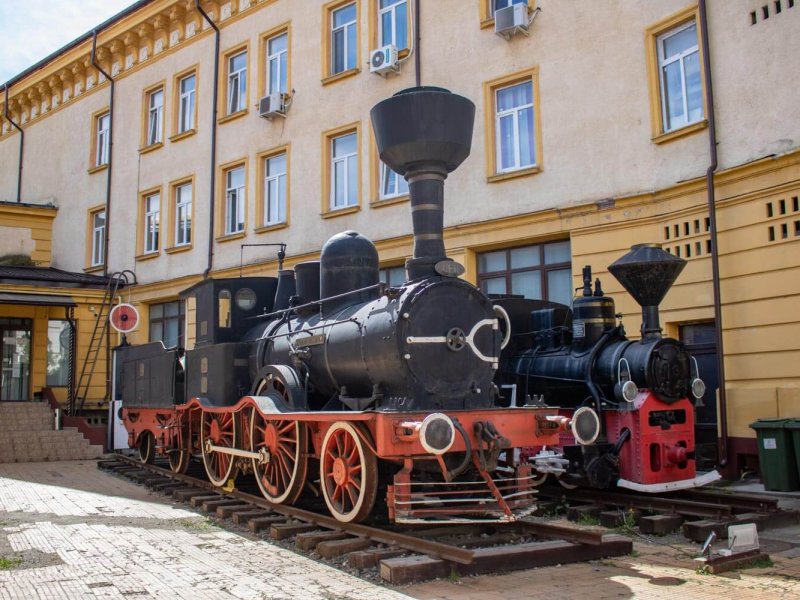
Between the halls, train compartments from the interwar period have been recreated, and video images run on the windows to recreate the atmosphere of traveling by train. In the museum’s inner courtyards, two narrow-gauge steam locomotives can be admired, along with photographs, documents, decrees, uniforms, books, and railway brochures.
A journey through time for visitors
A particularly special exhibit is the first reconstructed train set that operated the first railway journey in Romania, featuring the locomotive Călugăreni. It ran between 1869 and 1900 on the Bucharest–Giurgiu line. The railway diorama, with landscapes of plains and hills, tunnels, bridges, and signals, completes the visitors’ experience.
The museum was reopened to the public in 2012, after a long period during which access was restricted. For visiting, the use of public transport to the North Railway Station is recommended, with entry through the gate on platform 14, except on legal holidays.
We also recommend: The National Military Museum “King Ferdinand I”, a century of history and honor. The story of one of the most beautiful museums in Bucharest