Saint Spyridon the New Church, the second largest Orthodox church in Bucharest, was founded 260 years ago by Prince Scarlat Ghica
By Bucharest Team
- Articles
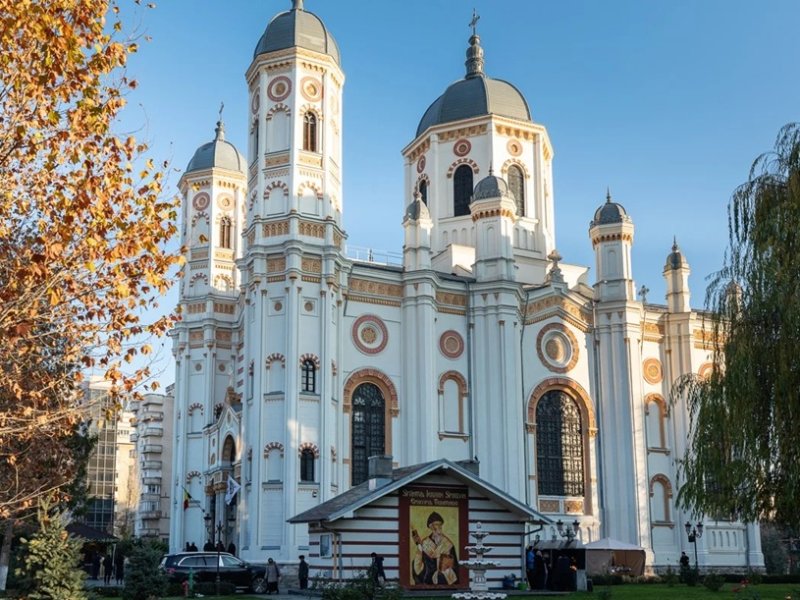
In the heart of Bucharest, on Șerban Vodă Road, not far from Unirii Square, rises one of the Capital’s most imposing and historically charged churches: Saint Spyridon the New Church. The building is not only an architectural and spiritual landmark, but also a witness to the political, social, and religious upheavals that have shaped Wallachia for more than two and a half centuries. The second largest Orthodox church in Bucharest, after the Cathedral of the Salvation of the Nation, Saint Spyridon the New combines monumentality with a story of resilience, faith, and continuity.
The foundation stone and the princely endowment of Scarlat Ghica
The history of the church is recorded right at its entrance, through the foundation inscription stone, a true birth certificate of the edifice. The text, deeply imbued with theological and historical meaning, speaks about the duty of every Christian to build the house of God on earth and about the devotion of the ruler of Wallachia, Scarlat Ghica, son of Prince Grigorie Ghica.
Desiring to glorify the name of God, “worshipped and praised in the Holy Trinity,” Scarlat Ghica decided to raise from the foundations a temple dedicated to Saint Hierarch Spyridon, Bishop of Trimythous, renowned as a miracle worker.
Construction began in the second year of his reign, in 1767, and was completed in 1768, on September 30, during his second reign. In order for the church to endure “in all its beauty and true faith,” it was later endowed with funds and permanent donations by Alexandru Ghica, son of Grigorie Ghica, considered the first benefactor. Thus, Saint Spyridon the New came into being as an expression of princely faith and responsibility toward the spiritual life of the community.
From princely monastery to monumental church
On the site of the present church there existed, until 1852, a princely monastery, about which very few details have been preserved. This lack of information only adds to the aura of mystery surrounding the place. Between 1852 and 1858, the old monastic ensemble was replaced by the current building, much larger and far more ambitious from an architectural point of view.
The new church was consecrated on November 8, 1860, marking an important moment in the religious life of Bucharest. Its impressive dimensions quickly turned it into a major urban landmark, and its liturgical and symbolic role continued to grow in the decades that followed.
A church tried by earthquakes and war
Over time, Saint Spyridon the New Church suffered numerous damages, caused both by natural disasters and by dramatic historical events. The earthquake of 1940 seriously affected the structure of the building, and the bombings of 1944, which heavily struck Bucharest, caused additional destruction.
During the time of His Beatitude Justinian, extensive restoration works were initiated, meant to save the edifice and restore its stability. After the completion of these works, in 1954, the church was re-consecrated by His Beatitude Justinian of Romania and His Beatitude Kiril of Bulgaria. On this occasion, Saint Spyridon the New was designated as a Patriarchal Chapel, becoming the place where events of great importance for the Romanian Orthodox Church take place, such as the ordination of auxiliary bishops, enthronements, high-level ecclesiastical visits, and the consecration of the Holy Chrism.
The danger of demolition and salvation during the communist period
A new difficult chapter in the history of the church opened after the 1977 earthquake, when the building once again suffered significant damage. The situation was worsened by the construction works of the Bucharest subway, which affected the church’s structural resistance. In this context, the communist regime placed the church on the list of buildings scheduled for demolition, as part of the urban systematization policy.
Saint Spyridon the New was saved once more through the intervention of His Beatitude Teoctist, who had been ordained in this very church on March 5, 1950. At his initiative, the church was repaired and beautified, and the final consecration took place in 1990, after the fall of the communist regime. This act of salvation transformed the church into a symbol of spiritual resistance in the face of ideological pressure.
Eclectic architecture and impressive dimensions
Saint Spyridon the New Church impresses through a distinctive architectural plan, rarely encountered in Bucharest. The building features a central dome and two massive towers at the front, which give it a monumental appearance. Its dimensions are remarkable: 41 meters in length, 14 meters in width, and 38 meters in height, which explains its status as the second largest Orthodox church in the Capital.
The architectural style is eclectic-historicist, harmoniously combining Neo-Romanesque, Neo-Gothic, and Moldavian artistic elements. This blend gives the construction a unique identity, situated at the boundary between tradition and modernity, characteristic of the 19th century.
The interior: art, light, and spirituality
The interior of the church is just as impressive as the exterior. Marble columns give the space a solemn and elegant air, while the colored stained-glass windows, made in Vienna, immediately attract attention. They depict biblical scenes and saints, filtering the light in a way that creates a deeply contemplative atmosphere.
The mural painting, executed in 1862 by Gheorghe Tattarescu, is another element of great artistic value. In these frescoes, clear influences of the Renaissance can be observed, both in the treatment of the figures and in composition and color. Tattarescu’s work transforms the interior of the church into a true museum of religious art, without diminishing its liturgical function.
A historical monument and a landmark of Bucharest
Today, Saint Spyridon the New Church is listed as a historical monument, under LMI code B-II-m-A-19750, in recognition of its architectural, artistic, and historical value. More than that, it remains a living space of faith, where past and present constantly meet.
Founded by Scarlat Ghica 260 years ago, tried by earthquakes, wars, and hostile regimes, the church has survived all adversities. Thus, Saint Spyridon the New is not only an imposing construction, but also a symbol of the spiritual continuity of Bucharest and of the profound connection between history, art, and faith.
We also recommend: The White Church in Bucharest, 300 years of history. How the most beautiful holy place on Calea Victoriei came into being