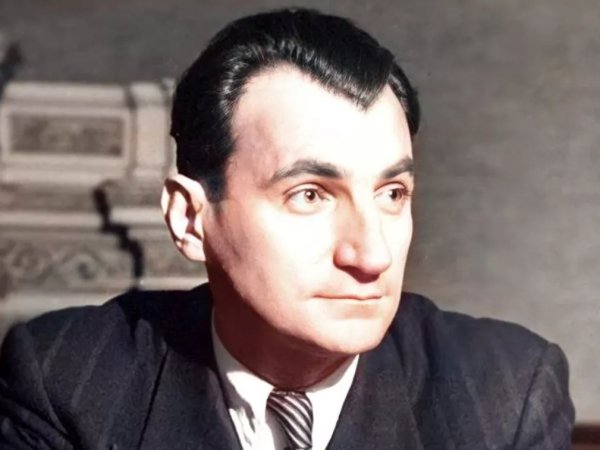
Who was Lucrețiu Pătrășcanu and why does he have a street bearing his name in Bucharest
- Articles
- 17 FEB 26
The figure of Lucrețiu Pătrășcanu remains one of the most controversial and complex in the modern history of Romania. A refined intellectual and jurist, a doctor of economic sciences, and a communist leader who stood at the forefront of the events of August 23, 1944, he had a spectacular destiny: rapid ascent, major political influence, and, in the end, a brutal downfall orchestrated by his own party. Convicted following a Stalinist trial and executed in 1954, Pătrășcanu later became an officially rehabilitated figure, yet never fully detached from the ambiguities of his past. Today, his name is borne by a street in Bucharest, an urban detail that invites reflection upon a character who was, at the same time, an architect of the establishment of communism and a victim of it.
The formation of a Marxist intellectual
Lucrețiu Pătrășcanu was born on November 4, 1900, in Bacău, into a family with intellectual concerns. He pursued higher studies abroad, obtaining a degree in law and a doctorate in economic sciences from the University of Leipzig. Upon returning to the country, he practiced as a lawyer and became a university professor at the Faculty of Law in Bucharest. He was a cultivated man, with solid theoretical training and an intellectual openness rarely encountered among the communist leaders of the era.
In his youth, he was drawn to Marxist ideas, which he embraced with conviction. For some contemporaries, he was “the only authentic Marxist” in Romania, through his theoretical rigor and his ability to interpret doctrine from his own perspective. Unlike other communist leaders formed in clandestinity or in party schools in Moscow, Pătrășcanu possessed a vast culture and connections within traditional political and intellectual circles.
He was arrested in 1940 and 1941, yet avoided prolonged detention. His connections and his bourgeois origin protected him to a certain extent. This distinct positioning – a convinced communist, yet with ties outside the party – would later prove fatal.
August 23, 1944 and the peak moment of his career
The events of August 23, 1944, when King Michael I decided the arrest of Marshal Ion Antonescu and the change of Romania’s alliance in the war, represented the peak of Pătrășcanu’s career. At that moment, the Romanian Communist Party was a marginal formation, without real popular support. Its leaders were either in prisons or in the Soviet Union.
Pătrășcanu became the acceptable communist representative in the political negotiations of the moment. He was appointed minister without portfolio in the government led by General Constantin Sănătescu and was part of the delegation that signed the armistice with the Allies in Moscow, officially formalizing the turning of arms against Nazi Germany.
For a short period, it seemed that he had every chance to become the leader of the Romanian Communist Party. He was visible, cultivated, capable of dialogue with representatives of the Royal House and with the leaders of the historical parties. However, the decisive support did not come from within the country, but from the Kremlin. And there, preferences were directed toward a leader originating from the working class.
The rivalry with Gheorghe Gheorghiu-Dej and the beginning of the decline
After the war, two main factions took shape within the party: the group of the “illegals,” led by Gheorghe Gheorghiu-Dej, and the group of the “Muscovites,” represented by Ana Pauker. Pătrășcanu did not fully belong to either of them.
His intellectualism, popularity, and often arrogant attitude made him uncomfortable. Although he remained Minister of Justice between 1944 and 1948, contributing to the organization of trials against political opponents – including the peasant leaders headed by Iuliu Maniu – his position was becoming increasingly fragile.
He supported and legitimized, from the position of minister, the political purges that eliminated the democratic opposition. He endorsed trials that led to severe convictions, including for officers and liberal leaders. Thus, although he would later be regarded as a victim of the regime, his responsibility in the establishment of the communist dictatorship cannot be ignored.
The Stalinist trial and the execution
In the 1950s, the struggle for power within the party ended with the victory of Gheorghiu-Dej, supported by Moscow. In order to consolidate his authority, it was necessary to eliminate all potential rivals. Pătrășcanu was arrested and subjected to a long, typically Stalinist trial, being accused of espionage in favor of Western powers, treason, and sabotage.
His trial, one of the longest in the history of Eastern European communism, was marked by torture, pressure, and fabricated accusations. Before the court, he refused to acknowledge the charges, adopting a defiant attitude. His last recorded statements express contempt toward the accusations brought against him.
On April 14, 1954, he was sentenced to death. Three days later, on April 17, he was taken out of his cell under the pretext of a walk and executed by a shot to the back of the head at Jilava prison. He was 53 years old.
The rehabilitation and the controversial legacy
After the death of Stalin and the beginning of the de-Stalinization process initiated by Nikita Khrushchev, the Romanian leadership was compelled to reexamine the political trials. Gheorghiu-Dej avoided a direct condemnation of Stalinism, but after his death in 1965, the new leader, Nicolae Ceaușescu, decided on the official rehabilitation of Pătrășcanu in 1968.
This rehabilitation also had a political purpose: the consolidation of his own authority and the distancing from the excesses of the past. Pătrășcanu was presented as a victim of abuses, yet without a profound analysis of his role in the repressive mechanism established after 1945.
Thus, his image remains ambivalent: a brilliant intellectual and a patriot with nationalist accents, but also an active participant in the destruction of Romanian democracy.
Why he has a street bearing his name in Bucharest
The granting of his name to a street in Bucharest reflects this dual perspective. On the one hand, Pătrășcanu is regarded as a victim of Stalinist purges and a symbol of the abuses of the communist regime. On the other hand, he was a man who contributed to the establishment of that regime.
Lucrețiu Pătrășcanu Street is located in Sector 3 of the Capital, in the Titan – Ozana area, near Theodor Pallady Boulevard. It is an important artery that connects residential neighborhoods and industrial zones, bearing the name of a historical figure who decisively marked the course of postwar Romania.
The presence of his name in the public space does not represent a simple glorification, but rather a reminder of the complexity of history. The destiny of Lucrețiu Pătrășcanu illustrates the paradox of a man who believed in an ideology to the end and who, ultimately, was crushed by his own system.
We also recommend: Who was politician Alexandru Lahovari and why does he have a statue in central Bucharest