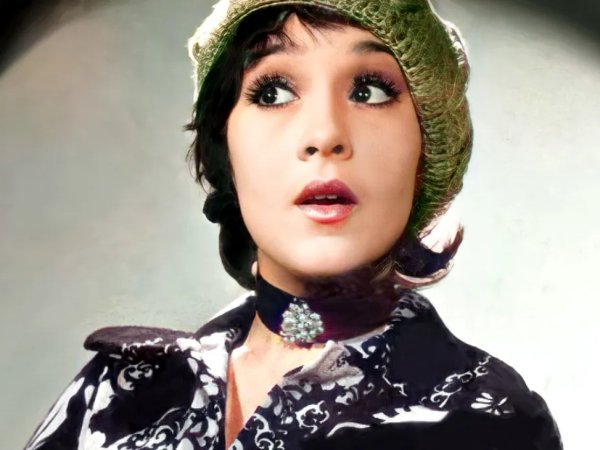
The talented Anda Călugăreanu, the child prodigy of Romanian music. The tragic story of the artist who disappeared far too early
- Articles
- 18 FEB 26
On October 24, 1946, in Bucharest, Anca Miranda Călugăreanu was born, the one who would become known as Anda Călugăreanu, one of the brightest and most sensitive presences of the Romanian stage. She came from a family with Armenian roots on her mother’s side, and her childhood was not without difficulties. After her parents’ divorce, she grew up alongside her father, a career officer, a severe man who imposed strict discipline on her and guided her toward the study of ballet.
Childhood, beginnings and the difficult road to affirmation
The rigorous education did not stifle her artistic nature, but, on the contrary, refined her ambition and rigor. She attended the “Dimitrie Cantemir” High School in Bucharest, where she became actively involved in the school’s theater troupe. During her teenage years, Anda discovered French music and passionately performed songs from the repertoire of Salvatore Adamo and Charles Aznavour. Her voice, warm and expressive, surprised through its maturity, and her interpretations had a special sensitivity.
The road to consecration was not simple, however. She tried several times to be admitted to the Institute of Theatrical and Cinematographic Art (IATC), but she was rejected on the grounds that she was too short. Perseverance always defined her. Only in 1984 did she manage to be admitted, being assigned to the class of actor and director Mihai Mălaimare.
The decisive moment of her debut took place in 1963, when, at only 17 years old, she presented herself at an audition for a soloist position in an Army ensemble. The famous comedian Mircea Crișan immediately noticed her talent and the originality of her voice. Despite obvious pressures to favor another candidate, Mircea Crișan firmly supported her. He was the one who suggested changing her first name from Anca to Anda, to avoid a cacophony, and the artist remained grateful to him all her life, calling him “godfather.”
The spectacular rise and consecration on the great stages
After the experience in the Army ensemble, where she worked for a short period, Anda was promoted to the programs of the Romanian Radio Broadcasting, making numerous recordings. In February 1965, she debuted on Romanian Television in a variety show, performing songs from Adamo’s repertoire, whom she imitated with astonishing naturalness.
Also in 1965 she made her recording debut with a single that contained four French songs and went on stage at the Palace Hall alongside the band “Sincron,” led by Cornel Fugaru. Her talent could not go unnoticed, so she was invited to shows produced by prestigious directors such as Alexandru Bocăneț, Valeriu Lazarov and Tudor Vornicu.
A landmark moment was her participation, on May 22, 1966, in the show “The Man and the Camera,” produced by Valeriu Lazarov and awarded at the International Television Film Festival in Montreux. During that period, Anda formed a remarkable trio alongside Dan Tufaru and Florian Pittiș, and their appearances became memorable.
Consecration came in 1966, at the National Light Music Festival “Mamaia,” where she performed songs that conquered the public and received a Mention for Interpretation. Two years later, in 1968, she represented Romania at the “Golden Stag” Festival in Brașov, alongside Luminița Dobrescu and Mihaela Mihai, being awarded a Mention.
Her international record was enriched with First Prize at the Friendship Festival in Berlin, first place at the Polbit Festival in Budapest and Third Prize at the World Festival of Youth and Students in Sofia. In 1970 she received the Romanian Light Music Record Award for the album “Anda Călugăreanu,” released by Electrecord.
At the Mamaia ’72 Festival she obtained the Popularity Prize for “How Young You Are,” Second Prize for “In the Fourth Row” and a special mention for interpretation. In 1973 she received the Prize of the Union of Composers and Musicologists for the song “The Young.”
Artistic diversity: theater, film and folk music
After 1973, Anda Călugăreanu approached folk music, participating in music and poetry performances, including those of the “Flacăra” Cenacle. She collaborated with artists such as Florian Pittiș, Dan Andrei Aldea and Mircea Vintilă, demonstrating a rare versatility.
On the stage of the Small Theater in Bucharest she shone in the musical “Master Manole” (1977), and in 1984 she played in the musical “Mitică Popescu,” signed by Nicu Alifantis, after the play by Camil Petrescu. She appeared on the stage of the “Nottara” Theater, of the National Theater “I.L. Caragiale” and of the Țăndărică Theater, demonstrating that her talent went beyond the boundaries of light music.
Her unmistakable voice brought to life the character Oache in the film “Maria Mirabela” (1981), directed by Ion Popescu-Gopo. She also appeared in films such as “Poor Ioanide” or “A Day in Bucharest,” and on the radio she performed roles in plays such as “The Quarrels in Chioggia.”
In 1987, Electrecord released the LP “Anda,” on the music of Nicu Alifantis, once again confirming the artistic maturity of the performer.
The last years and the premature passing
On a personal level, Anda was married first to Dan Tufaru, with whom she had a daughter, Ioana, born in 1977. She later remarried, in 1986, to Alexandru Medeleanu.
Between 1990 and 1992 she hosted the children’s show “Club Anda” on TVR 1, alongside the puppet Omidé, and went on tours in Canada and the USA. In her last years she was an acting teacher and had numerous projects in preparation.
In March 1992, after a tour in Israel alongside Stela Popescu and Alexandru Arșinel, she began to feel unwell. The diagnosis was devastating: serious lung problems. She underwent treatments in Greece and in Bucharest, but medicine could no longer do anything. On August 15, 1992, at only 45 years old, Anda Călugăreanu passed away and was buried at Bellu Cemetery.
Friends and colleagues spoke about her with emotion. Horațiu Mălăele remembered with admiration her talent and her friendship, and the writer Dinu Săraru described her as a “fragrant bouquet of lilies of the valley.” Nicu Alifantis emphasized that her departure was far too hasty, leaving behind the painful question: how many wonders could she still have created?
Anda Călugăreanu was, without a doubt, a child prodigy of Romanian music and theater. A star that burned intensely, illuminating the cultural stage of Romania, but that went out far too early, leaving behind an impossible void to fill and an invaluable artistic legacy.
We also recommend: The drama of Romanian artist Mălina Olinescu. The great light-music singer may have ended her life at only 37 years old