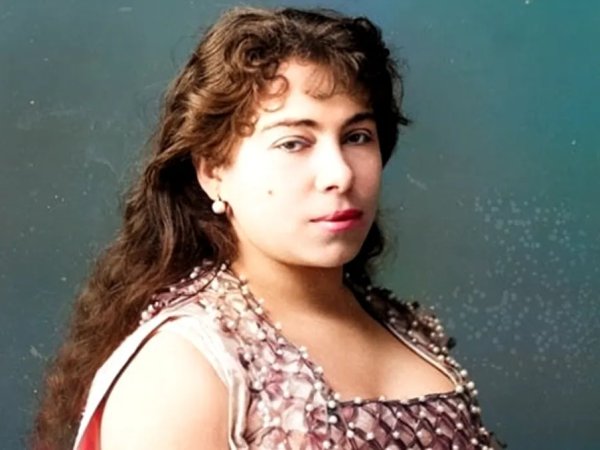
The story of the diva Elena Teodorini, the first soprano from Romania to sing at La Scala in Milan
- Articles
- 12 JAN 26
Elena Teodorini remains one of the most brilliant and, at the same time, unjustly forgotten personalities of Romanian culture. The first soprano from Romania to step onto the legendary stage of the Teatro alla Scala in Milan, she was a complete artist, acclaimed on the great stages of the world, as well as a devoted pedagogue who contributed decisively to the training of generations of musicians in Europe and South America. Her story is one of exceptional talent, tireless work, and a life placed in the service of art, in a period when the international affirmation of Romanian artists was extremely difficult.
Artistic roots and childhood in a family of theatre
Elena Teodorini was born on March 25, 1857, in Craiova, into a family deeply rooted in the artistic world. Her father, Theodor Teodorini, was an actor, and her mother, Maria Teodorini, enjoyed a solid reputation as an actress. The atmosphere in which Elena grew up was dominated by theatre, music, and rehearsals, an environment that shaped her artistic sensitivity from her earliest years.
An important role in her formation was also played by the famous actress Aristizza Romanescu, her first cousin, who represented for Elena an example of discipline, professionalism, and artistic excellence.
The young girl’s talent manifested itself very early, and at only six years old she was already playing the piano, demonstrating a natural ease in understanding music and a rare capacity for artistic expression. All these elements outlined a destiny that seemed predestined for the stage.
Studies in Milan and the formation of an exceptional artist
At the age of 14, Elena Teodorini took a decisive step that would change her life forever: she left for Milan to study at the Conservatory of this important European cultural center. The city was, in the second half of the 19th century, a true epicenter of classical music and opera, and contact with this environment offered the young Romanian artist a formation of the highest level.
At the conservatory, Elena attended courses in singing and piano, having the opportunity to study with renowned professors and to familiarize herself with the great traditions of Italian opera.
Although very young, she demonstrated impressive artistic maturity, managing to stand out through her voice, technique, and stage presence. The years spent in Milan were fundamental in defining her interpretative style and in building a solid international career.
Stage debut and rapid rise in Italy
Elena Teodorini’s career officially began in 1877, when, at only 20 years old, she appeared on the stage of the Municipal Theatre in Cuneo, Italy, as a soloist. Her debut was well received, and her talent did not go unnoticed by impresarios and theatre directors. In a relatively short time, her name began to circulate more and more frequently in the Italian musical world.
The success achieved in Italy opened doors for her to other European stages as well, and her reputation grew steadily. The moment of absolute consecration came in 1880, when, at only 22 years old, Elena Teodorini was invited to sing on the stage of the Teatro alla Scala in Milan.
This achievement was exceptional not only for a young artist, but also for Romania, as Elena became the first Romanian soprano accepted on the most prestigious lyrical stage in the world.
The triumph at La Scala and international consecration
On the stage of the Teatro alla Scala, Elena Teodorini performed the role of Marguerite in the opera Faust by Charles Gounod. Her performance was a true triumph, generating a rare enthusiasm even on this famous stage. The audience applauded her for minutes on end, and the critics of the time praised both her voice and the expressiveness of her interpretation.
The prolonged applause, which lasted approximately 15 minutes, sealed Elena Teodorini’s transformation into an international star. From that moment on, she was invited to sing on the most important stages of the world, becoming one of the most appreciated sopranos of her era.
The success at La Scala was not only a personal triumph, but also proof that Romanian talent could compete at the highest artistic level.
A brilliant career on the great stages of the world
After the success in Milan, Elena Teodorini enjoyed an impressive career, performing in leading cities such as Vienna, Paris, London, Moscow, Madrid, and Barcelona. She was also received with great enthusiasm in Latin America, where audiences appreciated both her vocal qualities and her interpretative refinement.
Despite her international fame, Elena never forgot her homeland. She also sang on stages in Romania, contributing to the development of local musical life and becoming a model of perseverance for young Romanian artists. Her presence on national stages was perceived as a source of pride and as a confirmation of the value of the Romanian artistic school.
Withdrawal from the stage and dedication to musical education
In 1903, at the height of her career, Elena Teodorini made a surprising decision for many of her admirers: she withdrew from stage activity in order to dedicate herself to pedagogy. Her choice was motivated by the desire to pass on the experience and knowledge accumulated over the years.
She began teaching singing and music in various parts of the world, settling for a period in Brazil, in Rio de Janeiro, where she founded a school of music. Her pedagogical activity had a significant impact, contributing to the formation of a new generation of artists.
She later taught in Paris and Buenos Aires, and between 1915 and 1922 she held the position of director of the Governmental Conservatory of Buenos Aires.
Return to the country and cultural legacy
After 1908, Elena Teodorini returned to Romania, determined to contribute to the cultural development of her native city. She invested her own resources in the restoration of the theatre in Craiova, founded by her father, wishing to leave a lasting legacy to the community that marked her childhood. In 1922, she founded the National Academy of Lyric Art in Bucharest, an important institution for musical education in Romania.
Her last journey to Brazil, in 1923, was dedicated to organizing a music festival, a gesture that reflected her constant commitment to promoting musical culture. Elena Teodorini passed away on February 27, 1926, leaving behind an impressive artistic and pedagogical legacy. Although today her name is less well known, her contribution remains essential to the history of Romanian and universal music.
We also recommend: Tuberculosis Crushed the “Prince of Operetta” on the Stage in Bucharest: The Tragic Story of Interwar Tenor Nae Leonard