The only Romanian who ever sang on Broadway was born in Bucharest. The story of singer Constantin Drăghici
- Articles
- 26 JAN 26
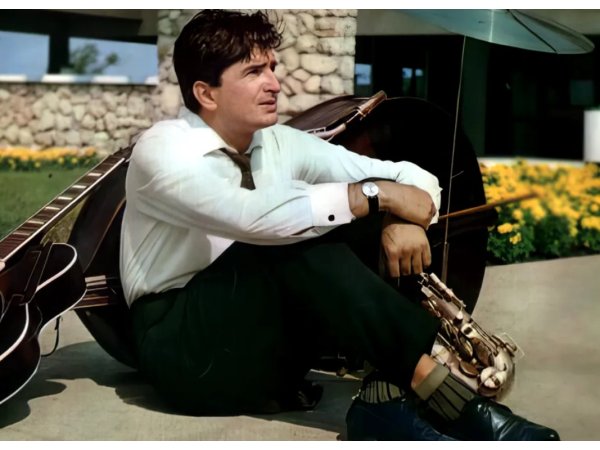
The story of Constantin Drăghici is one that seems taken straight out of a film: a child born prematurely, into a modest family, manages to conquer the Romanian public, then goes through a dramatic escape from communist Romania and, in the end, steps onto one of the most prestigious stages in the world, Broadway. His destiny is living proof that talent, perseverance, and courage can overcome borders, political regimes, and seemingly impossible obstacles.
A difficult childhood and the first signs of talent
Constantin Drăghici was born on January 19, 1932, in Bucharest, in far from favorable circumstances. He came into the world prematurely, at just seven months, to an illiterate mother and a father who worked as a tram driver. His family did not have material resources, but the child grew up in a warm environment, where love and support made up for the shortcomings.
From early childhood, little “Costeluș” felt an irresistible attraction to music. His strong, natural voice impressed those around him, and neighbors listened with delight whenever he sang. Although nothing at the time foretold an extraordinary artistic destiny, he knew even then that the stage would be his place. The dream of becoming a singer took root early, even if the idea of reaching Broadway seemed inconceivable at that time.
Musical studies and the choice of a different path
After graduating from high school, Constantin Drăghici decided to follow his passion and enrolled at the Conservatory in Cluj, where he studied classical music. His training was solid, and his talent did not go unnoticed. He was even invited to sing at the Cluj Opera, an opportunity that could have ensured him a stable career in the field of academic music.
However, Drăghici felt that his true calling was light music. Fascinated by this genre, closer to the public and everyday emotions, he chose a riskier path, but one that offered him the freedom to express himself authentically. The decision proved inspired, even if it meant giving up the security of a classical career.
Recognition in Romania and star status
The moment that definitively propelled him into the public eye came in 1961, when Constantin Drăghici appeared for the first time on television performing the song “Nu ești de vină tu” (“It’s not your fault”). His appearance had a huge impact. His warm, powerful voice, natural charisma, and stage presence quickly turned him into an idol of Romanian light music.
He became a constant presence on shows produced by Valeriu Lazarov and Alexandru Bocăneț, where he sang alongside the greatest artists of the time. His repertoire expanded with songs that entered the heritage of Romanian music, such as “Luna la Mamaia” (“The Moon at Mamaia”), “Tu” (“You”), “Am strâns toamnă după toamnă” (“I gathered autumn after autumn”), and “Nici o dragoste nu e ca a noastră” (“No love is like ours”).
International tours and artistic recognition
Constantin Drăghici’s success was not limited to Romania’s borders. The artist held numerous tours abroad, singing in France, Germany, Italy, Poland, and Russia. Audiences in these countries were captivated by his elegant style and emotionally rich interpretations.
An important moment in his international career took place in 1965, when he was invited to sing at the famous Friedrichstadt Palast in Berlin. He took the stage alongside major names such as Stela Popescu and Doina Badea, confirming his status as an artist of international caliber.
The restrictions of the communist regime and the decision to escape
Despite his immense popularity, Constantin Drăghici was not spared the constraints imposed by the communist regime. In 1971, he received an offer to sing in Los Angeles, but the Romanian authorities forbade him from leaving the country. This refusal was a heavy blow for the artist, who felt that his creative freedom was severely limited.
Disappointed and frustrated, Drăghici made a radical decision: to flee the country. He managed to take refuge in Germany, where he hoped to continue his musical career. Reality, however, proved much harsher than he had anticipated. Far from the audience that adored him, he was forced to start from scratch.
Exile, survival, and the road to Broadway
“In Romania I was a star, but in Germany I was an unknown,” Constantin Drăghici would later confess. In order to survive, he turned to his second profession, architecture, a field in which he worked for many years both in Germany and later in the United States.
Fate smiled on him again in 1982, when he received a contract to sing at Town Hall in New York. This event opened the doors to Broadway, where he performed in musical shows and nightclub programs. Thus, Constantin Drăghici became the first and only Romanian who ever sang on the famous New York stage.
Love, reunion, and the return home
During his exile, life also offered him personal fulfillment. He reunited with Olimpia Zaharia, an old friend from Romania. After years in which each had built their own path, the two found each other again in America, married in 1983, and lived together until the 1990s, when they decided to return to their homeland.
After the Revolution of 1989, Constantin Drăghici was welcomed back with enthusiasm by the Romanian public. In 1990, he gave a recital at the Mamaia Festival, being acclaimed as a living legend.
The legacy of a legendary artist
In 2001, he settled permanently in Romania, stating that he had always wished to die at home, in his mother tongue. He retired at the age of 65, benefiting from pensions from America, Germany, and Romania. His career spanned more than five decades of activity, nine author albums, and appearances on over 38 collective albums.
Constantin Drăghici passed away in 2015, but his music continues to be listened to and loved. He remains not only a symbol of Romanian music, but also an example of courage, perseverance, and talent that managed to shine on the greatest stage in the world.
We also recommend: The great artist Aurelian Andreescu was discovered at “Pescăruș” while having fun with friends