The Neighborhoods That Produced Champions: How Sport Grew in the Backstreets and Housing Estates of Bucharest
By Eddie Țone
- Articles
- 08 MAR 26
There is a theory, especially popular in football, that the best players come from places where there is nothing to lose. Argentinians have the villa miseria, Brazilians have the favela, and for several decades Bucharest had Giulești, Rahova, Grivița and an entire network of battered football pitches hidden between communist apartment blocks, where children kicked a ball around until darkness swallowed the field. Poverty, fortunately, does not automatically produce talent. Yet something in the atmosphere of the capital’s working-class neighborhoods generated, decade after decade, a remarkable number of champions. The secret carries less mysticism than people imagine: sport existed everywhere in those districts, and access cost nothing.
Grivița and the Birth of a Workers’ Club
On June 25, 1923, in a classroom of the primary school in the Grivița neighborhood, a group of workers from the Grivița Railway Workshops signed the founding document of a football team. The workers, known at the time as the “hammer men,” created the Cultural and Sports Association CFR Bucharest. The first elected president was the workshop foreman Teofil Copaci, while the team captain became the lathe operator Grigore Grigoriu. Neither director nor lawyer stood behind the club’s birth. A foreman and a lathe operator did. This is the DNA from which the club that would eventually become Rapid Bucharest emerged.
The story of the team’s famous burgundy colors perhaps captures the spirit of the club better than anything else. The wife of captain Grigoriu received the task of washing and maintaining the players’ kits after every match. By coincidence, her home contained plenty of burgundy and white fabrics. Mrs. Grigoriu chose burgundy, explaining that the color tolerated repeated washing far better than white. A club whose identity color came from the practical logic of laundry deserves a certain kind of respect.
Giulești, the neighborhood where the team later found its home, still treats football as a religion passed from father to son. Children grew up waving white-and-burgundy flags, older supporters reminisced about “Dan Coe’s Rapid” or, decades later, “Pancu’s Rapid,” and every match served as a lesson in loyalty. Giulești Stadium was built between 1936 and 1939 and counted as an architectural jewel of its era. The design followed, at a smaller scale, the horseshoe shape of Arsenal’s stadium in London. The venue opened officially on June 10, 1939, in the presence of King Carol II.
From this railway workers’ neighborhood also came Alexandru Neagu, nicknamed “The Hero of Guadalajara.” Neagu, often called “Sandu” or “the Cappellini of Giulești,” entered the world in Rahova on July 19, 1948. Raised in Giulești within a family devoted to Rapid, he grew into the embodiment of loyalty to the club’s burgundy colors. During thirteen years at Rapid he played 329 matches and scored 135 goals in all competitions. Journalist Ioan Chirilă, among the most respected sports writers of his generation, described Neagu’s goal in Guadalajara against Czechoslovakia at the 1970 World Cup as “the most beautiful goal in the history of the Romanian national team.”
Factories and the Pitch Behind the Apartment Block
Football in Bucharest’s working-class neighborhoods never existed in a vacuum. It relied on infrastructure, at least until that infrastructure vanished. Until 1989, almost eighty sports facilities with football pitches operated across the capital’s working districts. Most large factories maintained a sports ground where mass participation in sport received active encouragement. The communist regime, with all its contradictions, produced a dense and accessible sporting ecosystem.
The state regulated this sphere as carefully as any other. A decision issued by the Council of Ministers in 1956 required enterprises employing between 500 and 1,000 workers to maintain at least one volleyball or basketball court. Companies employing between 1,000 and 5,000 workers needed a volleyball court for every thousand employees, a tennis court for every two thousand employees, and a small sports complex. On paper the measure resembled bureaucracy. In reality it meant that a teenager from Berceni or Drumul Taberei could play football on the factory field next to the apartment block, free of charge, with no subscription and no waiting list.
The Girueta sports complex in Berceni offers a vivid example of this vanished world. Built on Drumul Găzarului among the apartment blocks constructed in the mid-1960s, it functioned informally as a neighborhood hub. Mothers brought children for fresh air, elderly residents spread blankets across the stands to enjoy the sun, and teenagers spent hours kicking a ball on the training pitches. Generations and social groups mixed naturally in that space, a dynamic that modern Bucharest, with synthetic fields rented by the hour, struggles to recreate.
Anthropologist Andrei Mihail, coordinator of the research project “Stadion de Cartier” (Neighborhood Stadium), documented this lost infrastructure and concluded that in twenty-first-century Bucharest, rental fees and enrollment costs for children often exceed what many residents can afford. The result produces a dramatic narrowing of the selection base. Once the fields disappeared and access required payment, the pipeline of future players shrank.
What Happened to the Fields After 1989
The fate of these sports bases after the Revolution tells a story Bucharest rarely likes to discuss openly. The privatization of socialist enterprises came together with the gradual decay of sports parks, followed by demolition or abandonment. Real-estate value grew enormous, and developers moved in. Today more than half of Bucharest’s sports bases have given way to apartment blocks, office buildings, or large retail complexes.
The list of losses runs long and depressing. The ICSIM Sports Base on Barbu Văcărescu Boulevard made way for Zona Arena, now used mainly for concerts. The Keoke sports complex on the shore of Lake Tei, built in the 1970s with eleven tennis courts, disappeared in 2000 to allow the construction of a residential complex. Spartac Stadium vanished beneath a shopping mall. The CFR BTA ground in Giulești disappeared under apartment buildings.
A clear mechanism explains this disappearance, described with clinical precision by those who studied it. Facilities remain neglected until collective memory gradually forgets their existence. Investors then obtain construction permits. Romanian law forbids the demolition of sports bases before building new ones to replace them. The law appears to function exactly enough to exist on paper.
A footballer raised in Grivița or Giulești during the 1970s and 1980s played on the factory field around the corner, attracted the attention of coaches from the neighborhood club, and entered a structured system. A child growing up in the same district today rents a synthetic pitch or abandons the game entirely. Those working-class sports grounds produced a large number of footballers who later played for the national team. How many could emerge today remains a question Romanian football seems reluctant to confront.
CS Rapid: The Olympic Medal Factory of Giulești
Rapid produced far more than footballers. Clubul Sportiv Rapid, separate from the football team while carrying the same name and colors, accumulated an impressive sporting record across multiple disciplines. The club’s achievements include eleven Olympic medals, thirty world championship medals, and more than one hundred European medals. Athletics provided the most significant contribution to that tally.
Gabriela Szabo stands as perhaps the most striking example of a world champion linked to a club with working-class roots. Born in Bistrița in 1975 and discovered at the age of twelve during a school cross-country race, she joined CS Rapid in 1994 and soon transformed the Giulești club into a landmark of global athletics. Her career includes three Olympic medals — gold and bronze at Sydney 2000 and silver at Atlanta 1996 — along with three outdoor world championship titles.
Her performance at the Sydney Olympic Games entered athletics textbooks. Szabo won the 5,000-meter race in 14:40.80, setting a new Olympic record that endured for sixteen years until Rio 2016, when Kenyan runner Vivian Jepkemoi Cheruiyot lowered the mark by fourteen seconds. In 1999 Szabo also captured the Golden League title alongside Wilson Kipketer, the Danish runner born in Kenya. The two athletes shared the grand prize: fifty kilograms of gold.
The athletics section of CS Rapid counts more than five hundred national championship titles for seniors and juniors, eleven Honored Masters of Sport, and more than five hundred Masters of Sport. Those numbers would impress any club in the world. Their significance grows even larger considering that the institution originated from an association of railway workers.
Dinamo and the Boxing Academy on Ștefan cel Mare
If Rapid represented the railway workers’ world, Dinamo belonged to the Ministry of Internal Affairs. That institutional backing ensured substantial resources during the communist era and produced remarkable results, especially in disciplines less visible to the broader public.
The boxing section of CS Dinamo created what specialists call the “Dinamo Boxing Academy,” a structure that produced Olympic, world, European, Balkan, and national champions. The club’s weightlifting section also delivered consistent success. Its most prominent representative remained Andrei Socaci, whose record includes six gold medals at the European Championships in 1985 and 1986, an Olympic silver medal in 1984, and twelve medals at World Championships.
Dinamo’s athletics section appeared in 1948, founded by a group of runners described at the time as enthusiastic rather than famous. The description carried unusual honesty for a sports club announcement. More recently, that section produced shot-putter Andrei Rareș Toader, who won the gold medal at the 2025 European Championships, the first title of that caliber for Romanian men’s athletics in fifty-two years.
The Neighborhood as a School of Sporting Survival
A romantic interpretation surrounds working-class districts and the athletes who emerge from them. The explanation usually centers on a single word: hunger. Hunger for success, hunger for escape, hunger for recognition. The narrative sounds dramatic and satisfying. Reality tells a more prosaic story.
Bucharest’s backstreets and apartment-block neighborhoods functioned as champion factories simply because they possessed infrastructure. Open fields, factory gyms, coaches paid by the state, clubs with multiple sports sections recruiting children from the surrounding districts. The communist system carried countless flaws, yet it produced a sporting ecosystem with a broad selection base and free access, a combination rarely encountered in elite sport.
Rahova Fight Club, a kickboxing gym founded in the basement of a commercial complex on Malcoci Street in Rahova, illustrates how the mechanism appears in its contemporary version around 2020. RFC built a reputation among local boys and girls, along with adults who gather for training sessions in the basement space. Its founder, kickboxer Alexandru Popescu, grew up among the realities of Rahova’s streets and understood that a gym can accomplish what other institutions often fail to achieve.
Football played with a goal painted on a concrete wall, athletics discovered during a school cross-country race, boxing that pulls a teenager away from dangerous influences — each example shares a common thread. Sport offers the clearest path toward a better life when alternatives remain limited. When that path disappears — the pitch replaced by a shopping mall, the factory gym turned into a parking lot, the monthly membership exceeding the minimum wage — a city also loses part of its reservoir of talent.
Bucharest today still counts several hundred sports fields. Before 1989 the number approached three hundred. Half of the football facilities have vanished. The number of champions that disappeared together with them remains a calculation nobody seems eager to make.
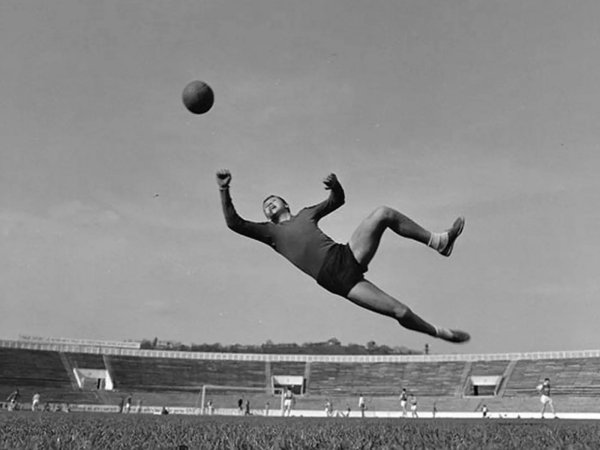
Photo: Arhiva Culturală Minerva
You may also like: Sports facilities and activities in Bucharest – from fitness and crossfit to running in the park