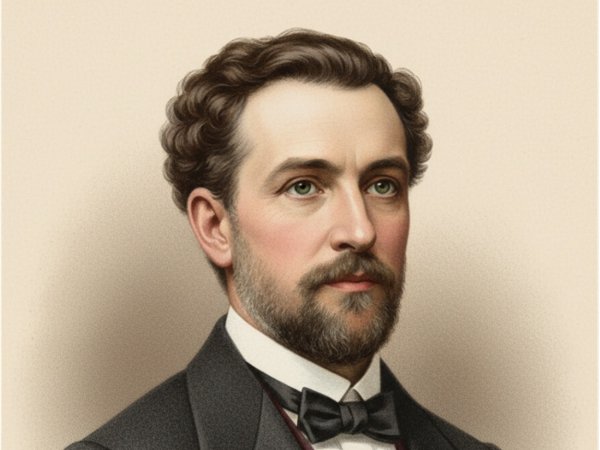
The incredible story of Vasile Boerescu, the Bucharest native who had the idea of the Union of the Romanian Principalities
- Articles
- 19 FEB 26
The modern history of Romania is marked by resounding names, intensely evoked in textbooks and official speeches. However, among the essential figures who decisively contributed to the formation of the modern Romanian state there are also personalities less known to the general public. Such a name is Vasile Boerescu, a Bucharest-born politician, jurist and diplomat, who played a decisive role in the achievement of the Union of the Romanian Principalities in 1859. Although collective memory associates primarily Alexandru Ioan Cuza with the act of the Union, the strategic idea of the double election – the election of the same ruler in both Moldavia and Wallachia – was formulated and strongly supported by Vasile Boerescu. Through political intelligence, oratorical talent and perseverance, he contributed decisively to transforming a favorable international context into a historical reality.
Origins, education and intellectual formation
Vasile Boerescu was born on January 1, 1830, in Bucharest, into a family belonging to high society. The privileged environment in which he grew up offered him access to a solid education, essential for his future career. He attended the courses of the prestigious Saint Sava National College in Bucharest, one of the most important educational institutions of the time.
During the Revolution of 1848 in Wallachia, young Boerescu was a student and already involved in public life through his collaboration with the newspaper “Pruncul român” (“The Romanian Child”). His courage manifested itself through the publication of articles with provocative titles such as “To the Reactionary Brothers” and “Citizen Brothers,” texts that led to his arrest in the context of the revolutionary unrest. This experience strengthened his liberal convictions and his attachment to national ideals.
After graduating from the college in 1850, he continued his legal training at the School of Law in Bucharest, and later left for Paris. In the French capital, he obtained his bachelor’s degree in 1855 and his doctorate in legal sciences in 1857. Contact with Western political and intellectual circles broadened his horizons and strengthened his belief that the modernization and union of the Principalities were indispensable steps for the future of the Romanians.
Publicistic activity and the idea of the Union
During the period spent in France, Boerescu actively campaigned for the political rights of the Romanian Principalities and for their union under the leadership of a foreign prince, a solution considered at that time a guarantee of stability and international recognition. Returning to the country in 1857, he became professor of commercial law at Saint Sava College, and from 1859 he taught at the Faculty of Law in Bucharest. In 1871 he became rector of the University of Bucharest, and in 1873 he was elected dean of the Faculty of Law.
Journalism was one of his main instruments of influence. Besides his early collaboration with “Pruncul român,” in 1857 he founded the publication “Naționalul,” the organ of the moderate liberals, with a predominantly cultural orientation but with a clear unionist political message. In the pages of this publication, Boerescu argued that the great European powers had opened a window of opportunity through the Paris Convention of 1858, and that the Romanians had to take advantage of the context.
He wrote lucidly that Europe had taken an important step, showing that the Union was possible, but that its realization depended on the will and political intelligence of the Romanians. This vision was to form the basis of his historic gesture in January 1859.
The decisive moment of January 1859
In January 1859, Vasile Boerescu was a deputy in the Elective Assembly of Wallachia. After Alexandru Ioan Cuza had been elected ruler of Moldavia in Iași, the political situation in Bucharest was tense. The conservatives hesitated, and the great powers had accepted only a partial union, with limited common institutions.
In the secret session of January 23, 1859, Boerescu delivered a memorable speech, proposing the election of the same ruler in Wallachia as well. His argument was simple and brilliant: uniting around the principle of Union had to materialize in uniting around the person who already embodied it – Alexandru Ioan Cuza. He appealed to the historical conscience of the deputies and to their responsibility toward future generations.
The proposal was accepted unanimously, including by the conservatives, who yielded in the face of the popular will and convincing arguments. Thus, on January 24, 1859, the Union of the Romanian Principalities was achieved, a founding moment of the modern Romanian state. Without Boerescu’s strategic intervention, this outcome might have been delayed or even compromised.
Political and diplomatic career
After the Union, Vasile Boerescu held numerous important positions in the Romanian state, which was in full process of modernization. He was a member of the Superior Council of Public Instruction, vice-president of the Council of State, and member of the Constituent Assembly of 1866. At that time, he was also part of the delegation that supported bringing a foreign prince to the throne of Romania, an idea materialized through the establishment of the constitutional monarchy.
He was Minister of Justice in the governments led by Manolache Costache Epureanu and Dimitrie Ghica, during which time he proposed the elimination of the death penalty, a modern and courageous initiative for that era. He also held the portfolio of Cults and Public Instruction, contributing to the consolidation of the educational system.
His most important position, however, was that of Minister of Foreign Affairs, in the governments led by Lascăr Catargiu and Ion C. Brătianu. In this capacity, in 1875, he concluded the Commercial Convention with Austria-Hungary, despite the opposition of the Ottoman Empire, the suzerain power. The act was considered an important step toward the assertion of Romania’s economic and political independence.
The last years and the political legacy
In 1876, Boerescu attempted to lay the foundations of a centrist party, wishing to create a balanced alternative between the major political forces of the time. Failing to achieve this, he joined the National Liberal Party and, together with G. Vernescu, founded in 1880 the Party of the Sincere Liberals.
Vasile Boerescu passed away on November 18, 1883, in Paris. His death meant the disappearance of a complex political figure, but his contribution to Romania’s history remained fundamental. By formulating and supporting the idea of the double election of Alexandru Ioan Cuza, he transformed a diplomatic opportunity into a decisive historical act.
Today, although his name is less frequently invoked than that of other contemporaries, Vasile Boerescu remains one of the architects of the Union of the Romanian Principalities. Through his legal, journalistic and diplomatic activity, he constantly fought for the modernization of the Romanian state and for the affirmation of its independence. His story is proof that history is made not only by visible leaders, but also by strategic minds who know how to turn ideas into reality.
We also recommend: What is the oldest street in Bucharest? On Smârdan Street in the Old Town, the Union of the Romanian Principalities was sealed