The History of the Little… "Mic" Bucureștean. From Obor to fusion dining: The evolution of Romania's national dish
By Eddie Țone
- Articles
- 16 APR 26
From one perspective, Bucharest is a city that breathes through the pores of searing grills—a metropolis where history is written with mustard-stained fingers and the unmistakable aroma of smoke drifting over its old neighborhoods. If Paris has the buttery scent of fresh croissants, Romania's capital possesses this heavy, honest, and absolutely seductive fragrance of meat grilled over coals—a blend of spices that has managed to survive political regimes, border changes, and, more recently, the assault of fusion cuisine.
The mititel (or mic, as it is commonly called)—this cylinder of minced meat that seems to defy the laws of gastronomic aesthetics with its raw simplicity—represents perhaps the only element of social cohesion that has functioned flawlessly for over a century.
Genesis from a Logistic Error in the Old Town
The official story of the Bucharest mic begins on a crowded evening in the late 19th century, in the kitchen of the "La Iordache" inn on Covaci Street. Iordache Ionescu, a figure who deserves a statue at least from mustard producers, was facing a crisis of epic proportions for a respectable innkeeper.
The sheep casings, traditionally used to wrap the fresh sausage mixture, had run out just as the customers were becoming increasingly vocal in their culinary demands. In a gesture of improvised genius, Iordache decided to throw the meat mixture directly onto the grill without any casing, shaping the portions into smaller forms so they would cook quickly.
What appeared to be a stopgap solution turned out to be an instant success. Customers discovered that the lack of a membrane allowed the smoke to penetrate the fibers directly, creating a crispy outer crust that hid a succulent interior. The name "mititei" (little ones) emerged naturally, attributed—according to urban legend—to the journalist and humorist N.T. Orășanu, a regular who had a habit of ironically naming menu items. Thus, bread became "an extension," and the small meat cylinder received this diminutive that would remain etched in the national vocabulary for eternity.
Sodium Bicarbonate and the Alchemy of Old-World Taste
The evolution of the recipe was slow and full of secrets kept sacredly under the aprons of old-school chefs. Initially, the mic was strictly a beef and mutton affair, with a considerable addition of suet to maintain tenderness.
The introduction of sodium bicarbonate into the mixture represented a chemical turning point, providing that fluffy appearance and elastic texture so highly prized. This seemingly mundane ingredient acts on the meat proteins, allowing juices to be retained during the cooking process and preventing the product from shrinking excessively on the grill.
Chef Constantin Bacalbașa, a fine chronicler of the era, described in his writings the atmosphere around these grills where social hierarchies vanished under the influence of garlic aroma. The "standard" recipe included thyme, black pepper, paprika, and—the essential element—strained bone broth, added gradually into the meat as it was kneaded for hours.
This processing technique transformed a simple meat paste into a complex emulsion, ready to face the fury of beech charcoal. Every innkeeper on Covaci or in the Obor area held a secret proportion of spices, turning a simple grilled dish into a personal signature.
Păstorel Teodoreanu and the Etiquette of Correct Consumption
If Iordache was the inventor, Păstorel Teodoreanu was the theorist and the greatest PR man for the Romanian mic. A refined gourmand and literary critic with a keen nose for wines, Păstorel treated the mititel with almost academic seriousness. He campaigned for the exclusive use of high-quality beef mixed with a precise amount of beef fat, practically banning pork, which he considered an impurity capable of altering the dish's nobility.
His rules were strict and full of charm. The mic had to be eaten hot, straight from the grill, necessarily accompanied by a fresh bun and a mustard strong enough to clear the sinuses without overpowering the meat's flavor.
In his vision, the mititel represented a bridge between the Orient and the Occident—a Balkan adaptation of the Turkish kebab, but refined through European meat-processing techniques. This interwar period was the golden age, when the mic climbed the social ladder, moving from dusty markets directly onto the tables of the Bucharest elite, next to crystal glasses filled with Drăgășani wine.
Obor as a Spiritual Temple and Epicenter of Authenticity
The passage of time and political shifts moved the center of gravity for the mititel from luxury restaurants to popular areas, with Obor Market becoming the absolute Mecca of this dish. In this space where time seems to flow by different rules, the mic underwent total democratization. Here, the preparation process became a public spectacle, a morning ritual where retirees, students, businessmen in expensive suits, and lost tourists stand in the same interminable line.
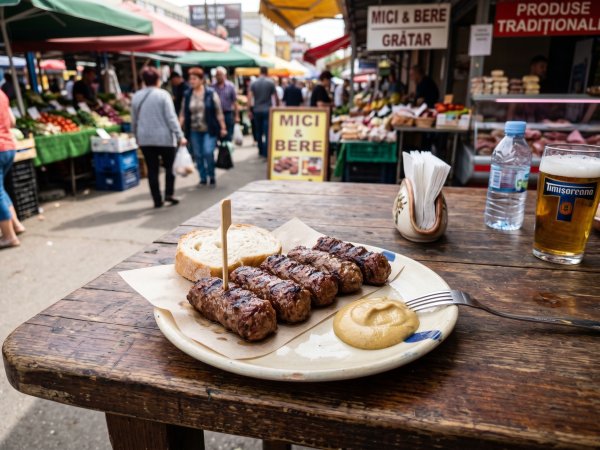
The specificity of Obor lies in the disarming simplicity of the service. Gray cardboard, generously filled with Tecuci mustard, becomes the only accepted vessel. The plastic fork is often viewed as a superfluous accessory; fingers are the preferred tools for feeling the correct texture of the meat.
This sensory experience, complemented by the metallic clatter of counters and the hum of the market, has turned the "Obor mic" into a cultural brand stronger than any state-funded marketing campaign. This is the place where the recipe has remained preserved in a pure form, resistant to the influences of modernity.
The Era of Communist Standardization and the State Recipe Myth
With the establishment of the communist regime, the mititel was subjected to a process of industrial standardization. The state wanted to control everything, including the proportion of fat on the citizens' plates. Technical regulations appeared, establishing exact quantities of beef and pork—the latter being introduced massively for reasons of cost and availability. However, the legend of the mic survived even during the years of food shortages, becoming a symbol of gastronomic resilience.
Despite attempts to turn the mic into a mass-produced item, small public catering units and experienced grill-masters continued to sneak in "unauthorized" ingredients to preserve the taste that made them famous.
The mititel became the official food of May Day, a holiday that, though politically imposed, was adopted by the masses as the perfect excuse to head to the countryside with a grill in the trunk. The smoke rising from the forests near Bucharest was the sign of a culinary freedom that the system could never completely censor.
Contemporary Reinvention and the Fusion Assault
Entering the 21st century brought a radical change in perspective. Modern Bucharest, eager for experimentation and international validation, began to view the mic through the lens of fine dining. Fusion restaurants or those with "fine dining" pretensions took the traditional recipe and subjected it to a process of deconstruction and aesthetic repackaging. Thus, we have witnessed the emergence of Wagyu beef mici, truffle-infused variants, or those served with artisanal mustard foam and purple potato chips.
This transformation is both fascinating and slightly ironic. The dish born from a lack of sheep casings in a neighborhood tavern is now presented on slate plates, decorated with micro-greens and drizzled with balsamic reductions.
The fusion mic represents the new generation's attempt to maintain a link with tradition, but in a visual language adapted to social media standards. While the taste remains essentially defined by bicarbonate and garlic, the presentation seeks to eliminate associations with market dust and grease-soaked cardboard.
Mustard: A Life Partner and Mandatory Accessory
An analysis of the history of the mic would be incomplete without giving due attention to mustard—the faithful companion that plays the role of moderator between the meat's intensity and the taste buds. In Romania, mustard for mici has a distinct personality, being typically more fluid and less pretentious than Dijon varieties. Tecuci mustard has, over time, become the gold standard, offering that necessary acidity to cut through the fat of the mic and cleanse the palate for the next bite.
Interestingly, mustard has remained constant in consumer preferences, even as the mici recipes varied. There is an unwritten etiquette in Bucharest restaurants stating that a mic without a generous pool of bright-yellow mustard is a fundamental error. Even in fusion versions, chefs avoid replacing this element entirely, preferring to refine it by adding horseradish or whole seeds, recognizing that without this chromatic and gustatory contrast, the experience would be incomplete.
The Mititel as a Social and Political Barometer
Beyond purely culinary aspects, the Bucharest mic functions as an instrument for measuring the nation's mood. The price of a portion of mici is often used as an informal indicator of inflation, being more relevant to the average citizen than figures provided by the National Institute of Statistics.
Furthermore, the mic has played key roles in electoral campaigns, becoming the preferred currency for voters' ballots in a political marketing spectacle that blends the smell of smoke with campaign promises.
The use of the mic as a tool of persuasion underscores its importance in the collective subconscious. It is the food that levels the playing field, brings people together, and, for a few minutes, suspends any ideological conflict. A rich man and a poor man may have divergent opinions on any subject, but both will agree that a mic must be well-seared on the outside and pinkish on the inside. It is, perhaps, the most effective element of internal diplomacy ever produced by the Wallachian space.
The Future of a Timeless Dish
Looking toward the future, the Bucharest mic seems to possess an immortality guaranteed by its very simplicity. Despite vegetarian trends or those promoting a lifestyle based on quinoa and kale, the grills in Obor and neighborhood restaurants remain full. Adaptability is the secret of its survival. The mic has learned to live in the menus of organic restaurants as a turkey variant and in supermarket freezers, ready to be tossed onto a Teflon pan in modern apartments.
Its transformation—from a logistic error to a national fusion symbol—is proof that authentic taste does not need sheep casings to remain relevant. The mic represents the victory of improvisation over rigid planning.
Bucharest will continue to evolve, glass skyscrapers will replace old inns, but somewhere, on the ground floor of a block or in a crowded market, someone will always be turning these delicious cylinders with metal tongs, ensuring that the aroma of history will never be lost in the current of culinary globalization.
You may also like: Where to find the best mici in Bucharest