The artistic side of Queen Marie of Romania. From brush to pen, she wrote a fairy tale about two sisters in love with the same man
- Articles
- 03 DEC 25
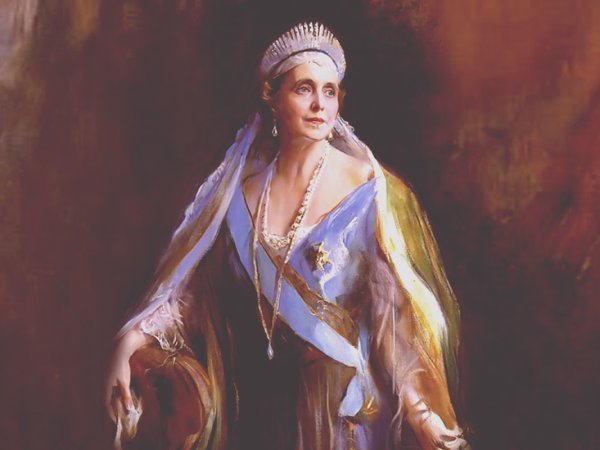
Queen Marie of Romania remains in history as a defining figure for the creation of Greater Romania, but beyond her political and diplomatic role there existed a deeply romantic soul, attracted to beauty in all its forms. For her, art was not only a refuge but also a way of asserting her personality in a world dominated by rules, rigidity, and princely obligations. From her youth, the brush and the pen became instruments through which she expressed her sensitivity, imagination, and connection to the world of dreams. From this creative side were born delicate paintings and texts full of lyricism, among which stands out a fairy tale about two sisters in love with the same man – a moving story about love, sacrifice, and devotion.
Art as refuge and personal affirmation
For Queen Marie, painting represented, from adolescence, a way to free herself from the constraints of life at the Court. The watercolor lessons held by the teacher Ruth Mercier, specialized in floral painting, opened for her a universe in which color and transparency intertwined in perfect harmony.
The Queen remembered this formative stage with admiration, acknowledging that she had quickly mastered the technique of watercolor painting, using diluted strokes in a play of light that offered the flowers a velvety depth.
From this period have been preserved numerous decorative watercolors, dominated by lilies, irises, poppies, and other flowers from her favorite gardens at Pelișor and Balchik. Moreover, the two residences represented for her an inexhaustible source of inspiration: wild gardens, vibrant colors, contrasts, and fragrances that found their place in the pages painted with meticulousness.
Her first larger work was a book painted on Japanese paper, an art object in itself, conceived as a declaration of her creative identity. Later, she created a similar book for her husband, King Ferdinand, this time on parchment. About this work, Queen Marie spoke with modesty and pride at the same time:
“It is my most important work... and it was planned with the thought of leaving something to our house that could not be alienated.” It was thus not only a proof of talent but also an attempt to leave posterity a symbol of her artistic sensitivity.
How the Queen moved from painting to writing
Queen Marie’s vivid imagination existed since childhood, when she told stories to her sisters and, later, to her children. She confessed that she saw with remarkable clarity the places she described: endless shores, high mountains, desolate lands, or mystical spaces where the four winds meet. This ability to create vivid images in the minds of her listeners led her daughter, Elisabeth, to suggest that she should write the stories, so as not to let “such beautiful pictures fade away.”
Thus was born her first published volume, The Lily of Life, a Fairy Tale, a book that appeared in 1913, when she still bore the title Princess of Romania. The text is deeply symbolic and emotionally charged, a story about two sisters in love with the same young man.
One of them gives up her love out of devotion for the other, but when he falls ill, she embarks on a dangerous journey to find a miraculous lily, a cure meant to save his life and restore happiness to her sister. It is a story about sacrifice, unconditional love, and the inner strength of the female character – recurring themes in Queen Marie’s writings.
A rare edition of this volume, illustrated by the artist Helen Stratton in Art Nouveau style, was recently acquired by the “I.N. Roman” County Library in Constanța. The book, preserved in exceptional condition, has a binding of cream-colored cloth, golden ornaments, and an elegant medallion on the cover, being considered a true collector’s piece.
The first editions of Queen Marie’s writings, treasures preserved in libraries
The Constanța library also holds other rare editions of Queen Marie’s writings, such as the volume My Country, published in Romanian in 1917 and translated by Nicolae Iorga, The Dreamer of Dreams (1914), Ilderim: A Story in Shadow and Sunshine (1915), and The Voice on the Mountain, an edition printed in English on the occasion of her visit to the United States. This last volume had a limited print run of 600 copies, being an exceptional bibliophile object.
In the library’s collections there is also a book about the history of the Orient, with Queen Marie’s holograph signature. Specialists assume that the volume might have belonged to the library at Balchik, dispersed after 1940.
These books are not merely rare pieces but fragments of Queen Marie’s complex personality, who left her mark on Romanian culture in a subtle yet profound way. Her writings are animated by sincerity, sensitivity, and a special aesthetic sense, conveying a timeless emotion.
Queen Marie and her passion for beauty in all its forms
For Queen Marie, art was not limited to painting and literature. Her Majesty was constantly involved in decorating the royal residences, promoting modern styles, bold colors, and traditional Romanian elements. She also supported young artists, being a true protector of Romanian creation.
Her passion for fashion was recognized worldwide. The Queen appeared often in the international press as a symbol of elegance and refinement. She introduced traditional Romanian costume elements into the royal wardrobe, which she wore naturally and with dignity, becoming an ambassador of local traditions abroad.
She frequently ordered dresses from famous European fashion houses, even when this went against the strict rules imposed by King Carol I. In her memoirs, she acknowledged that sometimes her chosen outfits were “a bit too conspicuous,” yet she did not give up the pleasure of experimenting with textures, colors, and accessories.
One of her favorite dresses was made of black crêpe-de-Chine, embroidered with gold and deep blue shades, worn together with a small tricorn-shaped black hat. This appearance seemed to her fascinating and elegant, expressing the way fashion had become a natural continuation of her artistic creativity.
The artistic side of Queen Marie remains a luminous chapter of her personality. Through painting, writing, fashion, and décor, she brought beauty into a period marked by wars and political upheavals. She left Romania not only a model of courage but also a cultural heritage that continues to inspire. Her art was, above all, a form of love – for people, for her country, and for everything that beauty means.
We also recommend: The Disappearance of Prince Mircea of Romania, the Alleged Fruit of the Love Between Queen Marie and Prince Barbu Știrbey