Stories of Bucharest: Ion Heliade Rădulescu printed the first Romanian newspaper, „Curierul românesc”, in the Capital, in 1829
- Articles
- 16 FEB 26
On April 8, 1829, in Bucharest, the first issue of the newspaper „Curierul românesc” saw the light of print, a publication that was to decisively mark the beginnings of the press in the Romanian language. Its initiator, Ion Heliade Rădulescu, one of the major figures of Romanian culture in the 19th century, assumed a difficult mission: that of bringing Romanian society closer to the Western model of public information and debate of ideas.
The birth of the Romanian press in a city at a crossroads
The moment of its appearance was not accidental. The year 1829 coincides with the end of Ottoman domination in Wallachia and the beginning of the Russian military administration, established following the Treaty of Adrianople. It was a period of political and social transformations, in which local elites were seeking to consolidate the idea of national identity and cultural autonomy. In this context, the press became not only an instrument of information, but also a vehicle of modernization and national affirmation.
In the introductory editorial, Ion Heliade Rădulescu acknowledged with bitterness that the Romanians were almost two centuries behind Western Europe in terms of the development of the press. In the West, the first newspapers had already appeared since the 17th century, while in the Romanian space the idea of a periodical publication in the national language was only just taking shape. Aware of this delay, Heliade did not adopt a resigned tone, but a mobilizing one: it was time for the “flower of the nation” to cease being “lower than the chaff of the other nations.”
An ambitious cultural and political project
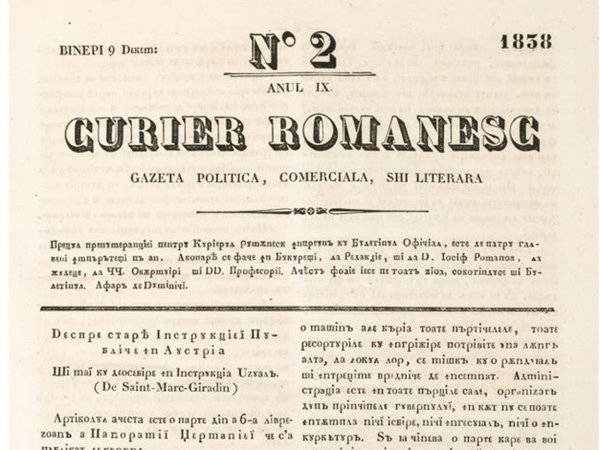
„Curierul românesc” was conceived from the beginning as a newspaper with a broad profile. On the masthead was written: “Political, commercial and literary gazette,” which reflected the intention to cover both internal and international political life, as well as the economic and cultural field. The newspaper had four pages and was initially printed in the Cyrillic alphabet, the alphabet used at that time in writing the Romanian language. Beginning with 1844, the publication gradually switched to the Latin alphabet, a process that accompanied the modernization of the language and its rapprochement with its Latin roots.
The first editors were Ion Heliade Rădulescu and Constantin Moroiu, a jurist educated in the West. This association was not accidental at all: Moroiu’s Western experience and Heliade’s cultural vision gave the newspaper a modern character and openness toward Europe. Some issues were also printed in French, the international language of circulation of the era, a fact that shows the desire for connection to the European space.
In the “Notification” that opened the publication, Heliade clearly explained the purpose of the gazette: a selection of the most useful and interesting things from the newspapers of Europe, information about the most useful articles of trade, internal matters and free accomplishments of our state, as well as notable judgments, advice and decisions of the Divan for the improvement of the homeland. In other words, the first Romanian newspaper – „Curierul românesc” – aimed to be a gazette of external, economic and internal news, complemented by opinion articles and cultural reflections.
Heliade dreamed that his newspaper would be read with tears of joy in the eyes in all houses. Young people and elders, men and women, learned and more ordinary people, all would be happy to hold in their arms a gazette in their own language. Even children – Heliade Rădulescu thought – would leave their games and gather around their mothers and fathers to read with their own eyes „Curierul românesc.” This idealized image reveals not only the founder’s enthusiasm, but also the conviction that the press can shape a community.
The hardships of the beginning and the struggle for survival
The debut of „Curierul românesc” was, however, far from easy. The first print run was only 280 copies, printed at the printing house of the Metropolitanate in Bucharest. The annual subscription cost two imperial gold coins, to which postal expenses were added, calculated according to distance. For a society in which literacy was low and purchasing power limited, maintaining a periodical publication represented a major challenge.
The appearance was generally weekly or biweekly, and for a short period the newspaper came to be printed five times a week. However, not infrequently, the publication interrupted its appearance for entire weeks. The reasons were diverse: lack of funds, technical difficulties, or even health problems of the editors. Readers were informed that the pause was due to the “bodily weakness” of one of the editors, who had been forced to go to the baths for treatment.
In critical moments, the editors warned their public that the newspaper would be suspended if 200 new subscriptions were not collected within a short interval. It was a form of pressure, but also proof of the economic fragility of the project. Heliade had to build almost from scratch the necessary infrastructure: printing, distribution, financial organization. Later, he brought printers from Pest and built his own printing house in Bucharest, a decisive step for consolidating editorial activity.
Varied content and encyclopedic spirit
„Curierul românesc” did not have rigid content. During the Lent of Easter, its pages acquired a predominantly religious character. In other issues, the emphasis fell on foreign news, including about recent inventions in Europe, or on rumors regarding the intentions of the Tsar. Sometimes readers found courses of literature and rhetoric, other times treatises of versification.
This diversity reflected the lack of a local journalistic tradition, but also the ambition to transform the newspaper into a platform of general education. „Curierul românesc” was not only a gazette of news, but also an instrument of intellectual formation. In a society in which access to books was limited, the newspaper became a means by which ideas circulated more rapidly and more widely.
Before being a simple journalistic product, „Curierul” was a means of affirming national identity. The Romanian press was formed in the wake of the Enlightenment movement and of the desire for cultural emancipation. By publishing texts in the Romanian language, by promoting the Latin alphabet and by debates on language and literature, Heliade and his collaborators contributed to consolidating a modern national consciousness.
Competition, supplements and legacy
Shortly after the appearance of „Curierul românesc” in Bucharest, in Iași the newspaper „Albina românească” was launched, under the guidance of Gheorghe Asachi. Between the two publications there developed a rivalry that was at times ironic. The editors of „Albina” rejoiced when censorship confiscated a print run of „Curierul,” while „Curierul” ironized the poor grammar of the Iași publication. This competition, although sometimes acidic, stimulated the development of the Romanian press.
Heliade did not limit himself to the main newspaper. In 1836 he launched the supplement „Muzeu național,” a literary and industrial gazette, in which a weather column appeared for the first time, placed in the footer of the last page. A year later, he published „Curier de ambe sexe,” a literary newspaper addressed especially to women, which included anecdotes and even dress patterns. These initiatives show the concern for diversifying the public and for extending the approached themes.
Although „Curierul românesc” ceased its appearance in 1859, and „Albina românească” in 1850, their disappearance did not mean a regression, but on the contrary. They opened the way to a true explosion in Romanian journalistic life. Until the beginning of the 20th century, over one hundred publications in the Romanian language saw the light of print, a sign that the model initiated in 1829 had taken solid root.
George Călinescu considered Ion Heliade Rădulescu the most important literary personality after Dimitrie Cantemir. Beyond the inevitable exaggerations of any hierarchy, it is certain that his role in founding the Romanian press was fundamental. „Curierul românesc” was not only the first newspaper with a long and constant appearance in the Romanian language, but also a symbol of the cultural awakening of a society in full transformation.
The story of the printing of „Curierul românesc” in Bucharest, in 1829, remains one of the founding pages of Romanian modernity. In a city that was beginning to seek its European identity, a visionary intellectual understood that the road toward progress passes through the printed word. From the 280 copies that came out of the printing house of the Metropolitanate was born a tradition that was to change forever the way in which Romanians informed themselves, thought and related to the world.
We also recommend: Who was Ion Heliade Rădulescu, the hero of the 1848 Revolution, founder of the Romanian press