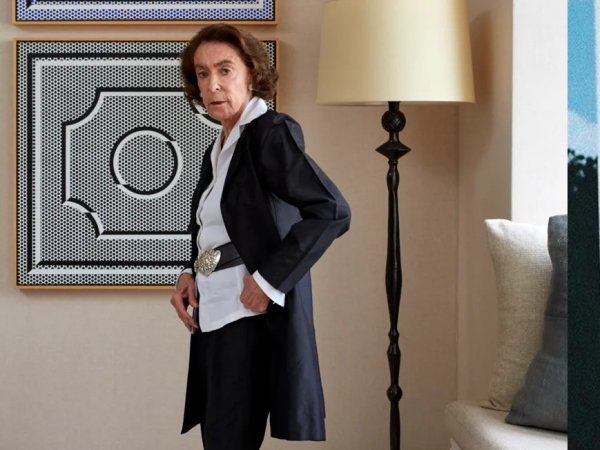
Romanian-born Mica Ertegun, the story of the Dior model who married America’s greatest music producer
- Articles
- 30 OCT 25
Mica Ertegun, born Ioana Maria Banu, came into the world in Bucharest, in a privileged family during an era when refinement and education defined social standing. Her father, Dr. George Banu, was a respected physician and a close associate of the Romanian Royal Family. Mica’s life seemed destined for comfort and culture—until history took a dramatic turn.
From Bucharest aristocracy to fleeing communism
With the installation of the communist regime after World War II, the Banu family became a target of persecution. In 1947, her father was arrested and imprisoned under false accusations. To save her family and secure their escape from the country, Mica agreed to a marriage of convenience at only 16 years old, to a 31-year-old nobleman named Ștefan Greciani.
The marriage was a necessary sacrifice, an act of survival in an era when freedom had become a rare privilege. Through this union, the family was granted permission to emigrate. Their departure was facilitated through royal intervention, with special trains provided for exiled aristocrats.
“The Russians gave us two trains. King Michael was in one, and his aunts were in the other. We were in the royal train. Crossing the border into Albania was the most beautiful moment of my life,” Mica recalled years later.
From Romanian refugee to Dior model
After a brief stay in Switzerland, the Banu family settled in Paris, where Mica discovered the world of fashion and elegance. Her refined beauty and natural grace soon caught the attention of major designers, and she was soon noticed by the legendary Dior fashion house.
For a time, the young Romanian became a model for Dior, showcasing haute couture creations by Christian Dior himself.
But beyond the glitter of Parisian high society, everyday life was far from easy. Despite their education and sophistication, the family had limited financial means.
Eventually, they decided to emigrate once again—this time to Canada—in search of a more stable future. There, they bought a small farm on the shores of Lake Ontario, financed by a modest loan, and began a quieter, humbler life.
A fateful encounter: meeting Ahmet Ertegun
In 1960, Mica traveled to New York for the first time with a heart-wrenching mission—to secure the release of her father, still imprisoned in communist Romania and gravely ill with cancer. Despite her efforts, her father died in detention, leaving her devastated.
Yet, in that same year, fate took an unexpected turn. During a social gathering in New York’s vibrant artistic circles, Mica met Ahmet Ertegun, a man who would change her life forever. Ahmet was the founder of Atlantic Records, one of the most influential record labels of the 20th century.
Of Turkish descent, Ahmet was a visionary who had discovered and launched legendary artists such as Led Zeppelin, The Rolling Stones, Eric Clapton, and Phil Collins. When he met Mica, he was still married, but their connection was immediate and profound. After his first marriage ended, Ahmet and Mica wed in 1961, forming one of the most elegant and admired couples in New York society.
From music mogul’s wife to design icon
Life alongside Ahmet Ertegun offered Mica not only financial stability but also the freedom to explore her creative passions. Fascinated by art, architecture, and interior design, she founded her own company, MAC II, which quickly became a prestigious name in the design world.
Her style was defined by balance—luxurious yet understated, sophisticated yet warm. Her ability to combine opulent materials with subtle details made her one of the most sought-after interior designers in New York. Her clientele included artists, business leaders, and cultural figures from across the globe.
Having lived in different countries and absorbed diverse artistic influences, Mica developed a cosmopolitan aesthetic rooted in elegance and harmony. Her designs transformed ordinary spaces into refined interiors that radiated comfort and sophistication. In New York, her name became synonymous with timeless taste and classic modernity.
A life shaped by art, love, and philanthropy
In 2006, Mica’s life took another tragic turn when her husband suffered a fatal accident. Ahmet Ertegun fell and sustained a severe brain injury, passing away shortly afterward.
The news deeply shook the music world. In his honor, Led Zeppelin reunited for the first time in 27 years, performing a historic tribute concert at London’s O2 Arena in 2007.
Following her husband’s death, Mica devoted herself to philanthropy. Deeply committed to education and culture, she donated more than 30 million euros to various causes.
Her most significant contribution was to the University of Oxford, where she established the Mica and Ahmet Ertegun Scholarships, supporting students in the humanities.
“We had a wonderful life. We spoiled ourselves. We didn’t have children. What else could I do with the money, buy diamonds? Many people give to hospitals, but I believe education is far more important,” she once said candidly.
A bitter disappointment with Romania
Despite living abroad for decades, Mica Ertegun never forgot her Romanian roots. She longed to invest in her homeland, but her philanthropic proposals were met with rejection by Romanian authorities. One of her most cherished projects aimed to restore Constantin Brâncuși’s sculptural ensemble in Târgu Jiu and to build a visitor information center nearby.
“I bought a piece of land at the base of the Column and wanted to build an information center for tourists, somewhere they could see the artworks, take photos, and have a Coca-Cola if it was hot. Everything had been approved, but when I was ready to begin, I was told it was no longer needed—that the people of Târgu Jiu would handle it,” she recounted with disappointment.
To make matters worse, local newspapers portrayed her unfairly, suggesting ulterior motives behind her initiatives. “The papers in Târgu Jiu were vicious—as if I were a thief. Some of the money went to Oxford instead. I hope many Romanians benefit from it. I felt insulted by how I was treated,” said Mica Ertegun.
A legacy of grace, generosity, and vision
The story of Mica Ertegun is one of resilience, grace, and determination. From a young refugee fleeing communism to a Dior model and, ultimately, one of New York’s most respected interior designers and philanthropists, she embodied elegance in its truest form.
She lived nearly a century, witnessing some of the most significant cultural and historical transformations of modern times. Her death in 2023, at the age of 97, marked the end of an extraordinary life story, one that bridged continents, worlds, and generations.
Romania may have missed the chance to directly benefit from her generosity, but Mica Ertegun’s legacy endures. Through the scholarships she founded, the students she continues to support, and the memory of her grace and intellect, she remains an ambassador of Romanian sophistication and humanity.
Her life stands as proof that refinement, intelligence, and compassion transcend borders and time, leaving behind a legacy of beauty and purpose that continues to inspire the world.
We also recommend: Jean Luis Calderon, the French journalist killed during the 1989 Revolution, has a street named after him in Bucharest