Noisy neighbors in Bucharest: What can you legally do, and where can you complain? Quiet hours and fines in 2026
- Articles
- 15 OCT 26
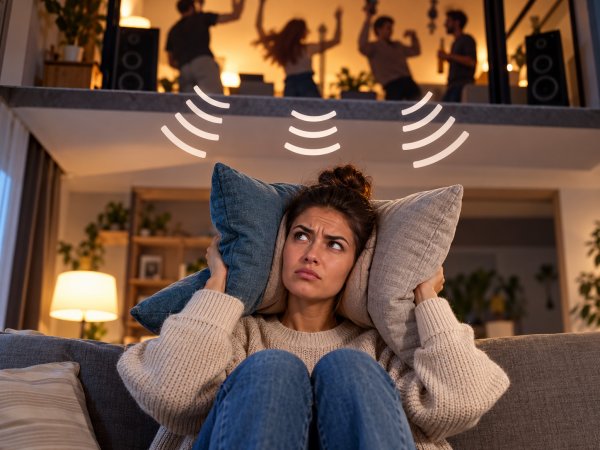
Loud music coming through the walls after midnight, a party upstairs that seems to go on forever, or the sound of drilling just when you're trying to rest. Living in an apartment building in Bucharest often means accepting a certain amount of noise, but there is a difference between the ordinary sounds of everyday life and disturbances that make it difficult to enjoy your own home. When asking a neighbor to turn down the volume doesn't work, knowing your legal options can make all the difference.
Romanian law sets specific quiet hours during which residents are protected against excessive noise, and those who ignore the rules can face substantial fines. However, one detail is often overlooked: a neighbor can also be penalized for disturbing the peace outside the official quiet hours, depending on the circumstances. With fines increased in June 2026, it is worth understanding exactly what the legislation says, which authorities can intervene and what role your building's homeowners' association can play.
What are the legal quiet hours in Bucharest?
Under Romanian Law No. 61/1991, the official quiet hours are between 10:00 PM and 8:00 AM, as well as between 1:00 PM and 2:00 PM. These rules apply throughout Romania, including all six sectors of Bucharest, and are intended to protect residents from excessive noise in their homes.
The legislation covers disturbances caused by loud music, shouting, commotion and the use of equipment or other objects at high volume, whether the noise originates inside a residential building or in its immediate vicinity. This means that the rules can apply not only to the apartment next door, but also to certain noisy activities taking place close to residential properties.
However, the existence of these legally protected periods does not mean that residents are free to make unlimited noise during the rest of the day. Article 2, point 25, of Law No. 61/1991 also prohibits unjustifiably disturbing residents through noise, shouting or loud commotion, without restricting the offense to particular hours.
For example, a neighbor who repeatedly plays music at an excessive volume at 6:00 PM may still be reported to the authorities, even though the official evening quiet hours have not yet begun. Whether the behavior constitutes an administrative offense depends on the circumstances, which must be assessed by the officers investigating the complaint.
At the same time, hearing footsteps, occasional conversations or ordinary household activities through the walls does not automatically mean that someone is breaking the law. Apartment living inevitably involves a certain degree of noise, and the distinction between everyday inconvenience and an unlawful disturbance is an important one.
What fines can noisy neighbors face in Bucharest in 2026?
The penalties for disturbing the peace were increased through Law No. 92/2026, which entered into force on June 13, 2026. As a result, many older online guides still mention amounts that are no longer applicable.
Under the updated provisions of Law No. 61/1991, unjustifiably disturbing residents through noise, shouting or loud commotion can result in a fine ranging from RON 200 to RON 1,000, even when the incident occurs outside the official quiet hours.
The penalties are higher when the disturbance takes place during the legally protected periods. Anyone who disrupts residents' peace between 10:00 PM and 8:00 AM or between 1:00 PM and 2:00 PM may receive a fine of RON 1,000 to RON 2,000.
The law also provides for fines of RON 4,000 to RON 6,000 in certain situations involving private parties with excessively loud music, organized in tents, temporary structures or uncovered spaces near residential buildings. This provision applies to specific circumstances and should not be confused with the rules governing an ordinary party inside an apartment.
The consequences can become more serious when the same type of offense is repeated within 72 hours of the first officially recorded violation. In the case of repeated disturbances during quiet hours, the penalty may increase to RON 4,000–6,000, while community service may also be imposed under the conditions established by law. For repeated disturbances outside quiet hours, the applicable fine may reach RON 1,000–3,000.
These increased penalties do not apply automatically simply because a neighbor is frequently noisy. The legal conditions regarding the previous officially recorded offense and the 72-hour period must be satisfied.
Where can you complain about a noisy neighbor in Bucharest?
When a neighbor repeatedly disturbs the peace, the most straightforward solution is often to discuss the problem directly, provided the circumstances allow for a calm and safe conversation. Sometimes, people are genuinely unaware of how much noise travels between apartments, particularly in older buildings with poor sound insulation.
If the disturbance continues, however, residents can contact the authorities responsible for maintaining public order, including the Romanian Police and the Local Police operating in their sector.
Contacting the Romanian Police
The Romanian Police can investigate complaints about excessive noise, establish whether an administrative offense has occurred and apply the penalties provided by law. In Bucharest, residents can contact the police station responsible for their neighborhood, with contact details available through the official website of the Bucharest General Directorate of Police.
When reporting an ongoing disturbance, it helps to provide the exact address, identify the apartment or area where the noise is coming from and explain what is happening. Mentioning how long the disturbance has continued can also help officers assess the situation.
The emergency number 112 should be reserved for genuine emergencies rather than routine noise complaints. If a dispute escalates into violence, threats or an immediate risk to someone's safety, however, contacting emergency services may be appropriate.
Reporting the disturbance to the Local Police
Bucharest's Local Police services, known as Poliția Locală, can also receive complaints about disturbances of public order and intervene within their legal powers. Because each of the city's six sectors has its own Local Police structures, contact numbers and reporting procedures may differ depending on where you live.
In Sector 1, for example, residents can contact the Local Police dispatch service at 021 9540, which operates around the clock for situations requiring intervention. Written complaints can also be submitted through the institution's official channels.
Residents of other sectors should consult their respective Local Police websites for updated contact details, particularly when reporting a disturbance that is happening at that moment.
Why written complaints can help when the problem keeps returning
A phone call may be the most practical option when loud music or shouting is happening in real time, but repeated disturbances are often easier to address when there is a clear record of previous incidents.
If the same neighbor regularly causes excessive noise, consider keeping track of the dates, approximate times, duration and nature of each incident. When submitting a written complaint, include these details alongside the building's address and any information about previous police interventions.
It is also useful to keep copies of your complaints, registration numbers and official responses. While documentation does not guarantee a particular outcome, it can help establish that the problem is recurring rather than isolated.
What can the homeowners' association do about a noisy neighbor?
In Romanian apartment buildings, the homeowners' association, or asociația de proprietari, is often the first institution residents turn to when conflicts arise. Although it cannot replace the police, it has an important role in maintaining reasonable standards of conduct within the building.
Law No. 196/2018 requires condominiums to have internal regulations covering the use of shared spaces and the principles of good neighborly relations. These regulations are adopted by property owners and must be respected not only by owners themselves, but also by tenants and other people temporarily staying in the building.
If a resident repeatedly disregards these rules, the affected neighbors can submit a complaint to the association's president or executive committee. The association may then discuss the situation with the person responsible, remind them of the building's regulations and attempt to resolve the dispute through the measures available under its legal authority.
For property owners submitting written complaints, the law also establishes a response deadline: the association's president must provide a written reply within a maximum of 10 days.
One important limitation is that a homeowners' association cannot issue the administrative fines established by Law No. 61/1991. Those penalties fall within the powers of the competent authorities, and a building's internal regulations cannot arbitrarily create equivalent sanctions.
Nevertheless, involving the association can still be worthwhile, especially when several residents are affected or the problem concerns the repeated behavior of someone living in the building.
What if the noisy neighbor is renting the apartment?
The obligation to respect other residents' peace and quiet applies equally to homeowners and tenants. Someone renting an apartment is not exempt from quiet-hour regulations simply because they do not own the property.
Under Law No. 196/2018, property owners are responsible for informing their tenants about the condominium's internal regulations. If a rented apartment becomes a recurring source of disturbances, the homeowners' association can therefore notify the landlord and ask for the building's rules to be respected.
At the same time, responsibility for a noise-related administrative offense can fall on the person actually causing the disturbance, regardless of whether they are a tenant or a property owner.
This distinction matters because contacting the landlord may help resolve a persistent problem, but it does not replace the possibility of reporting an ongoing disturbance to the police.
Can your neighbor use a drill or renovate their apartment during the day?
Renovation work is another common source of tension in Bucharest's apartment buildings, particularly when drilling, hammering or other noisy activities continue for several days.
Although property owners are generally entitled to carry out lawful renovations, that right does not exempt them from respecting the rules concerning residents' peace and quiet. Excessive noise caused by power tools during the legally protected periods of 10:00 PM–8:00 AM and 1:00 PM–2:00 PM may therefore fall under the provisions of Law No. 61/1991.
Outside those hours, renovation work is not automatically prohibited. However, if the noise is excessive and unjustifiably disturbs residents, the authorities may still assess whether the general provisions concerning disturbances of the peace have been violated.
Building regulations may also contain rules concerning the organization of renovation work, provided they remain within the limits of Romanian law.
For extensive renovations, informing neighbors in advance about the expected duration of the work and the hours when particularly noisy activities will take place can help prevent unnecessary disputes. Although this does not eliminate the inconvenience, it gives other residents an opportunity to plan around the disruption.
What can you do if the police intervene but the noise continues?
Some disputes are resolved after a single warning or fine, while others continue for months despite repeated complaints. When the problem persists, maintaining a consistent record of incidents and official interventions becomes particularly important.
Rather than relying solely on verbal discussions, residents can submit written complaints whenever appropriate, preserve the responses received and inform the homeowners' association about the ongoing nature of the disturbance. If several households are affected, each can describe the impact experienced in their own home.
In more serious cases, where excessive noise persistently interferes with the normal use of a property, legal action may also be considered.
Law No. 196/2018 allows affected people to approach the competent authorities or courts when a property owner acts in bad faith, prevents the normal use of the condominium and causes harm to others. However, taking a dispute to court requires an assessment of the particular circumstances and the available evidence, so legal advice may be necessary.
It is also worth remembering that police officers must assess each reported incident according to the law. Previous complaints may provide useful context, but they do not automatically establish that every subsequent noise incident constitutes an offense.
Living in Bucharest: Where does ordinary noise end and an unlawful disturbance begin?
Living close to other people inevitably means hearing some of what happens beyond your own front door. Children playing, occasional footsteps, household appliances and everyday conversations are part of apartment living, even when sound insulation is far from ideal.
The situation is different when noise becomes excessive, persistent or particularly disruptive, whether it involves loud music late at night, repeated shouting or activities that prevent residents from enjoying their homes in reasonable conditions.
For people facing such problems in Bucharest, the available options range from a direct conversation and a complaint to the homeowners' association to contacting the Local Police or Romanian Police. In persistent cases, written documentation and, where justified, legal advice may also become relevant.
Above all, residents should remember that Romanian law does not protect peace and quiet only after 10:00 PM. The official quiet hours provide additional protection, but certain excessive disturbances can also be sanctioned during the day, and the fines applicable in 2026 make ignoring these rules considerably more expensive.