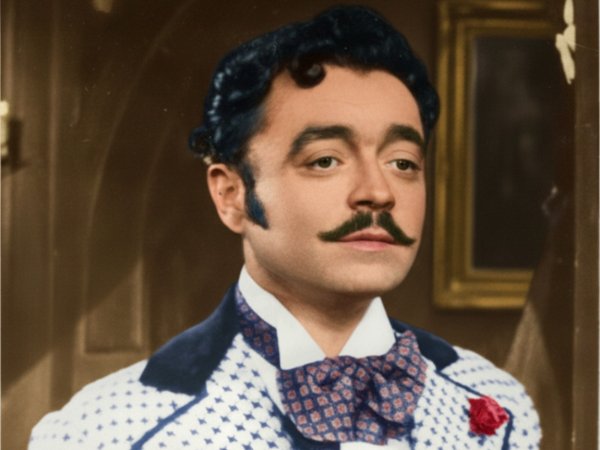
Ion Lucian, the master of theatre for children. The story of one of Romania’s greatest comedy actors
- Articles
- 10 MAR 26
The life of Ion Lucian represents one of those rare stories in Romanian culture in which success was not measured only in applause or popularity, but especially in the things built for future generations. Actor, director, pedagogue and theatre manager, Ion Lucian was more than an interpreter of memorable roles. He was a builder of institutions and a defender of the idea that theatre can also have a profound educational mission.
The great actor Ion Lucian
In a period in which the Romanian stage was dominated by ideology, propaganda and rigid cultural hierarchies, Ion Lucian chose an apparently marginal path: theatre for children and young people. Instead of pursuing major roles or quick notoriety, he preferred to create a space in which theatre could be sincere, courageous and educational. This choice defined his entire career and turned his name into a landmark for Romanian theatre.
Although he was also known and appreciated as a comedy actor, his true legacy is connected to the institutions and the people he formed. Ion Lucian was an artist who chose construction instead of glory and principles instead of comfort.
Childhood and the beginnings of an artistic destiny
Ion Lucian was born on April 22, 1924, in an interwar Romania in which theatre was considered a prestigious form of art, but access to it was often limited by elitist social and cultural circles. He came from a modest family, without direct connections to the artistic world, and his path toward the stage was not an easy one.
From adolescence, young Ion Lucian discovered a fascination for literature, poetry and theatre. He was not so much attracted by the brilliance of the stage or by the idea of celebrity, but by the power of theatre to transmit ideas and to educate the audience. For him, theatre was not only entertainment, but also a form of dialogue with society.
Determined to follow this path, he chose to study at the Conservatory of Dramatic Art in Bucharest. The period in which he was a student was extremely complicated for Romania. The country was going through the years of the Second World War, and after the conflict it would enter a radically different stage, with the establishment of the communist regime.
These years had a major impact on his formation. At the conservatory he did not learn only the technique of acting, but also lessons about discipline, responsibility and prudence. In an era in which artistic freedom was increasingly limited, Ion Lucian learned to preserve his principles without abandoning the profession.
Debut on stage and the first confrontations with the theatrical system
Ion Lucian’s artistic career began in the 1940s and 1950s, in a period when Romanian theatre was already strongly influenced by the ideology of the communist regime. Actors were often placed in situations of performing texts with propagandistic messages or participating in shows that supported the official discourse.
Ion Lucian, however, had evident qualities: a powerful voice, impeccable diction, scenic intelligence and a charismatic presence. Theatre critics quickly noticed him, and the audience appreciated him for the naturalness and refinement of his interpretation.
He performed on important stages in Bucharest and participated in shows that enjoyed success. However, he never became one of the actors favored by the regime. The reason was simple: he was not willing to accept major compromises in order to obtain roles or privileges.
In a system in which success could be conditioned by ideological conformity, Ion Lucian chose a more discreet but freer position. This attitude kept him away from certain official roles and privileged projects, but preserved his moral independence.
He understood quite early that artistic success in a politically controlled society often comes with a price. And Ion Lucian was not willing to pay it.
The choice of theatre for children and young people
One of the most important moments of his life was the decision to dedicate himself to theatre for children and adolescents. For many artists of the time, this area was considered secondary or even marginal.
Ion Lucian saw things differently. He was convinced that cultural education begins in childhood and that young audiences deserve shows just as serious and well constructed as those intended for adults.
For this reason, he began to create performances dedicated to children that did not treat them as an inferior audience. He avoided simplistic or moralizing texts and preferred intelligent stories, well written and staged with artistic rigor.
In his performances, children were not viewed as passive spectators, but as future adults who must be encouraged to think. The themes addressed were often courage, sincerity, freedom and personal responsibility. This vision was unusual for the time and contributed to changing the way theatre for children was perceived in Romania.
The Excelsior Theatre – the project of his life
The most important achievement of Ion Lucian remains the founding and development of the Excelsior Theatre in Bucharest. This institution became, over time, one of the most important cultural spaces dedicated to children and young people.
Ion Lucian was not only the director of the theatre, but also the main driving force behind its development. He selected the repertoire, formed actors, coordinated artistic projects and maintained high standards of professionalism.
For him, the theatre was not a bureaucratic institution, but a living organism. Every performance had to have meaning, and every collaboration had to be justified artistically.
Under his leadership, the Excelsior Theatre became a respected place in the cultural world, but also a space that was sometimes uncomfortable for authorities. Ion Lucian did not accept artistic compromises and did not tolerate superficiality.
This attitude inevitably generated tensions with certain cultural institutions or local administrations. For many officials, theatre for children was a minor genre that did not deserve special attention. Ion Lucian proved exactly the opposite.
Through his work, he managed to transform Excelsior into a modern theatre, respected and appreciated by the public.
An uncomfortable but respected artist
Ion Lucian was never a comfortable person for the artistic system or for cultural institutions. In an environment in which personal relationships, compromises and convenient silences were often the rule, he preferred to call things by their name.
He refused politically imposed texts, collaborations made out of obligation, or projects that diluted the artistic message. This attitude brought him the reputation of being rigid, authoritarian or excessively demanding.
In reality, those who worked with him say that he was severe only when it came to mediocrity. He had no patience for superficiality or lack of professionalism, but he respected people dedicated to the profession.
The controversies surrounding him were never related to personal scandals or questionable behavior. They were, for the most part, conflicts of vision: what theatre is and whom it should serve. For Ion Lucian, theatre was a form of cultural responsibility.
Personal life and the discretion of an artist
Another defining aspect of his personality was the almost total discretion related to his personal life. Unlike many artists of the era, Ion Lucian did not cultivate a public image and was not interested in social life.
He did not appear in magazines, did not attend social events and did not expose his family in the public space. Although he was married and had a family, he chose to keep these aspects of his life in the private sphere.
Those who knew him closely describe him as a sober, disciplined person and emotionally reserved. He was an extremely rigorous man who dedicated most of his time to theatre.
For Ion Lucian, the stage was not only a profession or a career. It was a personal mission, a way of contributing to the formation of the audience and of society.This total dedication inevitably involved personal sacrifices.
Late recognition and cultural legacy
Although he had a long and influential career, the official recognition of his value came relatively late. Only toward the end of his life did Ion Lucian begin to receive the awards and tributes he had long deserved.
Cultural institutions, colleagues from the profession and the public began to acknowledge his essential role in the development of theatre for children and young people in Romania.
Ion Lucian never sought these honors. He did not run image campaigns and did not try to publicly promote his achievements. Nevertheless, he accepted them with dignity when they came.
He died on March 31, 2012, at the age of 87. In his wake remained not only the Excelsior Theatre, but also an entire generation of artists who learned from him what discipline, respect for the audience and cultural responsibility mean.
Today, the name of Ion Lucian is associated with the idea of theatre made with seriousness and respect for spectators, regardless of their age. His story remains an example of how an artist can choose durable construction instead of rapid success and how an authentic passion can change an entire field of culture.
We also recommend: Boema Garden, the Summer Theater in Bucharest Where Romances and Light Music Were “Born”