Bucur Maternity Hospital, a brief history. Few Romanians know it was built from the donation of industrialist Dumitru Mociorniță

By Bucharest Team
- Articles
Few residents of Bucharest know today that Bucur Maternity Hospital, one of the essential medical institutions in the southern part of the Capital, has its origins in an exceptional act of generosity. The building that houses the maternity hospital was built with funds donated by the industrialist Dumitru Mociorniță, a name that, although no longer in the center of public discourse, had a major impact on the development of medical services in the city.
The first philanthropic initiatives and their role in the medical development of the Capital
A prosperous businessman but also a visionary of his time, Mociorniță invested in health at a time when the Romanian medical system needed private support to function at decent standards.
The donor financially supported several medical institutions that would become important landmarks. Among these are the Scarlat Longhin Clinical Hospital of Dermatology and Venereology, located on Calea Șerban-Vodă, today in ruins due to restitutions, as well as the first medical unit dedicated to tuberculosis patients in Bucharest, Filaret Hospital, currently known as the “Marius Nasta” Institute of Pneumophthisiology.
In a period when infectious diseases were rampant and the state lacked all the necessary resources to expand medical infrastructure, Mociorniță’s contributions represented vital support for the modernization of healthcare.
The construction of the Bucur dispensary – the beginnings of an essential institution
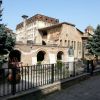
One of the industrialist’s most important achievements was financing a modern dispensary on Între Gârle Street in 1937. At the time of its inauguration, the press, represented by the publication Realitatea ilustrată, called it “the most beautiful dispensary in the capital.”
The building stood out for its elegant architecture, the facilities considered advanced for the era, and the role it was to play in a part of the city undergoing rapid development. The fate of the building, however, was complicated.
Nationalized in 1948, like many other institutions built through private efforts, it was taken over by the state and temporarily redirected to other functions. For a few years, it was used by the State Security and the Post Office, losing its medical purpose. Only later, with the reorganization of the healthcare system, did the building return to its original purpose, once again becoming a support point for the community.
Healthcare transformations of the 1980s and the birth of Bucur Maternity Hospital
A decisive moment for the evolution of the institution came in 1981, when administrative restructurings in healthcare radically changed the function of several medical buildings. During that period, the Ilfov County Clinical Hospital was transformed into the Sector 4 Clinical Hospital, becoming the current St. John Hospital.
Along with this reorganization, the medical unit took over the clinical departments operating at Bucur, and the maternity hospital from the unified Hospital no. 9 “Gheorghe Marinescu” was moved into the dispensary building.
Thus, the old Bucur Dispensary gradually transformed into Bucur Maternity Hospital, as we know it today. Over the years, this institution has witnessed the birth of tens of thousands of children and has become an important landmark in Bucharest’s medical system, especially for residents of the Berceni neighborhood and surrounding areas.
The life and rise of industrialist Dumitru Mociorniță
The personality of Dumitru Mociorniță deserves a special place in collective memory, as his life story is one of the most impressive social ascents in Romania during the first half of the 20th century. Although he came from a modest peasant family in Prahova, his destiny changed radically thanks to his own efforts and a providential event.
During his baccalaureate exam, the young Mociorniță was noticed by Prime Minister Ion I. C. Brătianu, impressed by his intelligence and seriousness. Brătianu offered him a scholarship at the Higher School of Commerce in Bucharest, the first major step in his career.
Later, also with public support, he attended the Higher School of Industry in Paris, where he completed his studies and gained experience in an economic environment far more advanced than Romania’s at the time. After graduation, he worked abroad, with the opportunity to build a stable career in Germany or the United States. Surprisingly to many, he chose to return to the country, convinced that he could contribute to Romania’s industrialization.
A bold investment and the birth of a Romanian industry
Upon returning to Bucharest, Mociorniță borrowed from banks and sought the support of his father-in-law, Grigore Alexandrescu, one of the pioneers of the Romanian light industry. With the money obtained, he bought two hectares of land on the banks of the Dâmbovița River, on Apele Minerale Street, known today as Ion Minulescu Street. It was an area beginning to develop industrially, and the location he chose was not accidental: nearby was the famous Văcărești mineral water spring, built in 1872, a popular spot at the time.
On the acquired land, Mociorniță established a tannery and leather factory, which quickly grew in size and notoriety. With a modern vision and industrial discipline close to Western practices, his business became one of the largest footwear producers in Romania. The products made in his factory were known for quality, and economic success allowed him to actively engage in social and medical projects.
The factory building he constructed still exists today at Ion Minulescu Street no. 67–93. Although it no longer operates under its original name, but under the name Flaros, and has changed its profile by renting out spaces, it still retains traces of its industrial past and represents one of the few architectural testimonies of the era.
The philanthropist’s legacy and his impact in Bucharest
Dumitru Mociorniță’s charitable efforts cannot be seen as isolated acts, but as part of a life philosophy in which social responsibility was as important as business success. In the interwar period, Romanian industrialists played an essential role in supporting society, and Mociorniță stood out as one of the most honest and dedicated.
The hospitals and dispensaries built from his donations have remained, despite political transformations, crucial points in the development of the capital’s medical network. Bucur Maternity Hospital is perhaps the most visible of his legacies, a place where thousands of families have experienced their most important moments. The fact that such an important institution was founded on the act of a man who started from nothing is a little-known detail, but one worth bringing back into public awareness.
A story about ambition, responsibility, and restoring dignity through health
The history of Bucur Maternity Hospital is not just the story of a building, but also of an era in which a few visionary individuals chose to invest in public good. Dumitru Mociorniță, the industrialist who built factories as well as hospitals, remains a rare example of authentic philanthropy during a time when Romania needed courage, innovation, and solidarity.
Today, the maternity hospital continues to operate and fulfill its mission, and rediscovering its origins is a necessary step to understand how much individual gestures can change society. Mociorniță’s legacy, present in the walls of the medical institutions he supported, remains proof that true progress is built with responsibility, vision, and generosity.
We also recommend: Filantropia Maternity Hospital in Bucharest, 212 years of history. The story of the oldest obstetrics and gynecology clinic in Romania