The other Lipatti. Valentin, essayist, translator and one of Romania’s greatest diplomats
By Bucharest Team
- Articles
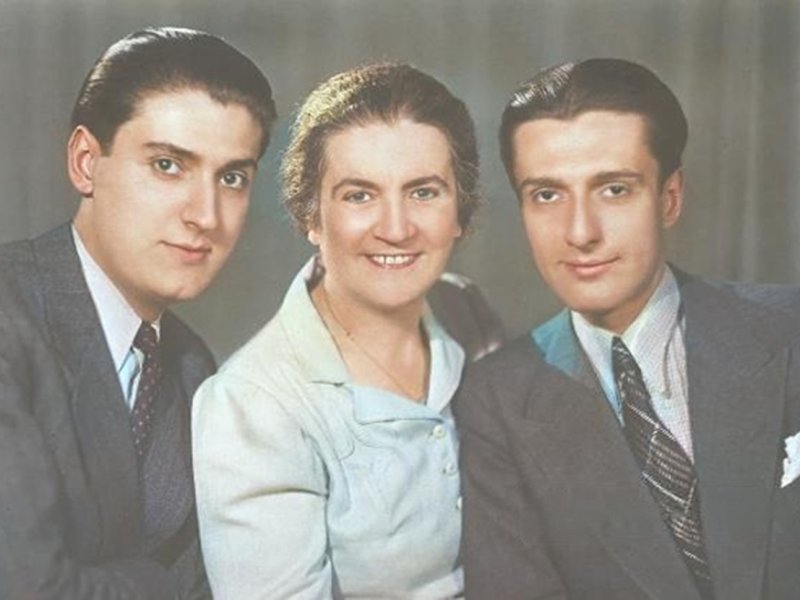
For a long time, the Lipatti family has been written about almost exclusively through the lens of music. The name of Dinu Lipatti became a symbol of Romanian pianistic genius, a universal benchmark of interpretative art. Much less known to the general public, however, remains his brother, Valentin Lipatti, a personality of remarkable intellectual and diplomatic stature. Far from the stage and applause, Valentin Lipatti built a solid career in culture and diplomacy, becoming one of Romania’s respected voices in the 20th century, in an extremely complicated international context.
An intellectual destiny in an elite family
Valentin Lipatti came from a boyar family, deeply rooted in the values of education, culture, and art. If Dinu Lipatti chose the language of music to express himself, Valentin opted for the word, the idea, and negotiation. His intellectual formation was complex, doubled by an authentic openness toward the great European cultures, especially the French one, which would define his professional path.
In his youth, Valentin Lipatti was also attracted to the world of theatre. He attended for two years the courses of the Conservatory in Paris, flirting with acting, during a period when his artistic searches were still taking shape. This experience refined his sense of expression and discourse, skills that would later prove extremely useful in his diplomatic career.
Academic training and university career
The decisive choice came upon his return to the country, when Valentin Lipatti attended the Faculty of Letters and Philosophy of the University of Bucharest, between 1942 and 1945. His humanistic studies consolidated his profile as a rigorous intellectual, attentive to nuances, to context, and to the dialogue between cultures.
After graduation, he became a member of the teaching staff at the Faculty of Romance and Classical Languages, where he taught between 1947 and 1964. His university activity was intense and appreciated, focused on French literature and on the cultural relations between Romania and the Francophone world.
Valentin Lipatti was not only an erudite professor, but also a shaper of mindsets, promoting critical thinking and intercultural dialogue in a period marked by ideological constraints.
The essayist and researcher of French culture
Valentin Lipatti’s academic concerns materialized in a series of reference works. Volumes such as Cours de littérature française (1967) and Dix-huitième siècle français (1976) reflect his constant interest in the Age of Enlightenment and in the circulation of ideas between France and Romania. In these studies, Lipatti analyzed reciprocal cultural influences, demonstrating the decisive role of the French spirit in shaping modern Romanian literature.
He also published French language textbooks and critical studies gathered in the series Valori franceze (1959–1968), in which he explored the impact of Western models on Romanian culture. These works contributed to maintaining a living cultural dialogue in a period when ideological isolation threatened authentic intellectual exchanges.
Entry into diplomacy and the role at UNESCO
The political context of communist Romania led the state leadership to turn, in diplomacy, to prestigious intellectuals capable of offering external credibility to the country. Alongside personalities such as Tudor Vianu, Iorgu Iordan, or Grigore Moisil, Valentin Lipatti was recruited into the Ministry of Foreign Affairs in 1964.
One year later, he was appointed Romania’s representative to UNESCO, a position he held until 1971. In this capacity, he continued the tradition of Romanian cultural diplomacy, being elected a member of the Executive Council of the organization. His activity contributed to promoting Romania’s cultural and intellectual heritage within an international framework dominated by the tensions of the Cold War.
The negotiator at Helsinki and Geneva
The peak of Valentin Lipatti’s diplomatic career was reached between 1972 and 1977, when he led Romania’s delegation to the Conference on Security and Cooperation in Europe, held in Helsinki and Geneva. This stage represented a major test of diplomatic intelligence and moral firmness.
Lipatti stood out through his principled positions, supporting fundamental ideas such as the non-use of force, respect for state sovereignty, and the peaceful settlement of conflicts. In a climate dominated by geopolitical pressures, he refused to automatically align himself with positions dictated by the Soviet Union, advocating for the equality of all states, regardless of their size or influence.
International recognition and diplomatic courage
His firm stance did not go unnoticed. The Western press appreciated the courage and clarity of his discourse. An article published in the Los Angeles Times on June 27, 1975, described him as “a courageous diplomat from behind the Iron Curtain who made the Russians grind their teeth.” Other international publications emphasized his professional authority, noting that “when Lipatti speaks, delegates listen.”
Thanks to his negotiating skills, Valentin Lipatti contributed to clarifying the concept of European collective security, influencing the formulation of the conference’s final act. This period was later evoked in his memoirs, suggestively titled În tranșeele Europei (In the trenches of Europe).
Ambassador, essayist, and prestigious translator
Between 1978 and 1984, Valentin Lipatti held ambassadorial responsibilities, but he withdrew from diplomacy before this function became fully subordinated to the political directives of Nicolae Ceaușescu’s regime. His withdrawal was an act of lucidity and professional dignity.
At the same time, he continued his activity as an essayist and translator. He wrote about Italian literature, about Montesquieu as an Enlightenment thinker, about the painter Modigliani, and about contemporary French drama. He translated into French works by I.L. Caragiale and Liviu Rebreanu, contributing to the promotion of Romanian literature in the Francophone space.
Memoirs and reflection on the contemporary world
Valentin Lipatti was also a lucid analyst of geopolitical developments. The volumes Balcanii ieri și astăzi (The Balkans yesterday and today), Război și pace în Balcani (War and peace in the Balkans), and Lumea în tranziție (The world in transition) reflect his concern for regional instability and global transformations.
Of particular documentary value are his memoirs, Strada Povernei 23 and În tranșeele Europei, in which he reveals the backstage of international diplomacy during the Cold War.
In the final years of his life, he looked at his existence with lucidity and melancholy, describing it as a struggle with illness and disillusionment. Nevertheless, recognition did not fail to appear: he was decorated with numerous orders and medals and became a member of the European Academy of Arts, Sciences, and Literature.
A legacy that deserves to be rediscovered
Although he lived in the shadow of his famous brother, Valentin Lipatti left behind a solid legacy in diplomacy and culture. He was a formidable negotiator, a profound intellectual, and a man of principle.
Rediscovering his work and activity means, in fact, recovering an essential part of the intellectual and diplomatic history of modern Romania.
We also recommend: The story of Dinu Lipatti, the genius of Romanian music. The greatest Romanian pianist died at the Christ-like age