The history of the Perla Restaurant in Bucharest, the venue where “Little Prince” Nicu Ceaușescu had fun away from curious eyes
By Bucharest Team
- Articles
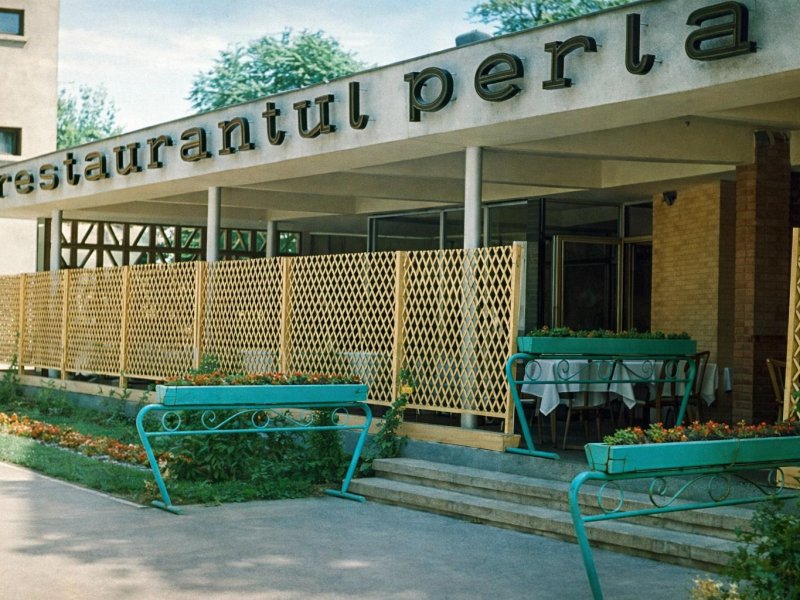
At the intersection of Dorobanți Street and Ștefan cel Mare Boulevard, in an area that pulsed with urban life and social effervescence, the Perla Restaurant was, for decades, one of Bucharest’s best-known and most respected venues. Especially during the 1980s, Perla was not just a restaurant, but a true landmark of public dining, a place where refined tastes, influential relationships, and stories whispered over discreetly lit tables came together.
A gastronomic landmark at an emblematic intersection of the capital
In an era dominated by shortages, restrictions, and political control, the existence of a restaurant with a strong identity, constantly frequented and appreciated for its services, was a rare achievement.
Perla managed to impose itself not only through its location, but also through the prestige it accumulated over time, becoming a true flagship of Bucharest gastronomy. Those who crossed its threshold knew they were not entering an ordinary establishment, but a space with unwritten rules, a select clientele, and a special status within the city’s landscape.
The restaurant’s management and the people behind its success
An essential role in the history of the Perla Restaurant was played by Paul Bundac, a well-known name in the world of venues along Calea Dorobanților. He had been the restaurant’s director since 1984, a period during which Perla had already consolidated its reputation as a respected and popular establishment.
After 1989, in a completely changed economic and social context, the space was first leased and later purchased by Bundac himself, who continued to manage it, preserving its spirit and standards.
Before the fall of the communist regime, however, the success of a restaurant depended not only on managerial skill or staff quality. Everything was strictly controlled, and supply was one of the greatest challenges.
Even though Perla was frequented by “people of status,” this did not bring real privileges. On the contrary, as those involved would later testify, in order to maintain a decent menu, numerous compromises were required, including substantial “incentives” to suppliers, within a system suffocated by shortages and bureaucracy.
Perla and the Warsovia period, the Romanian–Polish partnership
A distinct chapter in the restaurant’s history is represented by the years when the venue also bore the name Warsovia, following a Romanian–Polish partnership. This association brought with it a touch of exoticism and differentiation, extremely rare in Romania of the 1980s. At a time when the gastronomic offer was poor and uniform, Warsovia became a point of attraction for those who wanted something different.
The most famous symbol of this partnership was Okocim beer, imported from Poland. For many Bucharest residents, Okocim was considered far superior to the local Bucegi beer, which dominated the market at the time.
The fact that this beer could be consumed at Perla contributed significantly to the venue’s fame, turning it into a pilgrimage site for connoisseurs and for those eager to taste “something else” in an austerity-stricken Romania.
The Warsovia period strengthened the restaurant’s reputation as a cosmopolitan, discreetly Western space, despite the political and economic realities of the era. It was one of the few windows onto a freer world, even if only symbolically and gastronomically.
A discreet refuge for “Little Prince” Nicu Ceaușescu
The Perla Restaurant entered urban folklore definitively through its association with Nicu Ceaușescu, nicknamed “Little Prince,” the son of dictator Nicolae Ceaușescu. Away from curious eyes and official rigidity, Nicu would often spend time at the restaurant, in a cozy private booth, alongside his close friends.
Perla thus became a space of escape, where rules seemed more relaxed and the atmosphere less rigid than in other places frequented by the communist nomenklatura.
Nicu Ceaușescu’s presence, however, also brought tension. The Securitate was permanently on alert, and the restaurant staff lived with the constant fear of inspections or unforeseen situations. An incident recounted by Paul Bundac became emblematic of that period: one morning, Nicu had disappeared, and the security forces searched for him everywhere.
Around 7:30 a.m., they also arrived at Perla, rummaging through the entire establishment in search of him. Fortunately for the employees, Nicu was not there at that moment, otherwise the consequences would have been difficult to imagine.
Such episodes perfectly illustrate the climate of fear and uncertainty that hovered even over those considered privileged. Perla was a place of entertainment, but also a space where a simple visit could have serious implications.
Lăutari music and an elite clientele
One of the defining elements of the Perla Restaurant was authentic lăutari music. At a time when entertainment was closely supervised and often censored, the musicians at Perla managed to create a warm, vibrant atmosphere that attracted a loyal clientele. Not only Nicu Ceaușescu was drawn to this ambiance, but also numerous Securitate officers from the leadership of the Romanian Communist Party, who became regular customers of the venue.
Paradoxically, those who represented the repressive arm of the regime came here to relax, in a space where music, food, and drink offered the illusion of normality. At the tables of Perla, important conversations took place, plans were made, and relationships were consolidated, in a strange mix of power, fear, and good cheer.
Despite this, the status of the clientele did not protect the administrators and employees from the rigors of the system. The rules were the same for everyone, and even minor deviations could have serious consequences.
Restrictions, inspections, and life under the authorities’ scrutiny
The 1980s were marked by severe measures imposed by the Ceaușescu regime, and restaurants were no exception. One of the most absurd orders was that all venues had to close at 10:00 p.m. In addition, curtains were removed from windows so that interior activity could be visible from the street. Militia officers constantly patrolled, checking whether these rules were strictly observed.
For Perla, these measures represented a major challenge. Any delay, any deviation from the schedule, or any suspicion could lead to drastic sanctions, including the immediate arrest of those responsible. Employees lived permanently with the feeling that they were being watched, that every gesture was analyzed, and that any mistake could become fatal.
In this context, the success and longevity of the Perla Restaurant are all the more impressive. It managed to survive in a system hostile to initiative, maintaining its identity and appeal during a period when most venues were little more than personality-less canteens.
After 1989, the decline and disappearance of a symbol
The fall of the communist regime brought hope, but also radical changes. After 1989, the Perla Restaurant entered a new phase, being leased and then purchased by Paul Bundac. Nevertheless, economic transformations, increased competition, and changing public tastes made it increasingly difficult to maintain a traditional venue in a city undergoing rapid reconstruction.
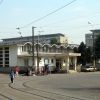
Eventually, the restaurant disappeared, and the building was demolished. Today, in the place where lăutari music and the clinking of glasses were once heard, there is a cosmetics and sanitary goods store, a pharmacy, and a bistro. The space has completely changed its identity, and few of those who pass through the area daily still know what Perla once meant for Bucharest.
The legacy of the Perla Restaurant in the city’s memory
Even though it no longer exists physically, the Perla Restaurant continues to live on in the city’s collective memory. It is recalled as a symbol of an era when restaurants had personality, prestige, and stories. It was not just a place to eat and drink, but a social space, a witness to recent history, a setting for contrasts between power and fragility.
Perla was the place where “Little Prince” Nicu Ceaușescu had fun away from curious eyes, where Securitate officers listened to lăutari music, and where privileged Bucharest residents tried to forget, at least for a few hours, about shortages and fear. In a Romania of control and deprivation, Perla represented an island of normality, with all its contradictions.
Today, the story of the Perla Restaurant remains an important page in the history of Bucharest, recalling times when venues were not simple businesses, but true urban institutions, laden with symbols, emotions, and destinies that met, collided, and faded away at the same table.
We also recommend: The “Pescăruș” restaurant in Bucharest, the favorite place of the communist nomenklatura