The eccentric Gheorghe Petrașcu, one of the greatest Romanian painters, has a street bearing his name in Bucharest
By Bucharest Team
- Articles
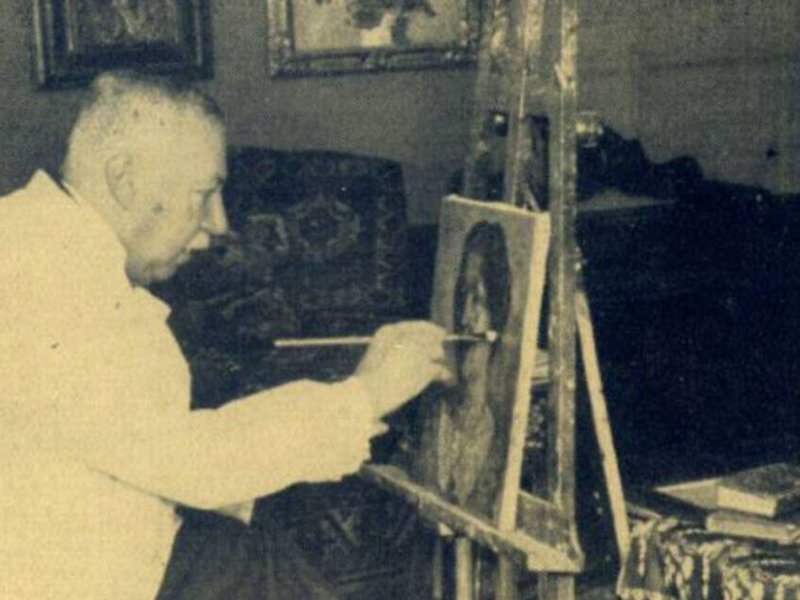
The history of Romanian art is marked by personalities who managed to transcend the limits of their era, asserting themselves through originality, expressive force, and a deeply personal vision of the world. Gheorghe Petrașcu is among those rare artists whose work continues to impress even today. Considered one of the most important Romanian painters of the 20th century, he was an eccentric spirit, a passionate creator, and a name that brought Romanian art into the circuit of European values. His recognition is visible not only in museums and collections, but also in the urban space of the capital, where a street bears his name.
Origins and early years in a family with cultural traditions
Gheorghe Petrașcu was born under the name Gheorghe Petrovici, on November 20 / December 2, 1872 — or, according to other sources, on December 1, 1872 — in the town of Tecuci, Galați County. He came from a family with intellectual and cultural concerns, a fact that decisively contributed to his formation. His father, Costache Petrovici-Rusciucliu, a small landowner from the Fălciu region, and his mother, Elena, née Bițu-Dumitriu, offered him a stable environment open to education.
From childhood, the future painter showed a clear attraction to drawing and color. His talent did not go unnoticed, and during his secondary studies in Tecuci, completed in 1889, he was noticed by drawing teacher Gheorghe Ulinescu, who encouraged his artistic inclinations.
Intellectual formation and the discovery of artistic vocation
After finishing secondary school, Gheorghe Petrașcu attended the Real High School in Brăila between 1889 and 1892, a period during which he strengthened his general education and obtained his baccalaureate diploma. Although his path initially seemed oriented toward a scientific career, in 1892 he was admitted to the Faculty of Natural Sciences in Bucharest, which he attended for two years.
However, the call of art proved stronger. Between 1893 and 1898, he studied at the Academy of Fine Arts in Bucharest, where he distinguished himself through seriousness and sustained work. He graduated with seven bronze medals and three mentions, results that confirmed an authentic talent in full development.
Paris and the encounter with great European art
At the recommendation of Nicolae Grigorescu, one of the spiritual mentors of his generation, Gheorghe Petrașcu received a scholarship from the Ministry of Public Instruction, led at that time by Spiru Haret. This opportunity allowed him to perfect his studies abroad.
After a short stay in Munich, he arrived in Paris, where, between 1898 and 1902, he attended the courses of the Julian Academy. He worked in the studio of the renowned William-Adolphe Bouguereau and came into direct contact with the major artistic movements of the time. During this period, he traveled frequently both in Romania and in various European countries, experiences that enriched his style and plastic vision.
Exhibition debut and public recognition
The year 1900 marked his important debut before the Romanian public, through his first personal exhibition organized at the Romanian Athenaeum, where he presented 60 works. The event drew the attention of prominent figures of Romanian culture, such as Barbu Delavrancea and Alexandru Vlahuță, who purchased works from him, validating his artistic value.
One year later, together with other young Romanian artists studying in Paris — Ștefan Luchian, Nicolae Vermont, Arthur Verona, Frederic Storck, Kimon Loghi, and others — Gheorghe Petrașcu took part in founding the society “Tinerimea Artistică,” a group that played an essential role in the modernization of Romanian art.
Travels, themes, and the maturation of style
Gheorghe Petrașcu’s work was built upon an extremely rich visual experience. He painted landscapes from numerous regions of Romania, such as Sinaia, Târgu Ocna, and Câmpulung-Muscel, as well as from abroad: France, Spain, Italy, England, the Netherlands, Belgium, and Germany.
Italy held a special place in his creation, with Venice, Chioggia, and Naples becoming constant sources of inspiration. In 1904, in Florence and Naples, he befriended the French painter Émile Bernard, a relationship that subtly influenced his artistic direction.
Artistic recognition and major exhibitions
Between 1903 and 1923, Gheorghe Petrașcu held numerous personal exhibitions at the Romanian Athenaeum, and between 1926 and 1930 he exhibited at the “Căminul Artei.” The peak of his exhibition career was represented by the two major retrospectives organized at Sala Dalles in 1936 and 1940.
He participated three times in the Venice Biennale, in 1924, 1938, and 1940, confirming his international status. He was also present at the International Art Exhibition in Munich and at many prestigious European artistic events.
Awards, distinctions, and official consecration
The value of his work was recognized through numerous distinctions. He received the Grand Prize of the International Exhibition in Barcelona in 1929 and that of the Paris Exhibition in 1937. In 1932, the French government awarded him the Legion of Honor.
On May 27, 1936, Gheorghe Petrașcu was elected full member of the Romanian Academy, becoming the first visual artist admitted in this capacity after Nicolae Grigorescu. In 1948, he became an honorary member of this institution.
Final years and artistic legacy
After participating in the Venice Biennale in 1942, the painter became seriously ill and was forced to cease creative activity. In the following years, he only sent works created earlier to exhibitions in Romania and abroad. Gheorghe Petrașcu passed away on May 1, 1949, in Bucharest.
His work, characterized by dense chromatics, expressive strength, and a profound concreteness of reality, includes paintings that have become landmarks of Romanian art, such as “Interior at Târgoviște,” “Self-Portrait,” “Toledo,” “Odalisque,” “Anemones,” and “Sunflower.”
Posterity, value, and the artist’s memory
After his death, recognition of Gheorghe Petrașcu continued. In 1972, on the centenary of his birth, the National Gallery of Bucharest organized a large retrospective exhibition. One year later, the documentary film “Gheorghe Petrașcu,” directed by Nina Behar, was produced.
In September 2022, the National Bank of Romania launched a silver coin dedicated to the 150th anniversary of the artist’s birth. His works are highly valued on the art market, constantly ranking among the most sought-after at auctions.
The house-studio in Târgoviște, built by the painter in 1922, now functions as a museum, keeping alive the memory of a creator who transformed Romanian painting into a language of European value. Gheorghe Petrașcu thus remains not only a street name in Bucharest, but a symbol of authentic Romanian art.
We also recommend: The story of painter Nicolae Grigorescu, the orphan from the Cărămidarilor neighborhood who painted icons to sell at the fair