Radu Vodă Monastery in Bucharest, Built in Honor of Victories Won in Battle, Was Meant to Be the Metropolis of the Capital
By Bucharest Team
- Articles
Radu Vodă Monastery in Bucharest, with the patronages of the Holy Trinity and Saint Hierarch Nectarios of Aegina, was built by Voivode Alexandru II Mircea (1568–1577) together with his wife, Ecaterina. The reason for its construction was one of gratitude: the voivode wanted to thank God for the victory he had achieved in the battles fought against Vintilă-Vornicul and Dumbravă-Vornicul on these lands.
Founders and Purpose of the Monastery
Initially, Alexandru II Mircea intended the monastery to be the Metropolis of the Capital, a symbol of the city’s faith and spiritual authority. At the time of its founding, the monastery was called the Holy Trinity, and its construction marked a moment of affirmation of faith and ducal gratitude.
The history of the monastery was not without obstacles. In 1595, during the wars and Turkish incursions, the Holy Trinity fell into Turkish hands. After Mihai Viteazul’s victory at Călugăreni, Sinan Pasha, one of the greatest enemies of the voivode, fortified the monastery with palisades, earthen walls, and bastions.
Destruction and Turbulent Periods
The entire city of Bucharest was also strengthened by the Turks, but these efforts proved insufficient. Following Mihai Viteazul’s victory in October 1595 at Târgoviște, Sinan Pasha was forced to retreat, but not before destroying all the fortifications he had built, including the monastery, down to its foundations.
The times were turbulent and dangerous: the city was devastated not only by the Turks but also by the troops of Christian voivodes or by Tatars. Fires and looting were constant, and the monks of the Holy Trinity were forced to take refuge at Mihai Vodă Monastery. Political upheavals and frequent changes of rulers in Wallachia made it impossible to reconstruct the monastery immediately.
Reconstruction of the Monastery
Only in 1614 did Voivode Radu Mihnea (1601–1602, 1611–1616, 1620–1623) begin reconstruction, maintaining the original plans and height of the building. From that moment, the church has been known by the name of its founder, Radu Vodă. His successor on the throne, Alexandru Coconul (1623–1627), oversaw the painting of the church, adding decorative elements to its interior.
During the Phanariote reigns, the Radu Vodă Monastery, one of the richest in Bucharest, was managed by Greek abbots. Although they were skilled merchants, they proved inadequate as administrators of the monastery buildings. Nevertheless, the monastery accumulated considerable wealth: estates, vineyards, houses, and shops in the city, but this prosperity was not reflected in improvements to the buildings.
Architecture of the Church
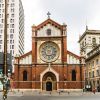
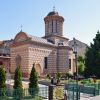
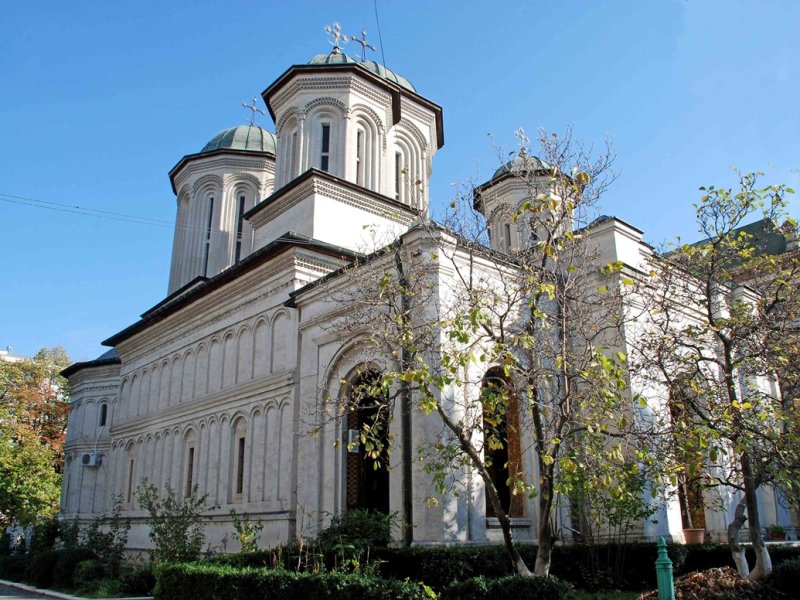
The plan and architectural style of Radu Vodă Church are inspired by the episcopal church at Curtea de Argeș, with a major difference: the construction material was brick, not stone. The church has a triconch plan, with a dome over the nave and an enlarged narthex. The three domes, the central one supported by twelve columns, symbolize the twelve apostles, following the model of Curtea de Argeș.
The facades are divided into two registers of unequal height, separated by a belt course. The decoration is simple and elegant, consisting of recessed niches with architraves that create a pleasant rhythm on the white-plastered surfaces. The current appearance of the church results from restoration carried out between 1967 and 1974 by architect Ștefan Balș, after which the church was repainted.
Restorations and Interior Elements
The restoration returned the church to its original form, eliminating modifications made in the 19th century, when the upper part had been rebuilt in the fashionable neo-Gothic style. At the same time, a porch was added, which remains to this day. The interior preserves a remarkable Baroque iconostasis and historic tombstones in the narthex, including the tomb of Vlad Voievod, son of Mihnea Turcitul, who died at the end of the 16th century.
The tomb of the founder, Radu Vodă, is located on the right, between the narthex and the nave. The gravestone, placed by his son, contains a long inscription detailing the glorious reign and achievements of the voivode, recalling his victories in wars and the burial in Hârlău in 1626.
Bell Tower and Monastic Cells
On the north side of the church is the bell tower, the last remnant of the once powerful monastery enclosure. Over time, earthquakes and deterioration affected the structure, but restorations respected its original appearance, preserving features from the 16th century.
The monastic cells, located on the hill south of the church, date from 1893 and were built by Ion Scorțeanu and his sister Maria Șchiopescu as a theological boarding school. These buildings support monastic life and educational activities, continuing the tradition of the monastery as a religious and cultural center.
Radu Vodă – A Symbol of Faith and History
Today, Radu Vodă Monastery represents a monument of great historical and architectural value, witnessing both periods of glory and turbulent times in Bucharest. Founded to celebrate military victories and intended to become the Metropolis of the Capital, the monastery has withstood earthquakes, looting, and political changes, preserving its religious and cultural significance.
Through successive restorations and proper care, the monastery continues to be a place of worship, prayer, and living history, where the faithful and visitors can discover the beauty of Romanian religious art and the legacy of an era when Voivode Alexandru II Mircea sought to create a symbol of faith and spiritual power in the capital.
We also recommend: The History of Bucur the Shepherd Church, the first place of worship built in Bucharest, and the story behind the city’s name