Precupeții Vechi Parish, the church of all saints: from the merchants’ quarter to today’s place of worship
By Bucharest Team
- Articles
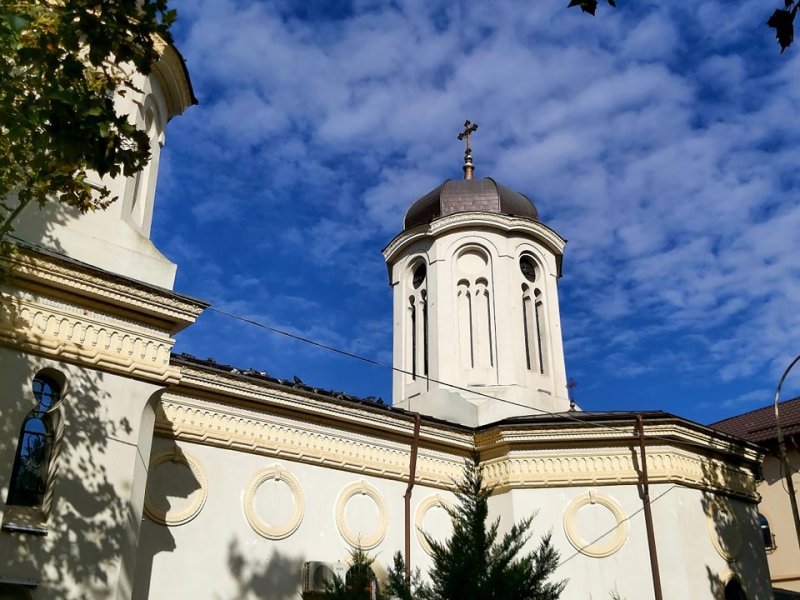
In the heart of old Bucharest, at 92 Toamnei Street, stands the Precupeții Vechi Church, a place of worship with a history of over two centuries, which continues to be a spiritual support for the surrounding community.
An old church in a historic neighborhood
Located in a former merchants’ quarter, the church bears the dedication “All Saints,” celebrated on the Sunday of All Saints, the first Sunday after Pentecost. Over time, this dedication has become the symbol of a united community that has placed its hope in the intercession of all saints and in the continuity of faith.
The Precupeții Vechi area was known, in past centuries, as a neighborhood of small merchants and craftsmen, simple yet hardworking people who felt the need for a place of prayer close to their homes. The church was born out of this natural need, gradually becoming the center of religious and community life in the quarter.
The founders and the beginnings under Phanariot rule
The Precupeții Vechi Church was built in 1773, during a period marked by Phanariot rule, when many local communities raised churches through their own efforts.
The founders of this place of worship were modest people of the area, whose names have been recorded with gratitude in the church’s history: Gheorghe Ieroschi, the monk, Năstase Simioneanu and his wife, Minca, along with Tudor, Ioana, Tudora, Petre, and other laborers.
Priests also contributed to the work of building and organizing religious life, such as Popa Grigorie, Popa Gheorghe, Popa Radu, and Maria, people who laid the spiritual foundation of the parish.
Built in a modest economic context, the church was never a monumental edifice, but over time it gained through its simple beauty and through the essential role it played in the lives of the faithful.
The trials of time and the first major repairs
Throughout the centuries, the Precupeții Vechi Church has gone through numerous trials, being subjected to the hardships of time, weather, and urban changes. Nevertheless, the place of worship has endured and has been enriched through the care and sacrifice of generations of believers and clergy, each contributing to the preservation and embellishment of the church.
An important moment in its history was the year 1898, when the church was repaired, enlarged, and repainted. These works were carried out through the dedication of the churchwarden Anton Georgescu and the priests Grigorie Dinescu and Ioan Ionescu.
From this period also dates the current iconostasis, adorned with icons painted by Gheorghe Zograf, an important name in church painting. His signature can be deciphered on the scene “The Last Supper,” painted above the royal doors, a detail that gives special artistic value to the iconographic ensemble.
Renovation works at the beginning of the 20th century
Between 1906 and 1909, the Precupeții Vechi Church benefited from new improvements, additions, and repaintings, carried out through the persistence of priest Nicolae Popian. These interventions contributed to strengthening the building and adapting it to the needs of a growing community.
During that period, Bucharest was rapidly transforming, and the church had to keep pace with change without losing its identity and traditional character.
The works were not only aesthetic in nature but also functional, aimed at the durability of the construction and the comfort of the faithful. Thus, the place of worship continued to be a stable spiritual landmark in a city undergoing rapid modernization.
Earthquakes and major structural interventions
The 20th century brought some of the most difficult trials for the Precupeții Vechi Church. The earthquake of 1940 caused significant damage, making extensive reconstruction works necessary.
At that time, the main tower was rebuilt, the walls and the two smaller towers were reinforced, and the painting was cleaned and completed. These interventions were essential for saving the building and for the continuation of liturgical life.
Later, between 1958 and 1964, important exterior repairs were carried out, the gas installation was introduced, and the painting was redone, with material support and the blessing of His Beatitude Patriarch Justinian.
As a sign of gratitude, the portrait of the patriarch was painted in the church, in the place reserved for founders, a gesture that highlights the close connection between the hierarchy and the local community.
The church painting and artistic continuity
The current oil painting of the Precupeții Vechi Church is the work of the painter Keber and dates from 1930. It was preserved and restored through successive interventions, which aimed to conserve its style and artistic value. In 1942, the painters Dogărescu and Hermineanu worked on the painting, making necessary corrections and additions.
A new stage of restoration took place in 1964, when the painter Gheorghe Teodorescu-Romanați, assisted by Constantin Stănescu, a priest-painter, intervened to restore the freshness and clarity of the iconographic ensemble. These works ensured the artistic continuity of the church, allowing the painting to remain coherent and harmonious despite the numerous restorations.
Recent earthquakes and the permanent need for care
The earthquakes of 1977 and 1986 caused new damage, affecting the masonry and the painting in several areas. These seismic events reminded the community that the church requires constant care and periodic consolidation and restoration interventions.
Despite the difficulties, believers and clergy continued to be involved, aware of the historical and spiritual value of the place of worship.
The Precupeții Vechi Church is not only a historical monument, but a living space where prayer and tradition meet daily. Therefore, the need for maintenance is not perceived as a burden, but as a natural responsibility toward the inherited legacy.
A living place of worship in today’s community
Today, the Precupeții Vechi Parish continues to be a meeting place for the faithful, preserving the link between past and present. From the merchants’ quarter of the 18th century to today’s urban neighborhood, the church has remained a silent witness to the history of Bucharest and a spiritual support for entire generations.
Through the constant care of priests, churchwardens, and parishioners, the Church of All Saints in Precupeții Vechi continues its mission, calling people to prayer, reflection, and solidarity. It is living proof that beyond walls and paintings, the true strength of a place of worship lies in the community that supports it and gives it meaning, day by day.
We also recommend: Saint Silvestru Church, a symbol of parental love. Lord Pârvan built it in memory of his seven children lost to the plague