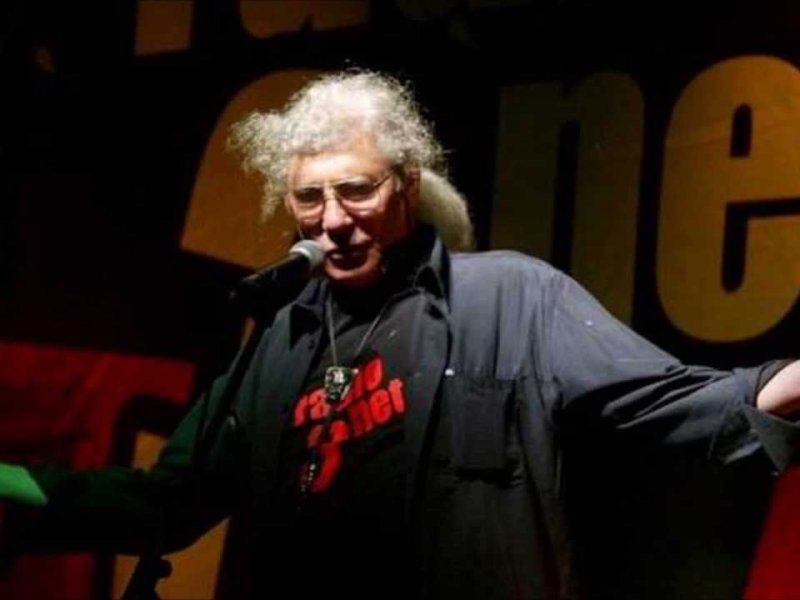
Florian Pittiș, Romania’s rebellious rocker of the communist era. How Moțu managed to start life over, every single time
By Bucharest Team
- Articles
Florian Pittiș lived his entire life according to the famous aphorism—to the fullest, as if tomorrow did not exist. “As Bob Dylan says, I don’t know how it happens that every day I wake up, it’s still today,” Moțu would remark. With this belief in his soul, he dedicated his 64 years to countless passions: he was an actor, director, translator, rocker and folk singer, lover of poetry, passionate Rapid football supporter, and radio host. In other words, Pittiș was the accomplished, unparalleled artist.
A life lived fully, as if tomorrow never existed
He knew exactly what definition would suit his tombstone. A modest message, without pretension, authentic, just like the way he wore his jeans and hair. The inspiration came while reading the obituary of a famous guitarist in his favorite magazine, “Rolling Stone”. Between the lines, he recognized his own life summarized in a single sentence:
“About that guitarist, it was written that he lived in such a way that the most beautiful thing that could be said on his grave was simply: ‘He was born, he played guitar, he died.’ The same thing could be said about me: he was born, he lived in the fullest sense of the word—or tried to live!—and he died,” Pittiș recounted in the TVR show “Travelling circular”.
This was the story of his life—from one end to the other. Never nostalgic and never worrying about the future, he lived the moment. He lived and sweated, as he liked to answer when asked, “What have you been up to, Mr. Pittiș?” Acting made him happy, and this explains the multitude of talents he acquired and the cultural fields he explored fearlessly.
He played Laertes in “Hamlet,” directed by Alexandru Tocilescu, with the same dedication with which he recited “I Am Young, Madam,” the poem by Mircea Dinescu. He translated and sang Bob Dylan’s songs and held hallway lectures about the depth of Leonard Cohen’s lyrics.
Taking life from the beginning, again and again
His most treasured belief was simple: “You may envy me, but every evening I can perform a miracle, I can start life from the beginning.” This line, spoken in a 1984 interview for the magazine “Teatru,” became his lifelong motto. He understood it early, especially after failing the entrance exam to IATC. He had to start over by taking courses at the Polytechnic Institute for a year—enough time to prepare better for the next admission exam and to “fix his voice,” because he had been rejected for having an overly strong “r,” considered a diction defect.
The failure did not discourage him. He took diction lessons from Ileana Cârstea Simion, who later became one of the most respected diction teachers. Pittiș was her first student, and she invented exercises just for him. Determined to become an actor, he worked at Bulandra Theatre as an unpaid electrician, directing the spotlight at rehearsals and performances. That backstage experience became the best preparation for his next exam. He watched “As You Like It” 236 times and “Saint Joan” 128 times, learning all the actors’ lines by heart.
One evening, chance placed him on stage. Liviu Ciulei asked him: “Do you want to act in As You Like It?” That question, asked in the calm of the actor’s dressing room, changed his life. Ciulei later hired him officially, and Pittiș uttered his first professional line on the Bulandra stage: “Please give me a moment of your attention.”
The roots of an actor and the birth of Moțu
His first appearance on stage had happened long before—at age four—in the show “The Kids’ Congress,” where he played “Ciuculeț.” That childish moment ignited his passion for theatre. He soon learned to read, starting with printed letters, then devouring all the plays at home and later at school. At 14, he even staged Act III of “A Lost Letter,” playing the drunk citizen.
His father, Nicolae, a retired pilot, sometimes worked as an extra in theatre productions, and young Florian often joined him. By 1958, he was already doing background acting in “The Man with the Mare.” But the turning point was high school, when actor Petrică Gheorghiu founded a drama club, and Pittiș was among the first to sign up.
His nickname, “Moțu,” was given by his grandmother, who adored him—he was the first boy in the family, the one meant to carry the name forward. As for the spelling “Pittiş” with two “t’s,” it was a clerical error on his birth certificate, never corrected.
A flourishing theatre career and the joy of music
After graduating as valedictorian from Radu Beligan’s class, Pittiș played roles such as Ariel in “The Tempest,” Laertes in “Hamlet,” and Sonnenstich in “Spring Awakening.” His favorite stage partner was Mariana Mihuț, with whom he shared perfect chemistry. She often described him as “crazy like me,” meaning passionate, spontaneous, and a perfectionist.
Their shared adventures included attending a Rod Stewart concert in America in 1979. In parallel, Pittiș became increasingly popular on television due to musical shows performed with Anda Călugăreanu and Dan Tufaru. His passion for beginnings pushed him to create his own theater shows, act in radio drama, and sing.
Thus was born “The Poetry of Young Music,” a series where he translated lyrics from fashionable rock bands like The Beatles. Soon, the show played three times a day, and Pittiș became a cultural phenomenon.
The hippie spirit, censorship, and resistance through culture
Influenced by the hippie movement, he adopted Lennon-style glasses, long hair, and smoked unfiltered Carpați cigarettes. The Communist Party wanted him clean-cut, but he always announced boldly: “Good day, I’m not getting a haircut!”
He did not shy away from speaking his mind, even when censorship was severe. He once recounted a conversation with a Securitate officer who asked if he wasn’t afraid. Pittiș replied that if they wanted to harm him, they would do so regardless—so why fear?
His other great love was Rapid Bucharest. He wore the club badge everywhere, covered his home in burgundy décor, and created the Aristocratic Rapid Club to promote the team’s spirit. He joked that he didn’t attend matches because he brought bad luck. After his death, Rapid players wore black armbands during their next match.
Rock, Club A, and the road to Pasărea Colibri
Pittiș’s musical talent appeared early. At kindergarten he sang “On the Mureș and the Târnave,” dressed in traditional costume. At 13, he discovered rock rhythms played illegally by Roma musicians in a restaurant. Later, in high school, he formed a band with improvised equipment: an amplified radio and a chair used as a drum.
By the ’70s, he was dedicated to spreading “young music” across the country through Flacăra Cenacle events. Villages and towns welcomed the cultural caravan, while Pittiș searched rural bookstores for banned books. He also appeared on television in a trio with Călugăreanu and Tufaru, born out of a spontaneous New Year’s Eve gathering.
Club A was another cornerstone of youth culture—a place where police did not enter and where Pittiș performed starting in 1974. He read the Universal Declaration of Human Rights on stage in 1975, a gesture that sparked suspicion and silent censorship.
The creation of Pasărea Colibri
The project that made him legendary was Pasărea Colibri, founded spontaneously in 1992 by Pittiș, Mircea Baniciu, Mircea Vintilă, and Vlady Cnejevici. After a successful show in Râmnicu Vâlcea, Pittiș announced on the microphone: “This was Pasărea Colibri.” The name stuck, and soon fans were asking where the group would perform next.
The band released albums such as “In Search of the Lost Nest,” “Chirps,” and “Bivouac Songs,” with many lyrics written or translated by Pittiș. His kitchen became a creative hub for artists like Vintilă, Minculescu, Dobrică, and Grigoriu.
Dylan, Lennon, and the mission to educate through rock
Pittiș often said: “I am part of the John Lennon–Bob Dylan party.” In 1981 he launched “The Poetry of Young Music,” aiming to show that rock was not mere entertainment but a tool for reflection. He owned a vast private collection of records and tapes and considered it his duty to “inform” the public.
About Bob Dylan, he said: “Since others did not sing him, I sang him—for information.” Dylan’s role, he believed, was crucial in bringing thought and poetry into rock.
We also recommend: The story of the artist Ilinca Cerbacev, descendant of Dimitrie Bolintineanu. She gave up skiing to dedicate herself to music