Famous boulevard names: Schitul Măgureanu, the Văcărescu family, the Cantacuzino family and the eternal monument of the Capital
By Bucharest Team
- Articles
The history of Schitul Măgureanu is closely connected to the evolution of Bucharest from a marginal market town into a modern capital. The first documentary attestation of this place of worship dates back to the second half of the 17th century and refers to a modest wooden church, with a single tower, covered with wooden shingles.
The beginnings of Schitul Măgureanu and the first documentary attestations
Located in an area dominated by water and vegetation, near the lake known today as Cișmigiu, the church was part of a monastic community of monks.
Documents of the time record that, during the reign of Matei Basarab, monks from Sărindar Monastery and those from Schitul Măgureanu used to fish in “the lake of Dura the Merchant,” showing that the area was lively but still peripheral. The hermitage was not only a place of prayer, but also a landmark of early community life.
From a monks’ hermitage to a convent of nuns
In the 18th century, Schitul Măgureanu is mentioned as a convent of nuns, a transformation whose origin is not entirely clear. Historical sources indicate that the church was built on a small hill, on the outskirts of Bucharest, by the old boyar family of the Măgurenii, related to the influential Cantacuzino family.
This change of status reflects the dynamics of monastic life at the time, as well as the important role played by great boyar families in organizing and supporting religious life. The hermitage thus became a space dedicated to nuns, while preserving its spiritual and community importance.
Constantin Văcărescu and the beginning of the stone church
The first important founder of the stone church was the great logothete Constantin Văcărescu, son of the martyr Ianache Văcărescu, a close counselor of Constantin Brâncoveanu. Married to Maria, the daughter of the high official Iordache Crețulescu and a granddaughter of Prince Brâncoveanu, Constantin Văcărescu chose to build a durable church, known as the Văcărescu Presentation or the Church of Saint Mary.
The chosen land was located above the pond of Gheorghe Dura, nicknamed “the Merchant,” an area situated at that time on the edge of the city. The death of Constantin Văcărescu in 1732 interrupted the works, and the fate of his family was later marked by tragedy, Maria and her second husband dying of plague in 1740.
The Cantacuzinos and the completion of the foundation
The foundation was completed by the daughter of Maria and Constantin Văcărescu, Elena, also known as Ilinca. Raised by her maternal grandmother, she married in 1747 the great treasurer Mihail Cantacuzino-Măgureanu, a member of one of the most powerful boyar families of the time.
Under the reign of Prince Constantin Racoviță, the two spouses finalized the church, having as helper the hieromonk Sofronie, abbot of Sărindar Monastery. From this second founder, the place of worship would receive the name by which it is known to this day: Schitul Măgureanu.
The inscription and the historical recognition of the hermitage
The original inscription, preserved on the northern wall of the current church, records October 5, 1757 as the date of completion of the old stone church. The text of the inscription evokes both the names of the founders and the historical context of the construction, emphasizing continuity between generations and the common effort to raise a place worthy of the glory of God.
Mihail Cantacuzino-Măgureanu and his wife also built the enclosure of monastic cells and the surrounding wall, transforming the hermitage into a complete monastic ensemble. Although the names of the craftsmen and painters have not been preserved, their contribution is reflected in the harmony and sobriety of the buildings.
The hermitage in maps, art and the life of the neighborhood
Military maps made by Ernst and Purcell at the end of the 18th century depict Schitul Măgureanu surrounded by walls and monastic cells, similar to the great monasteries of Bucharest at that time. The church is mentioned as the first place of worship in Bucharest dedicated to the Mother of God, later complemented by the dedication to Saint Visarion, considered a swift helper in times of plague.
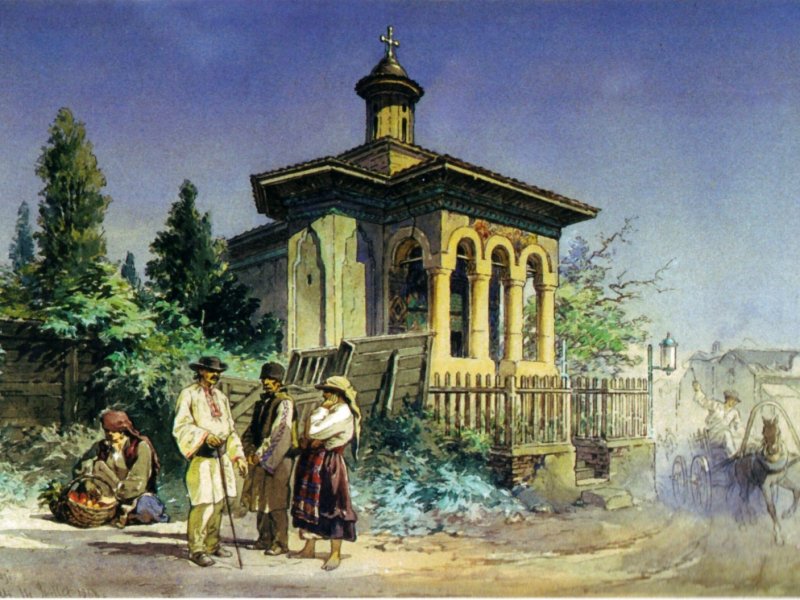
The image of the old church was immortalized in the 19th century by artists such as Carol Popp de Szathmary and Amedeo Prezziosi, and the beauty of the hermitage impressed entire generations. At the same time, it functioned as a metochion of Sărindar Monastery and as the church of the neighborhood that was rapidly developing around it.
Secularization, demolition and the construction of the new church
After the secularization of monastic estates, in 1875, Schitul Măgureanu entered the administration of the city of Bucharest, becoming a parish church. Urban pressure, street alignments and repeated arrangements of Cișmigiu Park eventually led to the decision to demolish the old church and the degraded monastic cells in 1880.
This loss provoked strong reactions in cultural circles, Grigore Tocilescu and Theodor Aman expressing regret over the disappearance of a monument of great value. Nevertheless, between 1881 and 1884 a new church was built in a different style, according to the plans of master builder Dumitrache Nicolau, with the support of the community and the authorities.
The current architecture and the revival of monastic life
The present church combines traditional ecclesiastical architecture with neoclassical elements, featuring a cross-shaped plan and two hexagonal wooden towers. The oil painting, executed by Gheorghe Ioanid, a student of Gheorghe Tattarescu, and the iconostasis carved by Costache Georgescu give the church notable artistic value.
After several administrative transformations, Schitul Măgureanu rediscovered its monastic vocation in 2009, when it was reactivated as a convent of nuns, and in 2013 reorganized as a monks’ hermitage. Today, Schitul Măgureanu remains a living monument of the Capital, carrying in its name the memory of the Văcărescu family, the Cantacuzino family, and of a Bucharest that truly breathes history.
We also recommend: Darvari Skete, an oasis of peace in the heart of Bucharest. The history of one of Romania’s most beautiful monasteries