Before Little Paris, There Was Little Constantinople. How the Phanariote Era Shaped Bucharest in the 18th–19th Centuries
By Bucharest Team
- Articles
The Phanariote period, which unfolded from the first half of the 18th century until the early 19th century, is often viewed through the lens of intrigue, corruption, and heavy Ottoman influence. However, beyond this simplified image, the Phanariote era represented a crucial stage in Bucharest’s evolution.
Phanariote Bucharest and the transformation from market town to oriental capital
Over these decades, the city shifted from being a disorganized market town, with muddy streets and low wooden houses, to a more complex capital strongly marked by Balkan and Oriental influences.
Bucharest of that era was a city oscillating between tradition and adaptation. The Phanariote rulers arrived with their customs and administrative structures, constantly altering the political and social atmosphere.
Gradually, the city became a cosmopolitan space where languages, cultures, and traditions blended. Before Bucharest earned the nickname “Little Paris,” it had already been a “Little Constantinople,” infused with oriental charm, striking contrasts, and a distinctive urban identity.
The mahalas: the social structure that defined the city
The most defining characteristic of Phanariote Bucharest was its division into mahalas. These communities, inspired by the urban model of the Ottoman world, functioned as semi-autonomous units. Unlike modern neighborhoods established through administrative decisions, mahalas formed organically, based on criteria such as craft, ethnicity, origin, or family ties. Each mahala had its own church, an informal leader, and its own rhythms of life, turning the city into a vibrant and diverse social mosaic.
Within the mahalas, strong bonds of solidarity developed. Neighbors helped one another build houses, organize family events, or overcome difficult periods such as fires or floods. This support network turned the mahala into an extended family where collective responsibility was valued. Even when the city was struck by crises, the mahalas contributed to an urban resilience rarely found in the region at the time.
Balkan-style architecture and the city’s oriental atmosphere
Phanariote-era houses gave Bucharest a unique appearance. Most homes were built in a Balkan style, with wide porches, deep arches, low roofs, and inner courtyards hidden behind tall walls. Behind these thick gates were gardens, annexes, small workshops, and spaces where families carried on daily life, sheltered from street dust and noise. This architectural structure lent the city an oriental charm—a discreet, intimate atmosphere typical of Balkan and Ottoman dwellings.
On the streets, however, things were different. Major roads were covered with wooden trunks laid like parquet—a costly but necessary solution to combat the city’s persistent mud. Most other streets remained simple alleys, difficult to traverse during rainy seasons.
The contrast between these areas highlighted the stark differences between the city center—home to power and nobility—and the peripheral zones, where life remained rudimentary and almost rural.
The Court of the Ruler and the oriental luxury of Bucharest’s elite
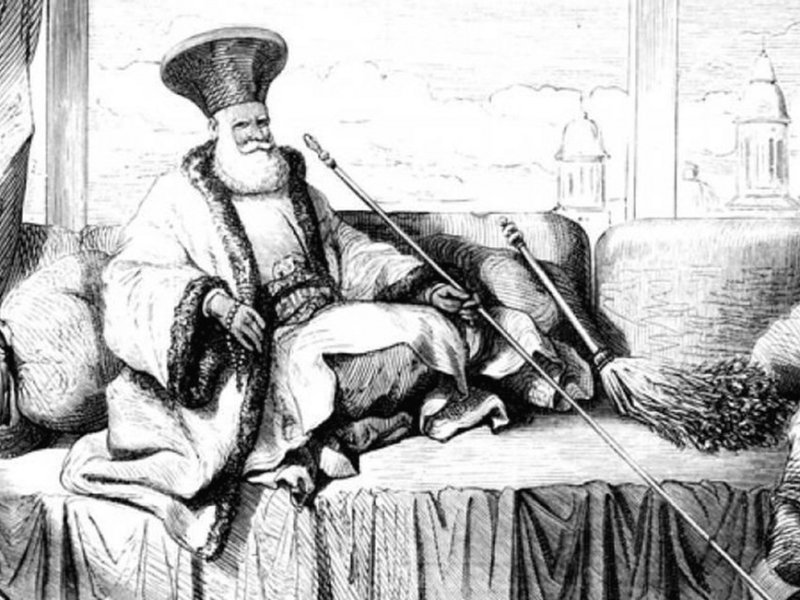
The Princely Court, located in what is now the historic center, was the political heart of the city. Major ceremonies took place there, administrative decisions were made, and a ceremonial life directly inspired by Istanbul played out. The Phanariote rulers brought with them numerous officials, servants, craftsmen, and Greek boyars, which intensified the oriental influence over Bucharest’s social life.
This influence permeated all daily aspects. Oriental desserts and dishes, such as baklava and early forms of stuffed cabbage with Ottoman roots, became part of local cuisine. Clothing also changed: long robes, loose trousers, embroidered scarves, and fine fabrics became fashionable.
The elite’s lifestyle embraced luxury and theatricality, with boyar households decorated with expensive objects, carpets, oriental vessels, and furniture brought from distant regions of the empire.
At the same time, Bucharest hosted merchants and craftsmen from various communities: Greeks, Armenians, Jews, Bulgarians, and Albanians. This ethnic mix turned the city into a commercial and cultural crossroads where economic exchanges and cultural influences circulated continuously.
First steps toward modernization: infrastructure, water, and lighting
Although the city retained its oriental air, the Phanariote period also introduced the first genuine attempts at modernization. Some initiatives aimed to improve infrastructure, others focused on urban order or access to drinking water. Several streets were paved with wood, and authorities began enforcing new rules regarding cleanliness and administration.
This era saw the emergence of rudimentary water systems consisting of simple pipes, reservoirs, and public fountains. Monasteries, boyar estates, and a few mahalas were connected to these sources, bringing a minimum level of comfort and hygiene, rare in many other Balkan cities of the time.
The first attempts at public lighting also appeared during this period. Although rudimentary and limited to a few major arteries, nighttime lighting offered a greater sense of safety and a more modern urban atmosphere, preparing the city for the sweeping 19th-century transformations that would follow.
Social contrasts: between opulence and poverty
Phanariote Bucharest was, above all, a city of contrasts. While the boyars enjoyed large, well-appointed homes and a cosmopolitan lifestyle, most inhabitants lived modestly, in small, simple houses, frequently affected by fires or floods. The narrow and muddy streets, strong smells, chaotic traffic, and lack of sanitation were part of everyday reality.
Still, within this diversity lay the city’s vitality. Craftsmen, itinerant merchants, servants, small shopkeepers, and laborers were the ones who animated Bucharest. They energized the markets, sustained economic ties with other regions, and contributed to the urban identity. Social life was intense, unfolding in churchyards, shops, or improvised tavern tables.
From East to West: the end of the Phanariote era
The end of the Phanariote era marked a profound transition. After the first decades of the 19th century, Bucharest began reorganizing along Western lines. Straighter boulevards appeared, streets were paved with stone, and more solid buildings were erected using brick and stone. Major fires that devastated the city accelerated reconstruction in a modern style, gradually eliminating wooden houses.
Neoclassical architecture, French inspiration, and Western urban planning began to define the city, preparing it for its transformation into “Little Paris.” Yet beneath this modernization, the social structure and mentality shaped in the mahalas continued to have a deep influence on the life of Bucharest’s inhabitants.
Phanariote heritage and Bucharest’s identity today
Although the mahalas no longer exist in their traditional form, their spirit can still be found in many aspects of the modern city. Neighborhood solidarity, hospitality, spontaneous sociability, and even the slightly chaotic blend of architectural styles and urban rhythms are direct legacies of the Phanariote era.
Modern Bucharest is essentially a layered city. Beneath the “Little Paris” façade lies an older Bucharest, Oriental, Balkan, organic, shaped by centuries of cultural interaction. The Phanariote period was undoubtedly the foundation of this multicultural, contrasting, vibrant city.
We also recommend: The Little Paris Museum, the French-styled Bucharest and the most beautiful journey through time in the Center of the Capital