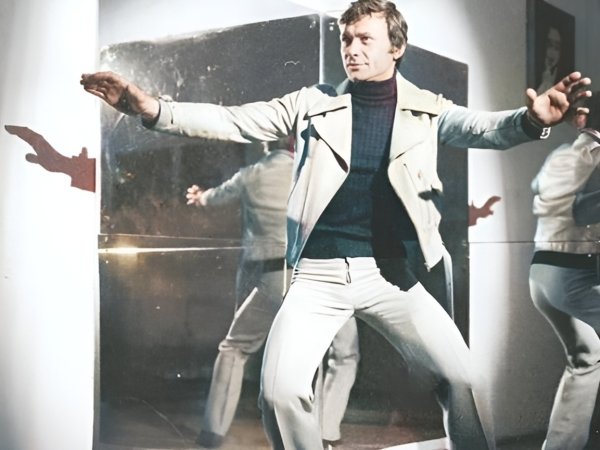
The story of Cornel Patrichi, the king of dance in Romanian communism. He scolded Nicu Ceaușescu when the “Little Prince” “cheated” him at card games
- Articles
- 02 FEB 26
Cornel Patrichi is one of those figures in Romanian culture who crossed eras, regimes and mentalities, leaving behind a strong imprint both in the world of dance and in the collective memory. Choreographer, ballet dancer and social personality of communist Romania, Patrichi was considered by many the “king of dance” in a period when art was strictly controlled by the state, and success often came with compromises and privileged relationships. His life was spectacular, full of contrasts, situated at the border between genuine talent, political opportunity and the desire for freedom.
Childhood and the beginnings of an unexpected destiny
Beyond his impressive artistic career, Cornel Patrichi also remained in the public eye because of his unusually close relationship with Nicu Ceaușescu, the son of dictator Nicolae Ceaușescu. Their friendship, sprinkled with episodes of familiarity hard to imagine for the ordinary Romanian of that time, offers a rare perspective on the backstage of power and privileges in Romanian communism.
Cornel Patrichi was born on April 1, 1944, in Bucharest, into a family with no direct ties to the artistic world. Nothing in his family environment seemed to announce the spectacular destiny that would follow. His childhood unfolded in a difficult context, marked by the end of the Second World War and the gradual establishment of the communist regime in Romania.
His entry into the world of dance was rather the result of chance than of an early conscious vocation. At one point, based on the grades obtained in Sports and General Culture, Cornel Patrichi was selected to study ballet. This seemingly trivial selection was to completely change the trajectory of his life, opening the path to an exceptional artistic career.
Professional training and affirmation in ballet
Once admitted to the Choreography High School, Cornel Patrichi began to discover his true passion. The rigorous study of ballet, the severe discipline and the contact with demanding teachers quickly transformed him into a promising young talent. He graduated in 1962, and shortly afterward he was hired as a principal ballet dancer at the “Constantin Tănase” Theatre in Bucharest, one of the most prestigious performance institutions in the capital.
This employment represented an important step, but not yet the peak of his career. At that time, Patrichi was already beginning to be noticed in the Romanian dance world, both for his impeccable technique and for his distinctive stage presence. A significant role in his rise was also played by his uncle, Nicolae Patrichi, the theatre’s musical director, who facilitated his access to important projects and to an elite artistic environment.
Professional rise and national consecration
In the years that followed, Cornel Patrichi became a reference name in Romanian ballet. His definitive consecration came in 1972, when he received the offer to become principal ballet dancer of the “Fantasio” Theatre in Constanța. Accepting this position meant the beginning of an intense period in which the artist commuted for ten years between Bucharest and Constanța.
This stage was one of maximum visibility and professional recognition. Patrichi was not just an appreciated dancer, but also a symbol of artistic success in communist Romania. His appearances were followed with interest, and his energetic and expressive style turned him into a benchmark for younger generations of ballet dancers.
Cornel Patrichi and Romanian cinematography
Besides his activity in theatre, Cornel Patrichi also had a consistent presence in the world of cinematography. He collaborated with important directors of the time and appeared in numerous productions that enjoyed public success. Among the films in which he acted are “Alexandra și infernul” (1975), “Melodii, melodii…” (1978) and “Detașamentul Concordia” (1980).
At the same time, Patrichi signed the choreography for several cinematic productions, demonstrating his artistic versatility. Films such as “Cântecele mării” (1971), “Eu, tu și Ovidiu” (1977) or “Viraj periculos” (1983) benefited from his choreographic vision, contributing to the consolidation of his status as a complete artist.
The relationship with Nicu Ceaușescu and the privileges of communism
A separate chapter in Cornel Patrichi’s life is represented by his relationship with Nicu Ceaușescu. The son of dictator Nicolae Ceaușescu was a controversial figure, associated both with absolute power and with the excesses and whims of the regime’s “little prince”. Surprisingly, Patrichi always spoke about Nicu in an extremely familiar language, emphasizing the friendship that connected them.
The two met frequently, played tennis and spent time together, and the choreographer did not hesitate to scold Nicu when he cheated. Patrichi openly recounted how he reprimanded him without restraint when the “little prince” “cheated” him in games, reactions that frightened those around them, aware of the risks of such an attitude in an authoritarian regime.
The life of luxury and the contradictions of success
The friendship with Nicu Ceaușescu brought Cornel Patrichi privileges that most Romanians did not enjoy. The artist acknowledged that, in that period, he had everything he could wish for: a luxurious house, purchased for the sum of 500,000 lei, access to vacations, comfort and a privileged social status.
However, his success was doubled by the awareness of the limits imposed by the regime. Freedom of expression was relative, and life under communism, even for the favored ones, involved compromises. This tension between privileges and lack of freedom would influence his decision to leave Romania.
Exile and the discovery of freedom
At some point, Cornel Patrichi felt the need to break ties with the system that had propelled him. He left Romania and initially settled in the German Democratic Republic, in Dresden. Here he continued to work in the field of ballet and to earn considerable sums of money, experiencing for the first time a real sense of freedom.
Later, he moved to Italy, where he lived until 1999. This period was one of artistic and personal maturity, during which Patrichi managed to build a life away from the constraints of the communist regime. Although material success did not elude him even in exile, the rupture from Romania was deeply emotional.
Return to Romania and the final years
After 2000, Cornel Patrichi returned to Romania, where he again became a visible presence in the public space. He worked in television and gained a new generation of admirers through participation in high-audience shows such as “Dansez pentru tine”. His appearances were marked by the same mix of artistic authority, humor and brutal sincerity.
In 2011, his life was shaken by the diagnosis of lung cancer. The disease progressed rapidly, and Cornel Patrichi passed away in 2016, at the age of 72. His death meant not only the disappearance of an artist, but also the end of an important chapter in the history of Romanian dance.
The legacy of a controversial character
Cornel Patrichi remains an emblematic figure of Romanian culture, admired for his talent and controversial for his connections with the communist regime. His life was a mixture of genuine success, political privileges and a constant search for freedom. These very contradictions turn him into a fascinating character, representative of an era full of paradoxes.
His story is not only about dance and choreography, but also about compromises, power and the price of success in an authoritarian system. Beyond moral judgments, Cornel Patrichi remains a name that made history, an artist who lived intensely and who left behind a legacy that is hard to ignore.
We also recommend: The “Pescăruș” restaurant in Bucharest, the favorite place of the communist nomenklatura